 Get Listed

How Does a Central Vacuum System Work?
When dust, swarf, granules or production waste need removing across a large site, dragging portable equipment from one area to another quickly becomes inefficient. That is usually the point where people ask, how does a central vacuum system work, and whether it offers a better long-term answer than standalone vacuums.
In an industrial setting, a central vacuum system is not simply a larger version of a mobile cleaner. It is a fixed, engineered network designed to move material from multiple points on site to a central collection unit. Done properly, it improves housekeeping, supports safer working conditions, reduces manual handling and gives operations teams a more consistent way to manage waste and recover valuable material.
How does a central vacuum system work in practice?
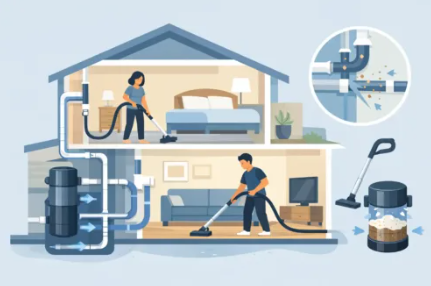
At its simplest, a central vacuum system creates suction from a fixed power unit, then distributes that suction through pipework installed around a building or production area. Operators connect hoses at designated inlet points, and material is drawn through the pipe network to a central separator or collection vessel.
The system relies on a few core elements working together. First, there is the vacuum producer, which may be a side channel blower, turbine or another suitably specified vacuum source depending on airflow, duty cycle and the material being handled. Second, there is the pipework network, sized to maintain stable air velocity and avoid blockages. Third, there are the inlet valves or connection points placed where cleaning or extraction is needed. Finally, there is the collection and filtration stage, where the conveyed material is separated from the airstream before the exhaust air is discharged or filtered.
That means the operator does not carry the motor and waste container around the facility. They use the hose and tools at the work point, while the power and waste handling remain in a fixed location. On a large industrial site, that difference matters. It reduces the effort involved in routine cleaning and makes it more realistic to maintain standards consistently rather than only when time allows.
The main components of a centralised vacuum system
Although designs vary by application, most centralised systems follow the same engineering logic.
The vacuum generation unit
This is the heart of the system. It creates the negative pressure that pulls air and debris through the pipework. The correct specification depends on what the site needs to collect. Fine dust, heavier metallic swarf, mixed waste, powders and liquid residues all behave differently in a pipeline.
For continuous industrial use, the duty rating of the vacuum producer is critical. A system intended for occasional light cleaning is a very different proposition from one expected to support several operators across multiple shifts. Under-specify it, and performance drops off as soon as demand increases. Over-specify it, and the customer may carry unnecessary capital and energy costs.
The pipework network
Pipework is more than a route from A to B. Its diameter, bends, branch layout and total run length all affect suction performance. Poorly planned pipework can create pressure loss, inconsistent pickup and material build-up.
In industrial environments, the network must also suit the waste stream. Abrasive debris may need more durable materials. Hazardous dusts may require conductive components and compliance measures linked to the area classification. Where the system is collecting over long distances or from several workstations, balancing airflow becomes a design issue rather than an installation detail.
Inlet points and operator stations
These are the access points where users attach hoses and tools. Their placement should reflect actual working patterns, not just the building layout. If inlets are too sparse, operators end up stretching hose runs and losing efficiency. If they are over-specified, the system becomes more expensive than it needs to be.
This is why site-specific design matters. A fabrication shop, a food process area and a heavy maintenance workshop all use vacuum points differently.
Separation, filtration and waste collection
Once material reaches the central unit, it must be separated from the airflow. Heavier debris may drop into a hopper, bin or skip arrangement, while finer particles are retained by filter stages. The filtration level depends on the material, the cleanliness requirement and any environmental or health and safety obligations.
For some applications, the collected material is simply waste. In others, it has value and can be recovered for reuse or controlled disposal. That can influence the type of separator, discharge method and container handling arrangement.
What happens when the system is switched on?
When an operator connects a hose and opens an inlet, air is drawn into the nozzle at high velocity. That airflow carries dust, debris or other material into the hose and through the fixed pipe network. As the material travels towards the central unit, the system maintains enough air speed to keep it suspended until it reaches the separator.
At the collection end, the material is removed from the airstream. The solids or liquids are deposited into the chosen container, while the air passes through filters before discharge. In more advanced systems, control panels may manage start-stop functions, monitor filter condition or coordinate use across multiple points.
From an operational point of view, the process is straightforward. From an engineering point of view, the challenge is making sure the airflow, vacuum level, pipe sizing and filtration all suit the application. That is where system design has a direct effect on reliability and running cost.
Why industrial sites use central vacuum systems
The strongest case for a central system is usually operational rather than theoretical. On busy sites, portable vacuums can become a compromise. They need moving, emptying and storing. They may not offer enough reach or capacity. In some cases, they also introduce avoidable manual handling and housekeeping delays.
A centralised system changes that by putting vacuum power where it is needed across the facility. Teams can clean production lines, plant rooms, mezzanines, conveyors or loading areas without moving a machine each time. Waste is collected in one controlled location, which can make disposal simpler and reduce disruption in active work areas.
There are safety benefits as well. Better control of combustible dust, fine particulates and process waste supports cleaner working environments. The exact requirement depends on the material and the zone classification, but this is one area where generic equipment is often the wrong choice. Hazardous or explosive atmospheres may require ATEX-certified solutions and carefully specified components throughout the system.
Where the design can vary
Not every central vacuum system is built for the same job, and that is where many buying decisions go right or wrong.
Some systems are designed mainly for general housekeeping. Others are built for source capture at machinery, continuous recovery of production scrap, or transfer of powders and granules as part of a wider process. Wet and dry recovery also require different handling arrangements, especially where oils, coolants or sludge are involved.
Distance matters too. A compact workshop installation with two inlets is relatively simple compared with a multi-area manufacturing site with simultaneous users and long pipe runs. Material density matters. Fine powder behaves differently from metal offcuts. Duty cycle matters. A few short cleans per day place different demands on the equipment than round-the-clock use.
This is why a central system should be treated as an engineered solution, not a catalogue item. Companies such as Forvac Industrial typically assess the material type, required throughput, site layout, operator usage and safety obligations before recommending the right configuration.
Common misconceptions about how a central vacuum system works
One common misconception is that more suction automatically means better performance. In reality, effective conveying depends on the relationship between airflow and vacuum. Too little air velocity can lead to blockages, while the wrong balance can reduce pickup at the tool.
Another is that any pipe route will do as long as it reaches the collection unit. It will not. Long runs, sharp bends and poor branch arrangements can all reduce performance and increase maintenance issues.
There is also a tendency to assume central systems only suit very large factories. While they are especially valuable on larger sites, they can also make sense in medium-sized facilities where repeated cleaning, material recovery or compliance requirements justify a fixed solution.
Is a central vacuum system the right choice?
It depends on the site, the waste stream and how cleaning or recovery fits into daily operations. If the requirement is occasional localised cleaning, a portable industrial vacuum may be more practical and cost-effective. If multiple areas need regular cleaning, if waste volumes are significant, or if the process benefits from fixed extraction and central collection, a centralised system usually offers stronger long-term value.
The key question is not whether the technology works. It does. The real question is whether the system is designed around the operational reality of the site. Capacity, layout, filtration, hazardous area compliance, maintenance access and future expansion all need considering early.
For more information on How Does a Central Vacuum System Work? talk to Forvac Services Ltd