


Find The Needle Add My Company
ICAO aerodrome codes: The ABCs of aircraft hangar design

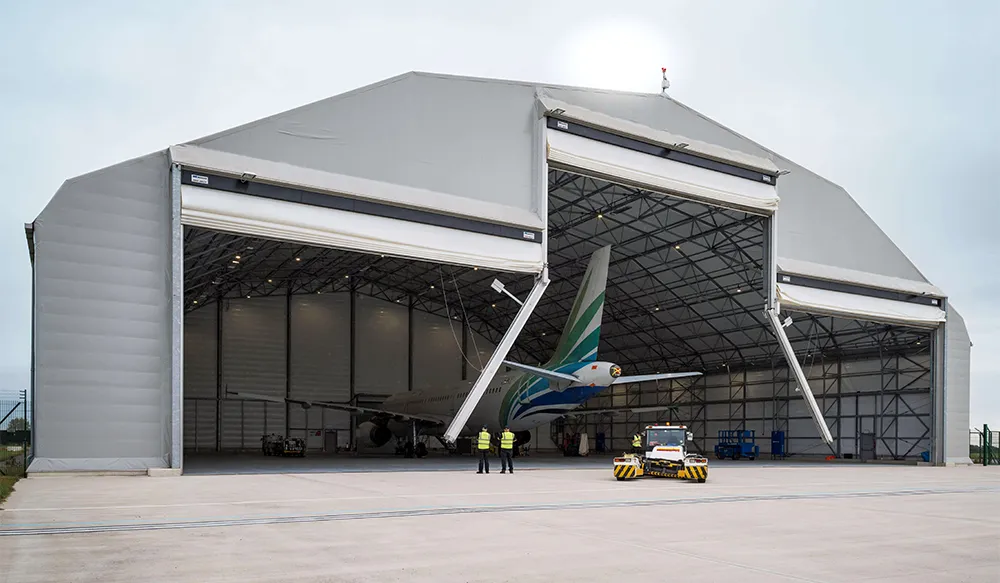
When a client approaches us to design their MRO hangar, they usually have an aircraft in mind. Boeing 737 or 747? A glance at these codes tells us exactly what we need to know.

Designing aircraft hangars is a complicated business. Rubb may have decades in the field with our fabric-clad, steel-frame hangars, but experience doesn’t amount to much if we don’t stay current with industry standards.


Clear classification

The International Civil Aviation Organisation (ICAO) developed a series of aerodrome codes to simplify aircraft categorisation by assigning aircraft two reference codes: one for field length (runway take-off distance—vital for airport planning), and one for wingspan.

As our main concern is custom-designing our fabric-clad MRO hangars for our clients’ aircraft, we mainly refer to ICAO’s wingspan codes. These run from A to F and have become industry shorthand for hangar requirements.

Code Wingspan Example aircraft
Code A < 15m PIPER PA-31 / CESSNA 404 Titan
Code B 15m – < 24m BOMBARDIER Regional Jet CRJ-200 / DE HAVILLAND CANADA DHC-6
Code C 24m – < 36m BOEING 737-700 / AIRBUS A-320 / EMBRAER ERJ 190-100
Code D 36m – < 52m B767 Series / AIRBUS A-310
Code E 52m – < 65m B777 Series / B787 Series / A330 Family
Code F 65m – 80m BOEING 747-8 / AIRBUS A-380-800


What about narrow- and wide-body?

Aircraft are still commonly categorised as narrow- or wide-body, though this classification is less specific than ICAO’s codes.

Many clients future-proof their hangars by opting for larger spans to accommodate bigger aircraft, a growing fleet, or servicing multiple planes at once. As such, most of our narrow-body hangars fall into Code D, and our wide-body projects into Code F. Code C and E are rarely used outside of specific airport requirements.


Rubb’s custom-designed MRO hangars

With decades of experience and dozens of completed projects, we have the expertise to quickly suggest aircraft hangar specification, pricing, and design. Below you can see our typical specifications along with previous case studies.

Code Suggested Rubb spec Example Rubb project
Code A 20m Span x 20m Long x 5m Leg C/W 18m Wide x 5m High Fabric Vertical Lifting Door CAE Aviation, Seychelles International Airport
Code B 25m Span x 30m Long x 6m Leg C/W 23m Wide x 6m High Fabric Vertical Lifting Door Loganair, Dundee Airport
Code C 40m Span x 45m x 8m Leg C/W 38m Wide x 12.5m High Fabric Vertical Lifting Door STS Aviation, Melbourne International Airport
Code D 50m Span x 50m Long x 8m Leg C/W 45m Wide x 15m High Fabric Vertical Lifting Door easyJet, Gatwick Airport / Welsh Gov., Bro Tathan Business Park
Code E 70m Span x 75m Long x 8m Leg C/W 65m Wide x 18.5m High Fabric Vertical Lifting Door Turkish Technic, Istanbul Airport
Code F 90m Span x 90m Long x 12.5m Leg C/W 85m Wide x 26m High Fabric Vertical Lifting Door AAR, Chicago Rockford International Airport

These codes allow us to clearly understand our clients’ operational requirements and propose a high-quality, cost-effective solution. There’s a reason top-flight clients like Boeing, Turkish Technic, and easyJet trust Rubb.

  • Custom bay configurations: Single, double, or triple bay layouts
  • Quick installation: Lightweight materials ensure fast construction with minimal disruption
  • Relocatable design: Adaptable structures that can be expanded, moved, or reconfigured to match changing requirements

In the market for an aircraft hangar? Rubb’s aviation experts are ready to get your project off the ground. Let’s talk.

For more information on ICAO aerodrome codes: The ABCs of aircraft hangar design talk to Rubb Buildings Ltd

Enquire Now

  Please wait...

Location for : Listing Title