 Get Listed


Why Future Aircraft May Need Folding Wings
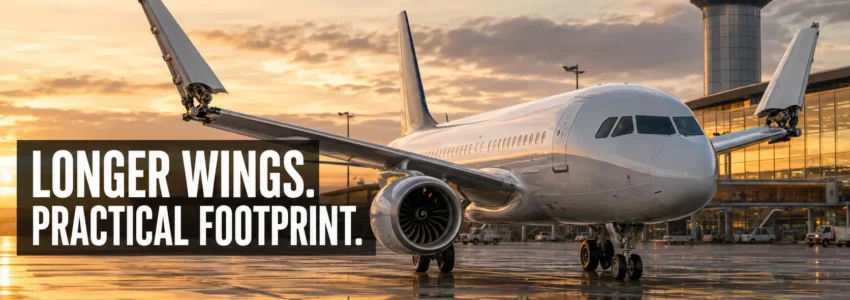
Aircraft wings are getting a second look.
For years, the basic challenge in commercial aviation has been clear. Airlines want aircraft that burn less fuel, produce lower emissions and operate more efficiently over long distances. One of the most effective ways to improve that efficiency is to use longer, slimmer wings.
The problem is that airports were not built for unlimited wingspan.
That is why folding aircraft wings are back in the conversation. They offer a way to give aircraft more aerodynamic efficiency in the air without making them too wide for existing gates, taxiways and ground operations.
Airbus has now moved its Wing of Tomorrow programme into a new phase, with plans to design, manufacture and flight-test full-scale wing extensions on an A321neo. The engineering idea is simple to explain, but far more difficult to deliver. It involves aerodynamics, materials, manufacturing, inspection and practical airport constraints all at once.
Why Longer Wings Improve Efficiency
A longer wing generally improves aerodynamic efficiency because it reduces drag.
More specifically, a higher aspect ratio wing, meaning a wing that is longer and relatively narrower, can generate lift more efficiently than a shorter, broader one. That matters because less drag usually means lower fuel burn.
For airlines and aircraft manufacturers, that has obvious appeal. Better efficiency can reduce operating costs and help support emissions targets without requiring a completely different aircraft concept.
This is not a new idea. Aerospace engineers have understood the efficiency advantages of longer wings for decades. The reason it remains such a live issue is that the pressure to improve performance has only increased.
Aircraft are expected to do more with less. Every design decision is now being measured against fuel efficiency, sustainability, operating economics and real-world usability.
Why Airports Create the Problem
If longer wings are so useful, the obvious question is why all passenger aircraft do not already have them.
The answer is practical infrastructure.
Commercial aircraft do not operate in isolation. They have to fit the world that already exists around them. Airport stands, taxiway clearances, hangars and gates are all designed around certain dimensions. If an aircraft becomes too wide, it can create operational restrictions even if the wing itself is aerodynamically superior.
In other words, an aircraft designer is not only designing for flight. They are designing for airports, maintenance facilities, turnaround times and the commercial realities of airline operations.
That is where folding aircraft wings become attractive. They offer a potential compromise between aerodynamic performance in the air and manageable dimensions on the ground.
How Folding Aircraft Wings Could Solve It
The principle behind folding aircraft wings is straightforward.
In flight, the wing extension is deployed so the aircraft benefits from greater span and improved aerodynamic efficiency. On the ground, the outer section folds to reduce the effective width of the aircraft.
This is already familiar in military and naval aviation, where aircraft often need to save space aboard carriers. In commercial aviation, however, the challenge is different. The mechanism must work reliably over a very long service life, under civil aviation standards, and without introducing unacceptable complexity, maintenance burden or safety risk.
That is a much tougher engineering proposition than simply attaching a hinge to a wingtip.
The folding section must remain structurally sound, precisely aligned and fully integrated with the wider wing. It must operate safely in changing conditions and continue to perform under repeated loading and environmental exposure.
What looks like a neat idea on paper quickly becomes a serious engineering project.
Airbus and the Wing of Tomorrow
Airbus has brought this concept back into focus through its Wing of Tomorrow programme.
The goal is not just to make a bigger wing. It is to explore how future wing design can improve efficiency while still working within the operational limits of the current aviation world.
The next stage includes full-scale wing extensions for an A321neo, which will be designed, manufactured and flight-tested. That matters because it moves the idea out of pure research and into a more practical, testable phase.
It also tells us something important about modern aerospace engineering. Concepts are one thing. Scalable, certifiable, manufacturable systems are another.
A folding wing extension might sound like a single innovation, but it actually depends on many disciplines working together. Aerodynamics, structural analysis, actuation, materials engineering, precision manufacturing and inspection all need to align.
Why Manufacturing the Wing is so Difficult
Modern aircraft wings are already among the most complex structures in engineering.
They must be light enough to support efficiency, strong enough to handle repeated stress and precise enough to perform exactly as intended. Once a folding section is introduced, the challenge becomes even more demanding.
The wing is no longer just a fixed aerodynamic surface. It becomes a moving structure with extra interfaces, additional tolerances and more demanding inspection requirements.
The hinge area, locking mechanism and surrounding structure must all withstand load without compromising alignment or long-term reliability. Small deviations can become serious issues in a component of this scale and importance.
Manufacturing therefore becomes a major part of the story, not merely a follow-on step after the design has been completed.
It is one thing to prove a concept can work once. It is another to produce it consistently, inspect it effectively and integrate it into a wider aircraft programme.
Composite Materials Make the Idea More Realistic
Much of this progress depends on advanced materials, particularly composite structures.
Composite materials allow engineers to achieve very favourable strength-to-weight characteristics, which is one reason they are so important in modern wing design. They also make it easier to pursue more ambitious aerodynamic forms without creating excessive weight penalties.
But composites do not remove complexity. They shift it.
Manufacturing composite structures requires careful process control, repeatability and detailed inspection. When a part must interact with a folding mechanism or load-bearing interface, those requirements become even more demanding.
A future wing is not just about a more elegant aerodynamic shape. It is about whether that shape can be manufactured, assembled and maintained to the standards aviation demands.
That is why this story is as much about industrial capability as it is about design ambition.
Inspection and Repeatability Matter Just as Much as Innovation
Ideas in aerospace do not succeed simply because they are clever. They succeed when they can be repeated.
That means the wing must not only perform well in testing. It must also be inspectable, certifiable and manufacturable at the consistency expected of a commercial aircraft programme.
Every new interface introduces another opportunity for variation. Every moving section creates another set of reliability questions. Every performance gain must be balanced against service life, maintenance demands and the practical realities of operating large fleets.
This is where a lot of promising engineering ideas become difficult. The challenge is no longer just how to make something work. It is how to make it work repeatedly, at scale and under scrutiny.
In that sense, folding aircraft wings are a very modern engineering story. They are not about novelty for its own sake. They are about solving a real-world problem without creating bigger problems elsewhere.
What Folding Aircraft Wings Reveal About Engineering
This is what makes the topic so relevant beyond aerospace. The folding wing question is really about compromise, and good engineering often is.
How do you improve performance without making maintenance harder? How do you reduce drag without making airport access impossible? How do you introduce a new mechanism without increasing operational risk beyond what the benefit justifies?
Those are not uniquely aerospace questions.
They also appear in defence, automotive, rail, energy and industrial engineering, where improvements in one area can create consequences in another. Better engineering is rarely just about pushing one metric higher. It is about balancing the whole system.
These challenges are familiar across precision aerospace engineering, where performance depends on tightly controlled materials, manufacturing and inspection.
Final Thoughts
Folding aircraft wings may sound futuristic, but the problem they are trying to solve is highly practical. Aircraft need to become more efficient. Longer wings can help as airports still impose physical limits so folding the outer wing may offer a workable compromise.
Whether that compromise becomes common in future aircraft will depend not only on aerodynamic benefit, but on whether the concept can be delivered reliably and repeatedly through real manufacturing and real operational conditions.
That is what makes the Airbus work so interesting. It is not simply asking how to build a better wing but asking how to build a better wing that still works in the real world.
Source article and further reading
This article is based primarily on Airbus’s announcement about the next phase of its Wing of Tomorrow programme, including the planned design, manufacture and flight testing of full-scale wing extensions on an A321neo.
Suggested source reference in the published blog:
Airbus, Wing of Tomorrow / future aircraft wing development announcement.
For more information on Why Future Aircraft May Need Folding Wings talk to PRV Engineering Ltd