 Get Listed


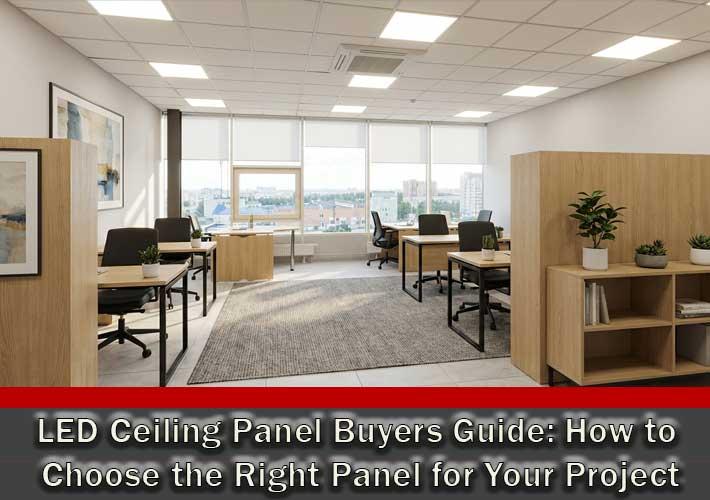
If you are buying LED ceiling panels for an office, school or commercial refurbishment, the specifications can look much the same at first glance. In reality, small differences in size, brightness and UGR (Unified Glare Rating) can have a big impact on comfort, compliance and long-term usability.
This guide is designed to help you choose quickly and make an informed decision. For a detailed glare explanation, see our UGR guide: What is the difference between UGR16 and UGR19?. You can also browse our full range of LED ceiling panels and filter by brand, colour temperature, UGR and more.
Quick buyer checklist
-
Size: 600 x 600 (most common), 1200 x 600 (two tiles), 1200 x 300 (narrow grids and corridors)
-
Colour temperature: 4000K is the standard, 3000K is warm, 5000K/5700K is daylight, or choose CCT switchable for flexibility
-
Brightness: lumens matter more than watts; consider wattage-switchable panels for on-site adjustment
-
UGR: UGR < 19 for general office/classroom use; UGR16 for premium low-glare requirements
-
IP rating: IP20 for general areas; IP44/IP65 for washrooms, kitchens, canteens and damp spaces
-
Controls: non-dimmable is common; commercial dimming is typically 1–10V or DALI
-
Accessories: surface-mount frames, suspension kits and emergency packs
Panel sizes explained: 600 x 600, 1200 x 600 and 1200 x 300
600 x 600mm is the most popular choice because it fits the standard suspended ceiling grid used in many offices and schools. The panel itself is typically 595 x 595mm, but it is referred to as 600 x 600mm because that is the grid size it fits.
1200 x 600mm panels cover the equivalent of two 600 x 600 tiles. They are often used in larger open-plan areas where fewer fittings are preferred for faster installation and a cleaner ceiling layout. The panel size is commonly around 1195 x 595mm (though sizes can vary by manufacturer).
1200 x 300mm is a slimmer format often used in corridors, narrow ceiling grids, reception walkways or where the ceiling layout does not suit square modules. The panel is typically around 1195 x 295mm.
Colour temperature: what most people choose
For commercial interiors, 4000K (neutral/cool white) is the most common choice. It looks clean, supports concentration and works well with modern office finishes. It is bright without feeling harsh.
-
3000K warm white: well suited to hospitality-style areas, reception spaces, breakout zones and softer interiors
-
5000K/5700K daylight: crisper and more ‘daylight-like’, sometimes used in task-heavy areas
-
CCT switchable: one panel with multiple colour temperature options, useful when you are unsure what a client will prefer
If you want flexibility on site, a CCT option can be a good choice, such as the Aurora Multi-Wattage 18–26W CCT Backlit LED Ceiling Panel or the Ovia 600 x 600mm CCT and wattage-switchable LED panel.
Lumens and wattage: do not choose on watts alone
Wattage helps you compare energy use, but lumens (lm) tell you how bright the space will feel. Many modern panels also offer wattage switching, allowing you to choose the output during installation. This is useful if a room feels over-lit or under-lit once the panels are in.
As a general guide, LED panels can range from around 1,750 lumens up to roughly 4,620 lumens for higher output models.
A good example of a flexible, installer-friendly option is the JCC Skytile 600 x 600mm LED ceiling panel (UGR19), which is available in multiple wattage outputs and includes a loop-in, loop-out wiring connector.
UGR for offices: does it need to be UGR19 or lower?
UGR is used to control discomfort glare in commercial spaces, particularly where people work under the lighting for long periods or use screens. In practice, UGR < 19 is a common target for offices and classrooms because it balances visual comfort with cost and availability.
Is it a legal requirement? That depends on the project specification rather than a single blanket rule for every building. Many office and education schemes follow recognised workplace lighting guidance, where UGR19 is widely treated as the benchmark for typical work areas.
If you need enhanced glare control for executive offices, design studios or premium fit-outs, consider UGR16 options such as the Ovia 600 x 600mm UGR16 ultra low-glare LED panel.
Backlit vs edge-lit
LED ceiling panels typically come in two designs: edge-lit and backlit. Edge-lit panels place LEDs around the frame and use a light guide plate to spread the light. They are often slimmer and can be more cost-effective, making them popular for basic office and retrofit projects.
Backlit panels position LEDs behind the diffuser, which can deliver more even light distribution, higher output and improved long-term reliability. For that reason, backlit panels are now the preferred option on many commercial projects where consistent brightness and performance over time are priorities.
TP(a) vs TP(b): what it means
TP(a) and TP(b) describe the fire performance classification of the diffuser used in LED ceiling panels when installed as part of a suspended ceiling.
TP(a) panels use a diffuser that meets stricter fire propagation requirements. Because the panel effectively forms part of the ceiling build-up, TP(a) is commonly specified for offices, schools, healthcare buildings and other commercial environments.
TP(b) panels have a lower fire performance rating and are generally used where the panel is not relied upon as part of the ceiling’s fire performance, or where requirements are less demanding. In many modern commercial projects, TP(a) is specified as standard and TP(b) is now less common.
Recommended lux level for an office
For general office work, a maintained illuminance of around 500 lux at desk height is widely recommended. It supports comfortable visibility for screen use, reading and writing without unnecessary glare or eye strain. Circulation spaces such as corridors are often lower (around 300 lux), while detailed tasks may require higher levels.
Applications: where each panel type fits best
-
Offices and meeting rooms: 600 x 600, 4000K, UGR < 19, with optional DALI or 1–10V controls
-
Schools and classrooms: UGR < 19 as a baseline, with UGR16 where higher comfort is required for longer occupancy
-
Corridors and circulation: 1200 x 300 is common; glare control still matters, but tasks are less demanding
-
Washrooms, kitchens and canteens: consider IP44 to IP65 depending on moisture levels and cleaning requirements
IP rating: IP20 vs IP65
IP20 panels are suitable for general indoor spaces such as offices, classrooms and meeting rooms. If the fitting may be exposed to moisture, steam, splashes or frequent cleaning, step up to IP44 or IP65. In higher moisture environments, an IP-rated panel reduces the risk of ingress and premature failure.
Examples include the Aurora IP54 600 x 600 LED backlit ceiling panel and the Aurora IP54 1200 x 600 LED backlit ceiling panel.
Dimming and controls: why DALI and 1–10V are common
Many LED panels are supplied as non-dimmable, which suits standard on/off installations. Where dimming is required in commercial settings, 1–10V or DALI control is far more common than mains (TRIAC) dimming. Mains dimming is less typical in commercial projects due to higher circuit loads, compatibility limitations and the need for centralised control strategies.
Surface mounting frames
If you do not have a suspended grid ceiling, a surface-mount frame allows you to fix a panel to a solid ceiling. Suspension kits are also available if you want a ‘floating panel’ look or need to drop below services. Most manufacturers offer a range of compatible mounting accessories.
Best value LED panels
Price is often a deciding factor, particularly on larger installations. Some projects simply need to meet basic performance requirements without premium optics or advanced control gear, making value-led LED panels a sensible option.
Best-value panels typically focus on the essentials: standard sizes (most commonly 600 x 600mm), a fixed colour temperature such as 4000K and a reliable lumen output. UGR compliance may not be required in every setting, or a higher glare rating such as UGR22 may be acceptable depending on the space.
As a rough guide, price-led panels can be found around the £10 mark, while higher specification panels with UGR19 compliance are often nearer £20 each.
Reliability and warranty
Reliability matters in commercial lighting, especially where maintenance access is disruptive. Many LED ceiling panels are supplied with return-to-base warranties, while some manufacturers provide enhanced cover. Aurora Lighting, for example, offers a three-year on-site warranty and a five-year standard warranty on selected ranges, including Aurora BackLite 600 x 600mm backlit LED ceiling panels. This means approved faults are handled at the installation site rather than requiring removal and return, helping reduce downtime.
Recommended picks
-
Best all-round office panel (UGR19, flexible output): Aurora Multi-Wattage 18–26W CCT Backlit LED Ceiling Panel
-
Premium low-glare for screen-heavy spaces (UGR16): Ovia UGR16 600 x 600
-
Trusted commercial 600 x 600 option: Collingwood Solis Multi-Wattage LED Ceiling Panel 600 x 600mm UGR19
-
IP-rated option for damp areas: Aurora IP54 600 x 600
If you want a straightforward starting point, choose 600 x 600, 4000K and UGR < 19 for most offices and classrooms, then adjust the IP rating and control gear to suit the environment. When you are ready to compare, browse the full range of LED ceiling panels.
General Q&A
What size LED ceiling panel do I need for an office?
Most offices use 600 x 600mm panels because they fit standard suspended ceiling grids. Larger spaces may use 1200 x 600mm panels to reduce the number of fittings, while 1200 x 300mm panels are common in corridors or narrow ceiling layouts.
Do LED panels have to be UGR19 or lower in offices?
UGR19 is widely used as the target for offices and classrooms because it provides suitable glare control for screen-based work. It is not a universal legal requirement, but many specifications are written around UGR < 19 to meet workplace guidance and comfort expectations.
What colour temperature is best for office LED panels?
4000K neutral white is the most common choice for offices, providing a clean light that supports concentration. Warmer 3000K is often used in reception or breakout areas, while 5000K or daylight options suit spaces where a brighter, more clinical feel is required.
Are LED ceiling panels dimmable?
Many standard panels are non-dimmable. Where dimming is required in commercial environments, 1–10V or DALI systems are typically used rather than mains (TRIAC) dimming.
What does TP(a) mean on an LED panel?
TP(a) refers to the fire performance classification of the diffuser when the panel is used as part of a suspended ceiling. TP(a) diffusers meet stricter fire propagation requirements and are commonly specified for offices, schools and commercial buildings.
Can LED ceiling panels be surface mounted?
Yes. If you do not have a suspended ceiling, panels can be installed using surface-mount frames or suspension kits, allowing a tidy, professional finish on solid ceilings.
For more information on LED Ceiling Panel Buyers Guide: How to Choose the Right Panel for Your Project talk to Expert Electrical Supplies Ltd