 Get Listed

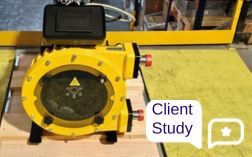
A recent project involved the specification of a peristaltic metering pump for the controlled transfer of nanocomposite materials used in stereolithography processes. The client approached us after reviewing our previous work supplying a precision-engineered resin transfer pump to a leading Formula 1 team.
They wanted to transfer a very abrasive high performance composite ceramic resin from a container to a machine which manufactured parts for the team’s Formula 1 car. As we had specific experience in pumping nanocomposites the client got in touch to see if we could help.
What are nanocomposites?
A nanocomposite is a multiphase material where at least one phase has dimensions of less than 100 nanometres in length, width or thickness. Widely used in nanotechnology, a nanometre (nm) is equal to one billionth of a metre or 0.000000001 metres.
A multiphase material is a substance that contains two or more distinct phases, where each phase has its own properties, crystal structure and chemical composition.
These materials combine the properties of the separate components in a way that enhances their electrical, mechanical, optical or thermal properties.
Their unique properties mean that nanocomposites are being used increasingly in a broad range of industries and applications, such as:
-
Aerospace - creating lighter, stronger components
-
Construction - making building materials tougher and more durable
-
Sports and recreation - producing lighter, stronger components for sporting equipment
-
Electronics - enhancing magnetic properties, conductivity and miniaturisation
-
Packaging- improving barrier properties to keep out oxygen and moisture, and preserve food for longer
-
Medical - making better drug delivery systems, dental materials and tissue engineering
-
Automotive - making vehicles lighter and more durable, to help boost fuel efficiency
What is stereolithography?
This is a 3D printing process that uses a laser to cure and build up liquid resin into a strong and hardwearing, 3D object - layer by layer. This simple process enables users to create smooth, durable, highly detailed parts.
Also known as SLA, stereolithography offers a number of production advantages:
-
Material options
A whole range of resins can be used, enabling the production of materials with different thermal, optical and mechanical qualities
-
Smooth finish
Parts made using SLA have a smooth surface, saving time and reducing the need for costly post-processing
-
High level of detail
SLA produces highly accurate parts with fine detail and tight tolerances. This makes it perfect for processes where precision is critical
Stereolithography can be used for a variety of applications:
-
Prototyping
SLA is being used more and more for creating accurate prototypes to work up designs and test functionality at an early stage
-
Medical devices
Producing parts with tight tolerances using biocompatible materials makes SLA extremely useful for the design and production of medical devices
-
Moulds and patterns
SLA can be used to create detailed moulds for injection moulding or casting
-
Jewellery and dental
The smooth surface and high levels of accuracy make SLA perfect for making intricate jewellery and dental models
What material was being pumped?
It’s called Accura Bluestone, an SLA engineered stable nanocomposite with excellent thermal resistance. This makes it ideal for applications that involve high temperatures and/or humidity. It has the highest stiffness available, outstanding accuracy and high production speed.
Accura Bluestone is actually a photosensitive polymer. This is a kind of polymer that undergoes a change in its chemical or physical properties when exposed to light, usually visible or ultraviolet light. Often used in stereolithography and jetting processes, these materials provide good levels of fit, feel, form and looks.
Photosensitive polymers are also exceptionally strong with tensile strength up to 9.8 ksi. However, as these materials become stronger they can be more brittle. But Accura Bluestone has notched impact strength of 0.24 to 0.32 ft-lb/in. In fact, it has a vast range of applications including parts for:
-
Wind-tunnel test models for motorsports and aerospace
-
Fixtures, jigs and tools
-
Under-the-bonnet vehicle parts
-
Electrical connectors, adaptor fittings, sockets and bases
-
Water-handling products like impellers for pumps
-
Housings and enclosures for business machines that need high levels of stiffness
-
Lighting components
What did the client need?
The client required a pump to filter a drum containing their abrasive nanocomposite ceramic resin.
The pump had to run constantly whenever the SLA printing machine was not being used. It would filter out any cured debris floating in the tank to ensure smooth and uninterrupted operation.
It would also pull out any ceramic filler from the bottom of the tank, to maintain a proper mixture and stop it settling out.
The pump also had to be self-priming and have automated operation so that operators could easily control start-up, stopping and pump flow rate.
Preserving nanocomposite fluid
A key factor was the high cost of nanocomposites which can be anything from £50 to £75 per litre.
So the client stressed that it was crucial that everything possible was done to preserve the quality of the fluid and ensure its longevity and cost-effectiveness. This would include keeping it moving to prevent hardening, but at low shear. As well as maintaining fluid quality by filtering and removing any waste solid particles.
This would all help to ensure that when it’s finally 3D printed, each piece would have as few imperfections as possible, so it wouldn’t have to go to waste, which would be very costly.
Important information from the client
The client had already carried out some research and visited our website.
They had seen our AMP16 control pump on there and wondered if the same technology could be applied to a different size of pump.
The AMP16 is an intelligently controlled metering pump which uses peristaltic pump technology to guarantee easy and precise metering of viscous, gaseous and shear-sensitive fluids containing particles.
So what pump did we select?
North Ridge Pumps are the UK’s largest pump supplier with over 25 years successful trading and growth.
We are specialists at specifying pumps for a huge range of applications. As we are not limited to specifying just one pump type or technology, we draw on our expert knowledge and wide-ranging experience to bring together the best solution for every client, not just an off-the-shelf product. We pick the right pump for every project offering our client the best long-term option.
-25091014062997518-25091014081600492.jpg "FMP30 Control2 (1)-25091014062997518-25091014081600492.jpg")
-25091014062998918-25091014083168951.jpg "Peristaltic Dosing Pump (1)-25091014062998918-25091014083168951.jpg")
In fact, we did have a pump solution with the same technology as AMP16 control pump, but in a larger size which would suit this client’s needs. Our choice was the FMP30 peristaltic pump, which has been designed and developed to enable users to achieve straightforward, low maintenance metering while also automating the process.
For more information on Peristaltic Metering Pump for Transferring Nanocomposites talk to North Ridge Pumps Ltd