 Get Listed

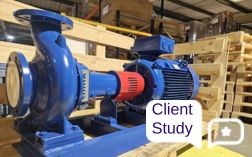
Today we’re looking at a recent project we supplied for a freshwater cooling pump in which the client needed for continuous cooling of plant equipment using a closed-loop system.
We supplied the cooling pump as a replacement to an existing pump which was over 16 years-old and constantly breaking down.
The client had contacted the original supplier about a replacement but was unhappy with the lead time they quoted. They got in touch with North Ridge Pumps to see if we could supply a new closed-loop cooling water pump in their required time frame. Naturally, we were happy to help.
What is closed-loop water cooling?
This works on a pre-assembled water-cooling system where the cooling fluid, usually water, or a special coolant such as glycol circulates within a sealed loop.
it’s a very popular option for many processes such as industrial plants, power plants located in remote areas as well as data centres thanks to minimal maintenance requirements and simple installation.
Here's how it works:
-
The system absorbs heat from plant machinery, or water is pumped through components at sufficient flow to cool the equipment
-
The coolant flows through a heat exchanger / radiator where the heat is cooled by the surrounding air or by powerful fans
-
The colder coolant is pumped back to the main water tank and the process starts again
Key features of closed-loop water cooling
-
Self-contained unit
It's built as a single pre-assembled unit, already filled with coolant and good to install and go
-
Easy to install
Closed-loop systems are purposely designed to offer rapid installation – just attach the radiator and fans to the machinery or equipment requiring cooling
-
Sealed system
The water or special coolant is contained within a sealed loop which cuts down the risk of leaks and external contamination which could damage any machine parts or components
-
Low maintenance
Closed-loop systems are manufactured to need only minimal maintenance such as removing dust from the radiator, checking of strainers and fan from time to time
-
Cost-effective
Closed-loop systems usually cost less than open-loop or tailor-made custom cooling set-ups as pumps only need to circulate liquid within the system at low pressure and high flows, with special materials not required.
What’s an open-loop water cooling system?
The two systems offer radically different approaches to the challenge of removing heat from plant equipment, machinery, datacentres and other hot components.
Open-loop systems, also called custom water-cooling, offer users much more flexibility. Users can buy and assemble their own cooling loop by selecting specific components like pumps, reservoirs, tubing, fittings, water blocks, coolant and radiators to optimise the system performance and aesthetics. Water may also be abstracted from open water courses such as lakes, reservoirs or the sea.
They offer slightly better cooling performance compared to closed-loop systems, as users can draw fresh water from large bodies which may already be cool, utilise high-performance components and larger radiators. The downside is that these systems require regular maintenance, such as checking for leaks, changing the coolant, cleaning components and replacing if necessary.
In addition, open-loop systems might be more costly upfront as all components have to be bought separately. But they may be more cost-effective in the long run if the right components are specified.
In comparison, closed-loop cooling water pumps are pre-assembled and pre-filled with coolant, making them easier to install and maintain. They need minimal maintenance and are more affordable than open-loop systems, especially for entry-level or mid-range requirements.
What’s more, while these systems are usually less powerful than open loops, closed loops provide a good level of cooling performance for most uses, and are a budget-friendly choice.
So which is best?
Clearly, each case is different with a wide range of suitable applications, budgets, size of equipment or machinery and amount of usage factoring into the decision.
But in general, an open-loop system is best if the highest possible cooling performance is demanded, it’s a high-end build, or users enjoy selecting and buying components.
However, if easy installation is a priority, there is water scarcity, a smaller budget or users want a simpler cooling solution, a closed-loop cooling pump could be a better option.
What type of pump is used for cooling?
For many cooling applications, a centrifugal pump controlled via an inverter is usually specified. This is because it’s highly efficient, the lowest cost and most reliable option for this type of application.
Centrifugal pumps can have an optional cartridge seal for quick replacement and reduced downtime. Alternatively they can select a packed gland for ease of maintenance, or a mechanical seal for reliability. In addition, the heavy duty baseplate design lowers vibration and ensures the unit has a longer life span.
Most important of all, this pump design has bearings which offer long life and durability thanks to the lubrication – either oil or grease sealed-for-life bearings. In fact, the two types of lubrication also offer different advantages and are designed for different applications.
So, oil or grease bearing lubrication?
Grease sealed-for-life bearings are:
-
Simple and cost-effective
These bearings are usually easier to install and more affordable than to oil-lubricated solutions
-
Suitable for moderate speeds and normal to light workloads
-
Lubricated for life
They don’t need regular relubrication which cuts down on maintenance
-
Protected from contaminants
The seals stop dirt and other debris from getting in, prolonging the life of the bearing
While oil-lubricated bearings are:
-
Ideal for high-speed, high-temperature applications
Oil transfers heat away from the bearing effectively, making it perfect for more demanding environments
-
Good for heavy-duty applications
Oil lubrication offers better protection and is more durable under heavy workloads
-
Easier to maintain and monitor
Oil can be filtered or replaced, and levels can be monitored more easily than when using grease
So which is best?
In short, for the majority of bearing uses, grease-sealed-for-life bearings may be the better option because of their suitability for moderate speeds and loads, easy maintenance and basic simplicity.
On the other hand, bearings lubricated by oil are more appropriate for heavy-duty workflows which demand oil's proven lubrication and cooling properties, or for high-temperature, high-speed applications.
What pump did we specify?
At North Ridge Pumps, there are no limits on the pumps we can specify, we’re not restricted to just one pump type or technology.
As the UK’s largest pump supplier with over 25 years successful trading and growth, we’re specialists at selecting pumps for a huge range of applications.
We use our expert knowledge and depth of experience to create the best solution for every client, not just a standard solution picked off the shelf. In fact, we specify the best pump for every project brief offering the most cost-effective long-term option.
Our specification
For this job, we supplied our XHLE long-coupled, end suction, single-stage horizontal centrifugal pump. It’s a big, heavy-duty pump design with proven high flow and pressure capabilities.
%20(1)-25072112173170643.jpg "Closed-loop Cooling Water Pump")
This closed-loop cooling water pump is standardised to the European standard EN 733 / DIN 24255 certification, both covering end-suction centrifugal pumps. This means that it’s the same size as many other models on the market, so it can easily replace most horizontal centrifugal pumps that are already installed with minimum disruption and downtime.
Designed for pumping clean, low viscosity or slightly contaminated fluids without any solids or fibres, it’s a great option for a variety of applications in the marine and industrial markets.
It can handle fresh water, sea water, petrol, diesel and kerosene, and is used for water supply and treatment, dewatering, irrigation, firefighting, fuel transfer and mining.
A wide range of product benefits
As the pump head is easily accessible without having to first remove the motor, this long-coupled design is simple to maintain. It’s extremely robust and designed for non-stop use with extra bearings in the pump head, which take a lot of strain away from the motor during operation.
What’s more, the motor and centrifugal pump have separate shafts, so if it breaks, only the pump shaft needs replacing. The long-coupled design also incorporates a large gap between the motor and pump. This shields the motor from fluid getting in if a seal ever fails.
This particular specification
The cooling pump for this specific job was manufactured with a cast iron casing and bronze impeller. Bronze is the preferred material for the impeller in cast iron pumps because of its strength, corrosion and wear resistance in saline or marine environments, and because it won’t contaminate the pumped fluid.
The pump was fitted with a 45Kw motor generating over 4000 L/min (250m³h) at just over 30m head.
If you need a proven, hardworking, cost-effective cooling pump, speak to North Ridge Pumps – we’ll be happy to assist you.
For more information on Closed-loop Cooling Water Pump for Continuous Freshwater Cooling talk to North Ridge Pumps Ltd