 Get Listed

Net Positive Suction Head is central to assessing whether a pump's inlet conditions are suitable for the liquid and operating duty. North Ridge Pumps' guide distinguishes the NPSH available from the installation from the NPSH required by the pump, and explains why an operating margin is needed rather than a near-equality on a datasheet.
What NPSH describes
Every liquid has a vapour pressure that changes with temperature. If pressure within the pump falls sufficiently, vapour cavities can form and subsequently collapse as pressure rises. This cavitation can affect performance and damage components.
NPSH expresses the pressure above the liquid's vapour-pressure threshold as a height of that liquid, commonly in metres. It therefore depends on fluid properties as well as the pressure conditions at the inlet.
The pressure-to-head relationship
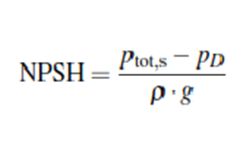
The source expresses the basic relationship as NPSH = (total absolute suction pressure − vapour pressure) / (density × gravitational acceleration). The pressures must be expressed on a consistent absolute basis, with the vapour pressure corresponding to the actual pumping temperature.
For the installation, the calculation also considers pressure at the liquid surface, the elevation relationship between the vessel and pump, velocity effects and losses through the suction pipework. Longer or narrower pipes, extra fittings, restrictions and increased suction lift can reduce the available head.
Warmer liquid can also reduce the margin because its vapour pressure is higher. A system that appears satisfactory at one temperature or tank level therefore needs reassessment if operating conditions change.
Available and required NPSH are different
NPSHA is a property of the installation: it describes what the system provides at the pump suction under the conditions assessed. Tank pressure, liquid level, pipe losses, temperature and density all influence it.
NPSHR is established by pump testing for a stated performance criterion, flow and speed. It depends on the hydraulic design and operating point rather than being a figure calculated solely from the site's pipework.
The manufacturer's stated criterion matters when comparing required values. North Ridge notes that a three-percent head-drop criterion is widely used, but the basis should be checked rather than assumed. Meeting a test criterion is not the same as demonstrating that all cavitation has disappeared.
Allow for real operating variation
Available NPSH needs to exceed the pump's required value by an appropriate margin. A design with little allowance can be vulnerable to warmer fluid, a lower vessel level, a partially closed valve, fouled strainers or a change in duty.
The guide does not prescribe one universal margin for every installation. The correct allowance should be established for the pump, fluid and operating envelope with the supplier or responsible engineer.
Ways to improve suction performance
Reducing suction losses may involve a larger pipe diameter, a shorter route or fewer restrictive fittings. These measures can increase NPSHA without changing the pump's hydraulic design.
Other approaches concern the pump itself. Special suction impellers can reduce the required NPSH; double-entry first-stage designs divide the incoming flow, while an inducer ahead of the main impeller can improve inlet conditions. A booster pump is another option where the system needs additional pressure before the main pump.
Each approach requires an assessment of the complete installation. It is important to confirm what is causing the limited margin rather than replace components without checking pressure, elevation, temperature and losses together.
Review the operating point
North Ridge also recommends considering where the pump operates on its curve. Moving away from the intended duty can increase NPSHR, and satisfactory operation at one point does not establish suitability at another.
Monitoring liquid temperature and changing suction conditions helps identify a reducing margin before damage develops. North Ridge can assess the available and required values with customers and discuss pump or system changes where the inlet conditions are inadequate.
Source: North Ridge Pumps
For more information on NPSH Explained: The Formulas, the Margin, and How to Stop Cavitation Before It Starts talk to North Ridge Pumps Ltd