 Get Listed

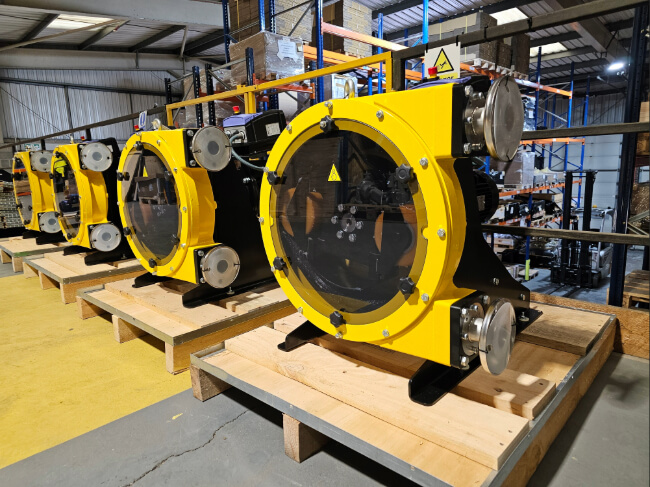
Six peristaltic pumps were specified for a developer building a lithium-ion battery recycling facility. North Ridge Pumps' case study describes four wastewater-transfer duties and two chemical-dosing duties, with material compatibility and abrasive particles central to the selection.
The four transfer duties required a flow range of 1,000–6,000 litres per hour, while the two dosing duties required 25–1,000 litres per hour. The equipment was intended to operate for twelve hours a day with process fluids spanning pH 6–11. These figures describe the customer's requested duties; the performance limits of each selected model need to be checked against its detailed operating conditions.
Recycling involves several material streams
Lithium-ion batteries contain a cathode, an anode, an electrolyte and a separator within a protective casing. Their compositions differ between chemistries, so a recycling process may need to recover several metals and other materials while keeping unwanted contaminants out of the recovered products.
North Ridge's background discussion identifies lithium iron phosphate, nickel manganese cobalt, lithium cobalt oxide, lithium manganese oxide, nickel cobalt aluminium and lithium titanate among the battery types encountered in different applications. Their differing compositions influence the materials entering the recycling process.
The source also discusses developing solid-state batteries, which use a solid electrolyte. Regardless of the technology, the liquid-handling equipment at a recycling plant must be selected for the actual process stream rather than a general label such as 'battery waste'.
Physical and chemical separation
A recycling process may use crushing and grinding to liberate materials, followed by magnetic, gravity or flotation techniques for suitable separation stages. The aim is to distinguish and recover useful components from the mixed feed.
Chemical and hydrometallurgical stages can include leaching, solvent extraction and precipitation. These operations create different liquids, slurries and dosing requirements. Wastewater transfer between process and sorting equipment therefore needs to be considered alongside the controlled addition of treatment chemicals.
The pumps in this project were selected for those liquid-handling tasks. They form part of the plant's process arrangement rather than providing a complete recycling or mineral-separation system on their own.
Compatibility and contamination control
The pH range, chemical composition and suspended solids influence the suitability of hoses, fittings and other wetted materials. Corrosion, deposits, elastomer compatibility and abrasive wear all need consideration. pH alone does not establish whether a material will resist a particular chemical mixture.
North Ridge also highlights the importance of avoiding unwanted nickel, copper or zinc entering a stream where these materials are being recovered or separated. Contamination can create further processing work or reduce the quality of the recovered material, making the wetted construction a relevant part of the specification.
The company states that the selected wetted components were compatible with the process range and contained no nickel, copper or zinc. This is a specification for the supplied arrangement, not a property that should be assumed for every peristaltic pump or fitting.
Why peristaltic technology was chosen
In a peristaltic pump, the process fluid passes through a replaceable hose or tube. This separates the liquid from much of the mechanical assembly and avoids a conventional shaft seal in the wetted pumping chamber.
For abrasive wastewater, the absence of that seal removes one common location for particles to cause leakage or wear. The hose remains a service item and must be selected for chemical compatibility, abrasion and the required operating conditions.
North Ridge describes optional protective measures including an ECTFE coating for the casing and leakage sensing that can stop operation if the hose begins to fail. The choice of inlet and outlet fittings also matters: their materials determine compatibility, contamination risk and electrical characteristics. Stainless-steel parts should not be treated as electrically non-conductive.
Variable-speed transfer and dosing
The company proposed pumps from its FMP and AMP ranges with motor-mounted inverters. Variable-speed control allows output to be adjusted to the process requirement, with the relationship between speed and flow established within the pump's operating limits.
North Ridge identifies heavy-duty gearboxes with additional bearing support as part of the supplied design for extended operation. Reinforced, abrasion-resistant hoses were selected for the suspended solids present in the process streams.
The project combined larger wastewater-transfer duties with lower-flow chemical dosing. Reviewing both the requested duty and each model's performance envelope was therefore important; a range-level flow requirement does not establish that every model can deliver its highest value under every condition.
Maintenance and ongoing operation
Replacing the hose is a central maintenance task in this design. Access and the ability to change the wearing component can help reduce the complexity of servicing compared with systems requiring a more extensive wet-end strip-down.
North Ridge's case study brings together fluid compatibility, contamination control, variable-speed operation and maintenance planning. Its engineering team can assess similar wastewater and dosing applications against the actual fluid data, required flow, pressure and expected operating hours.
Source: North Ridge Pumps
For more information on Lithium Battery Recycling & Water Treatment Pumps talk to North Ridge Pumps Ltd