 Get Listed


UK Schools Face Tougher Mobile Phone Rules: Why ‘Not Seen, Not Heard’ Is No Longer Enough
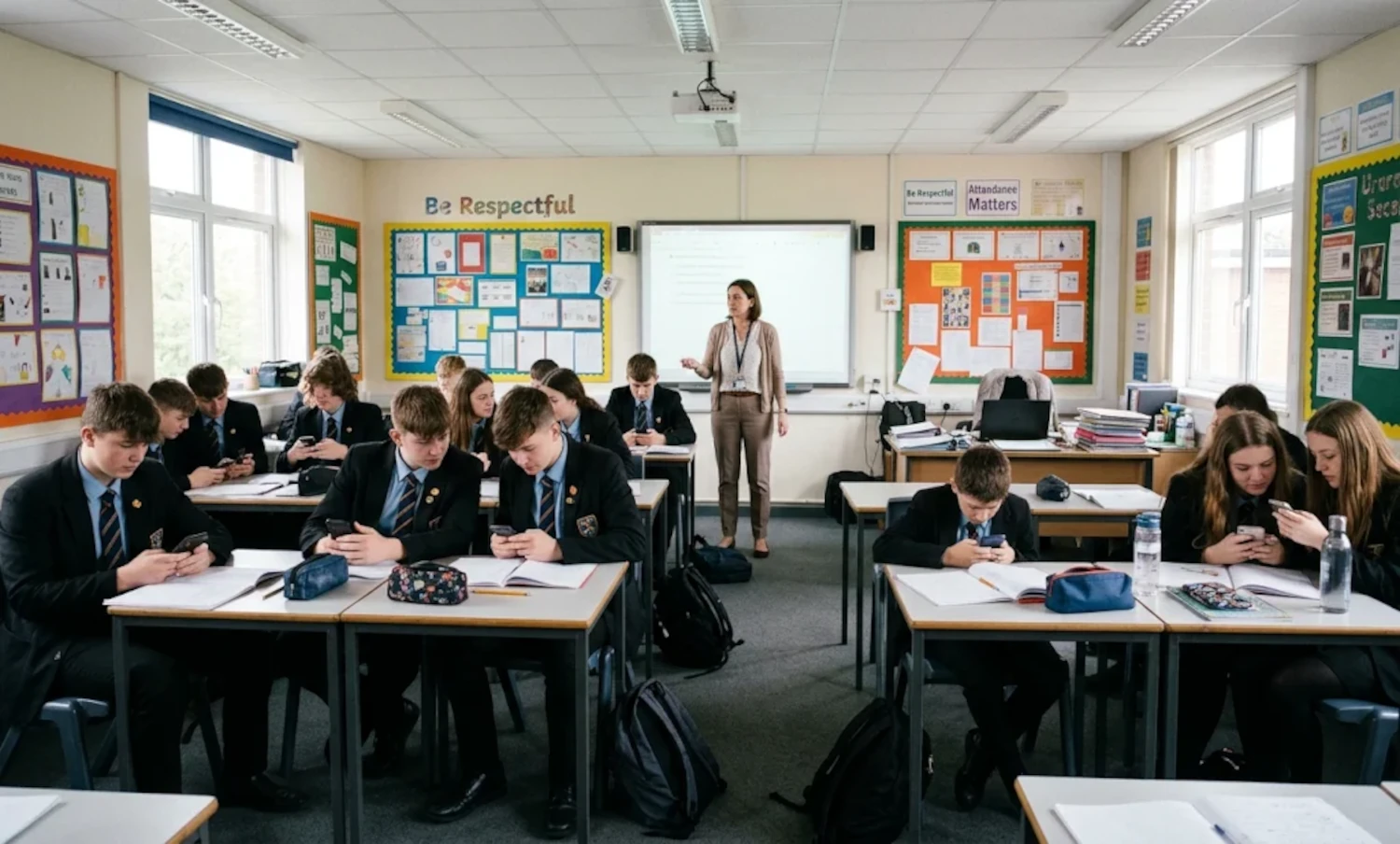
New school mobile phone guidance will go further than ‘not seen, not heard’. Discover what the 2027 rules mean for UK schools, teachers and pupils.
Schools must go further to tackle mobile phone disruption
Schools in England are facing a further tightening of mobile phone restrictions, following the Government`s announcement on 10 November 2026 that it intends to strengthen statutory guidance on mobile phone use in schools.
The proposed changes will move schools away from the relatively common ‘not seen, not heard’ approach, under which pupils can bring smartphones onto school premises, provided they remain switched off and out of sight in a bag or pocket.
Instead, schools will be expected to adopt more robust, whole-school policies that ensure pupils cannot access unsecured mobile phones at any point during the school day.
The announcement follows growing concerns about the impact of smartphones on children`s education, concentration, social development and wellbeing, as well as evidence that existing school policies are not being consistently enforced.
With the revised guidance scheduled to take effect from September 2027, school leaders have been given further time to consider how they will implement the changes. However, the Government is encouraging schools to move towards the stronger approach sooner.
So what exactly is changing, why does the Government believe existing arrangements are insufficient, and what will the new requirements mean for schools, teachers, pupils and parents?

Why ‘not seen, not heard’ is no longer enough
For many schools, the traditional approach to mobile phone restrictions has been relatively straightforward: pupils can bring their phones into school, but they must keep them switched off or on silent and out of sight.
In theory, this prevents mobile phones from disrupting lessons while allowing pupils to retain access to their devices before and after school.
In practice, however, this approach has proved difficult to enforce.
Phones can still be accessed discreetly beneath desks, in toilets, corridors and playgrounds. Notifications, messages and social media can continue to distract pupils even when devices are not openly being used.
There are also alternative ways of accessing connected technology, including smartwatches and wireless earbuds.
The Department for Education`s November announcement highlighted a particularly significant problem:
- Only 16% of secondary school pupils said their school`s mobile phone rules were followed all the time.
The Government also presented figures showing a substantial difference between schools` enforcement approaches. Where pupils are allowed to keep phones in their bags or blazers, only 20% of school leaders reported that the rules were followed all the time. Where schools require phones to be handed in, this figure rises to 74%.
These findings suggest that simply telling pupils not to use their phones is clearly not enough. If devices remain immediately accessible, schools are still reliant on pupils voluntarily following the rules and teachers spending time identifying and challenging breaches.
The Government`s position is that schools need to remove the opportunity for distraction in the first place.
What will the strengthened school mobile phone guidance mean?
The central principle of the latest proposed changes is that pupils should not have unsecured access to their mobile phones during the school day.
Schools will be expected to introduce practical arrangements that ensure phones cannot be accessed, rather than simply requiring them to remain switched off or hidden away.
The Government has identified several possible approaches:
- Lockable phone pouches: Pupils place their devices inside individual secure pouches which remain locked throughout the school day.
- Central collection: Phones are handed to designated staff at the beginning of the school day and returned at home time.
- Secure lockers: Pupils deposit their devices in secure storage before lessons begin, retrieving their phones when leaving school.
- No phones on school premises: Schools may simply prohibit pupils from bringing mobile phones, and other devices, onto the premises altogether.
Importantly, the Government is not prescribing one compulsory storage system. Individual schools will retain flexibility to choose an approach appropriate to their buildings, pupils, resources and circumstances.
However, the underlying expectation will be much clearer: mobile phones must be inaccessible to pupils throughout the school day.
This means mobile phones must be inaccessible during lessons, lesson transitions, breaktimes and lunchtime.
Schools will also need to consider other connected devices, such as smartwatches, where these provide similar messaging, notification or recording functionality.
The changes are intended to establish a consistent phone-free environment, rather than simply a classroom rule that can be circumvented outside lessons.
When do the new mobile phone rules come into effect?
There are two important dates to be aware of.
The existing statutory guidance on mobile phones in schools became statutory on 29 June 2026, with schools expected to begin following it from 1 September 2026.
The Government`s announcement on 10 November 2026 represents a further strengthening of that guidance.
The revised guidance is scheduled to come into effect in September 2027.
Schools are being encouraged to heed the latest guidance and adopt a stronger more effective approach before then, wherever possible.
It is important to distinguish between these two stages. Schools are already expected to operate phone-free environments under the existing statutory guidance. The forthcoming changes will go further by making it clear that pupils should not be able to retain unsecured phones in their bags or pockets and phones should remain inaccessible throughout the entire school day.
The guidance applies to schools in England, including maintained schools, academies, free schools, non-maintained special schools and independent schools. It does not apply to further education colleges or standalone post-16 institutions, although these educational establishments may choose to adopt similar policies.
It is important to note that education policy is devolved, so the English Government`s announcement should not be interpreted as an automatic change to the rules in Scotland, Wales or Northern Ireland.
How are schools currently failing to enforce mobile phone rules?
One of the main reasons behind the latest announcement is the gap between the policies schools have introduced and what is actually happening in English schools.
The Government`s own figures make uncomfortable reading.
According to the Department for Education`s November 2026 announcement:
- Only 16% of secondary pupils say their school`s mobile phone rules are followed all the time.
- Only 20% of school leaders report consistent compliance in schools where pupils can keep phones in their bags or blazers.
- By comparison, 74% of school leaders report that rules are followed all the time where phones are collected from pupils.
There is further evidence of the problem in the Department for Education`s June 2026 pupil survey.
Among pupils in Years 7 to 13, 41% reported that lessons had been interrupted by pupils using mobile devices when they were not supposed to. This was an improvement on the 58% who reported this in June 2025, but it still demonstrates the scale of the challenge.
The problem is not necessarily a lack of school rules. Many schools already have clearly defined and widely understood restrictions in place.
Rather, it is the difficulty of enforcing those restrictions consistently across an entire school day, particularly where large numbers of pupils retain access to their devices.
Teachers can find themselves spending valuable lesson time challenging phone use, confiscating devices and dealing with disputes over whether a rule has been broken.
The Government believes that removing access to phones altogether will make enforcement simpler and reduce the burden on teaching staff.
How will the new rules be enforced?
The strengthened guidance will give schools clearer backing to introduce and enforce more restrictive mobile phone policies.
Ofsted already considers schools` mobile phone policies and their implementation as part of its inspection framework. This means schools need to be able to demonstrate not just that a policy exists, but that it is being implemented effectively.
Individual schools will continue to determine their own disciplinary arrangements.
Under the existing guidance, schools should communicate their mobile phone policy clearly to pupils, parents and staff, including the consequences of breaching it.
Sanctions may include confiscation and other disciplinary measures consistent with the school`s behaviour policy.
The existing statutory guidance also confirms that headteachers, or authorised staff, have powers to search pupils or their possessions in specified circumstances. Mobile phones can be identified as items that may be searched for in a school`s behaviour policy. Staff must follow the relevant statutory searching, screening and confiscation guidance.
The forthcoming changes should make it easier for schools to challenge pupils who attempt to circumvent restrictions by keeping phones in pockets, bags or other personal belongings.
However, the Government is not proposing a single national enforcement system or a compulsory confiscation procedure. Schools will retain responsibility for deciding how their chosen arrangements operate in practice.
What will the new requirements cost schools?
One of the biggest questions surrounding the announcement is how schools will pay for the additional equipment and resources needed to enforce a genuinely phone-free environment.
For schools already collecting phones at the beginning of the day, the changes may involve relatively little additional expenditure.
However, schools currently relying on ‘not seen, not heard’ policies may face significant costs if they need to introduce new storage arrangements.
Potential school expenditure includes:
- Purchasing lockable phone pouches for every pupil.
- Installing secure lockers or dedicated storage facilities.
- Providing secure mobile device collection and return points.
- Employing additional staff or allocating existing staff time to manage devices.
- Developing procedures for lost, damaged or unclaimed phones.
- Communicating and administering the revised policy.
The Association of School and College Leaders (ASCL) has warned that providing secure storage or lockable pouches for every pupil could involve substantial expenditure.
During discussions with the Commons Education Select Committee, union representatives suggested that lockable pouch systems could cost between £20,000 and £40,000 per school.
The National Association of Head Teachers (NAHT) has also warned that going beyond existing arrangements will come at a cost, arguing that schools need additional funding and support if they are expected to introduce more robust systems.
Since this latest November 2026 announcement, the Government has not confirmed a dedicated funding package to cover these additional costs.
For schools already operating successful collection or secure storage systems, the financial impact may be much smaller. For others, particularly larger secondary schools, the costs could be considerable.
There is also an ongoing staffing consideration. Systems need to be practical to administer, secure enough to protect pupils` property and straightforward enough not to create further disruption and delays at the beginning and end of each school day.
What does the research say about mobile phones and children`s education?
The Government`s decision reflects growing international concern about the relationship between smartphones, digital distraction and educational outcomes.
There is increasing evidence that mobile phones can interfere with concentration, classroom engagement and opportunities for face-to-face social interaction.
However, it is important to distinguish between evidence of distraction and evidence that banning phones automatically improves academic attainment or mental health.
Several research findings are particularly relevant.
Digital distraction in the classroom
The OECD`s PISA 2025 research highlights the extent to which digital devices can distract pupils during lessons.
In the UK, 19% of pupils reported that their classmates were frequently distracted by digital devices during most or all science lessons.
The same research found that UK pupils reporting digital distraction in science classes scored 38 points lower in science than pupils reporting no such distraction, after accounting for pupils` and schools` socioeconomic backgrounds.
It also found that pupils in UK schools where mobile phones were not allowed on school premises were around 40% less likely to report digital distraction.
This is clear evidence in support of reducing access to phones during the school day. But it does not establish that phone bans alone can drive improvements in academic performance.
The impact on mental wellbeing
A major UK study published in 2025, known as the SMART Schools study, examined mobile phone policies and their association with mental wellbeing among 1,227 pupils aged 12–15 across 30 schools.
It found that pupils attending schools with more restrictive mobile phone policies spent less time using phones and social media during school hours.
However, researchers found no evidence that restrictive school policies were associated with better overall mental wellbeing or reduced phone and social media use outside school.
This is an important determination. Restricting mobile device access during lessons and breaktimes can clearly reduce immediate distractions, but it does not necessarily address wider issues surrounding children`s relationship with technology.
The effect on social development
Concerns also extend beyond academic performance.
Smartphones and social media can compete with face-to-face interaction, particularly during unstructured periods such as breaktimes and lunchtimes.
The Government has highlighted research suggesting that 40% of children aged 9–16 were turning down real-world opportunities to spend time online.
A phone-free school environment is intended to encourage pupils to spend more time interacting with their peers, developing friendships and participating in activities without the constant interruption of notifications and online content.
The evidence is still developing, but the wider argument is that schools should provide an environment in which children can concentrate, communicate and socialise without the pressures associated with being permanently connected.
What do pupils, teachers and parents think about school phone bans?
The debate around mobile phone restrictions is not entirely one-sided.
While many parents and teachers welcome stronger controls, there are also concerns about how bans are implemented, whether they are fair and whether schools have sufficient resources.
Parents generally support restrictions
Department for Education polling published in November 2026 found that 90% of primary school parents, 78% of secondary school parents and 85% of special school parents supported their child`s existing school mobile phone policy.
This suggests substantial parental support for restrictions, although it does not mean every parent agrees with every form of ban or enforcement.
Some parents remain concerned about being able to contact their children during emergencies or knowing that their children can contact them when travelling to and from school.
Secure storage systems can help address some of these concerns by allowing pupils to retain their phones for their journeys while preventing access during the school day.
Pupils report benefits as well as frustrations
Experiences reported by pupils at schools that have already introduced stricter restrictions provide some insight into how policies can work in practice.
BBC reporting from schools in Cheshire, Kent and Sussex has highlighted pupils noticing greater opportunities to socialise, improved concentration in lessons and fewer distractions from notifications.
Some pupils have also reported that removing phones from the school environment has encouraged them to think more carefully about their screen habits outside school.
However, not every pupil welcomes restrictions. Smartphones are an important part of many young people`s social lives, and some are concerned about losing contact with friends or being unable to communicate with parents during the day.
Teachers want clearer rules along with practical support
For teachers, the issue is often less about whether phones are distracting and more about the time and effort involved in enforcing existing restrictions.
The Government`s latest announcement is intended to give school leaders greater authority and clarity when implementing their policies.
However, teaching unions have highlighted the need for appropriate funding, secure storage and practical, workable procedures.
There is also a wider concern that inconsistent enforcement can create unnecessary conflict between pupils and staff, particularly where some pupils are allowed to retain access to their devices while others are not.
The challenge for schools will be to introduce arrangements that are consistent, proportionate and understood by everyone.
What about pupils with medical needs or special educational requirements?
The Government has confirmed that schools will retain the ability to make reasonable adjustments and exemptions where appropriate.
This is particularly important for pupils with medical needs, disabilities or special educational needs and disabilities (SEND).
Some pupils may need access to a mobile phone or connected device for medical monitoring, communication or other essential support.
Schools must continue to comply with their legal responsibilities, including their duties under the Equality Act 2010 to make reasonable adjustments where necessary.
The intention is not to impose an inflexible blanket restriction that overlooks individual circumstances.
Instead, schools will need clear procedures for identifying and managing legitimate exceptions while maintaining the wider phone-free environment.
Preparing for a genuinely phone-free school day
The Government`s November 2026 announcement represents a further shift in how mobile phone restrictions are expected to operate in English schools.
The existing statutory guidance already requires schools to establish phone-free environments by default. The next stage is intended to make sure that pupils cannot simply keep their phones in their bags or pockets and access them whenever supervision is reduced.
For school leaders, the priority should be to review existing policies, assess the practical requirements of stronger enforcement and communicate proposed changes to parents, pupils and staff.
For schools that need to introduce secure phone storage, options such as lockable pouches and dedicated storage facilities could provide a practical way to keep devices inaccessible while allowing pupils to retain them for their journeys to and from school.
Ultimately, the objective is not simply to remove smartphones from classrooms. It is to create a school environment where pupils can concentrate on learning, develop relationships and participate fully in school life without the constant distraction of personal devices.
With the strengthened statutory guidance due in September 2027, schools have an opportunity to plan ahead and put effective arrangements in place.
Frequently asked questions: Mobile phone rules in UK schools
1. When do the new mobile phone rules for schools come into effect?
The Government announced further strengthened statutory guidance on 10 November 2026. The revised guidance is scheduled to come into effect in September 2027. The existing statutory guidance became effective on 29 June 2026, with schools expected to follow it from 1 September 2026.
2. Can pupils keep mobile phones in their school bags under the new rules?
The forthcoming guidance is intended to end ‘not seen, not heard’ policies where pupils retain unsecured access to phones in bags or pockets. Schools will be expected to introduce arrangements that keep phones inaccessible throughout the school day.
3. Are schools required to use lockable mobile phone pouches?
No. Schools will be able to choose their own arrangements, including lockable pouches, secure lockers, collecting phones at the start of the day or prohibiting phones from the school site.
4. Does the mobile phone ban apply during breaktimes and lunchtime?
Yes. The existing statutory guidance covers the entire school day, including lessons, the time between lessons, breaktimes and lunchtime. The forthcoming strengthened guidance will reinforce this expectation.
5. How will schools be monitored for compliance with mobile phone rules?
Ofsted considers schools` mobile phone policies and their implementation during inspections. Schools are also expected to have clear behaviour policies and consistent procedures for dealing with breaches.
6. Will schools receive funding to introduce secure mobile phone storage?
No dedicated funding package was confirmed alongside the November 2026 announcement. School leaders and teaching unions have raised concerns about the cost of lockable pouches, secure lockers and the staff resources needed to administer more restrictive policies.
7. Are there exemptions for pupils with medical needs or SEND?
Yes. Schools must consider reasonable adjustments and individual circumstances, including medical needs and special educational requirements. The Government has confirmed that appropriate exemptions will remain possible.
8. Do the new mobile phone rules apply across the whole UK?
No. The Department for Education`s statutory guidance applies to schools in England. Education policy is devolved, so Scotland, Wales and Northern Ireland have their own arrangements.
If you have any questions about phone pouches for schools, or if you have any special requirements, remember we are here to help. Give us a call on 01273 110390 and we’ll provide you with free, expert advice.
For more information on UK Schools Face Tougher Mobile Phone Rules: Why ‘Not Seen, Not Heard’ Is No Longer Enough talk to Insight Security