 Get Listed


Discover how to choose security screws and anti-tamper fastenings. Compare Two-Hole, Pin Hex, Pin Torx and Five-Lobe screws for your application.
Security screws and anti-tamper fastenings provide a simple but effective way to protect equipment, fittings and installations against unauthorised removal. However, with several different drive types, head styles, materials and thread options available, choosing the most appropriate fastening for your application is essential.
In our latest video, we take a closer look at some of our most popular two-way anti-tamper security screws, explaining the differences between the main types and highlighting the features that make each one suitable for particular applications.
Whether you`re securing electrical equipment, public facilities, external fixtures or valuable components, understanding the options available will help you make a more informed choice.
What Are Security Screws and Why Are They Used?
Conventional screws can usually be installed and removed using commonly available tools, making them relatively easy for an unauthorised person to remove. Security screws are designed to make this more difficult by incorporating specialist drive designs that require a matching driver bit or tool.
These specialist fastenings are widely used wherever there is a risk of theft, vandalism, tampering or the unauthorised dismantling of equipment.
Common applications include:
Public buildings and facilities: Securing signs, access panels, seating, fixtures and fittings in locations where they may be exposed to tampering.
- Electrical installations: Protecting socket fittings, enclosures, control panels and other electrical equipment against unauthorised access.
- Street furniture and outdoor equipment: Fixing signs, information boards, public amenities and other external installations.
- Commercial and industrial premises: Securing machinery guards, equipment covers, brackets and components that should not be removed without authorisation.
- Retail and leisure environments: Helping to protect displays, fixtures, fittings and equipment in shops, restaurants, entertainment venues and other public-facing premises.
- Transport and infrastructure: Securing selected panels, signs and fittings in locations where unauthorised removal could cause disruption or create a safety concern.
The appropriate fastening will depend on the level of tamper resistance required, the environment in which it will be installed and whether authorised access may be needed in the future.
Understanding the Different Types of Security Screws
Not all security screws offer the same features. Their drive designs, materials and head styles influence their suitability for different installations.
Our video introduces several popular options available from Insight Security.
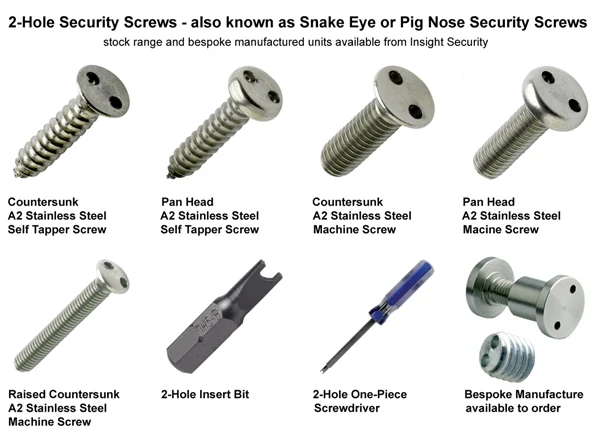
1. Two-Hole Security Screws – Also Known as Pig Nose or Snake Eye Screws
Two-hole security screws feature a pair of small holes in the screw head. Installation and removal requires a matching driver bit with two corresponding pins.

Their distinctive appearance makes them a popular choice where both tamper resistance and an attractive finish are important.
Typical applications include public fixtures, signs, display fittings, decorative installations and other applications where a conventional screw head may be undesirable.
Available in a range of head styles and thread types, two-hole security screws offer flexibility across a variety of fixing requirements.
2. Pin Hex Security Screws
Pin Hex security screws feature a hexagonal drive socket with a hardened steel security pin positioned in its centre.

The central pin prevents the use of an ordinary hexagonal driver bit, meaning that a specially designed security bit with a corresponding central recess is required.
These fastenings are suitable for applications where a neat, practical fixing is required alongside protection against straightforward removal using standard tools.
They can be useful for securing equipment housings, brackets, panels and other fittings in commercial and industrial environments.
3. Pin Torx Security Screws
Pin Torx security screws use a six-lobe Torx-style drive socket incorporating a central security pin. As with Pin Hex screws, the central pin prevents the use of a conventional driver bit, so a compatible security Torx bit is required.

The six-lobe drive design provides a familiar fastening format for applications where Torx-style fixings are preferred, while the additional pin provides a measure of protection against unauthorised removal.
When choosing these screws, it`s important to ensure that the driver bit matches the specific screw size and drive configuration.
4. Five-Lobe Security Torx Screws
Five-lobe Security Torx screws provide another option for applications requiring specialist tamper-resistant fastenings.

Their five-lobe drive profile differs from the more familiar six-lobe Torx design. The restricted availability of compatible driver tools can provide an additional deterrent against casual or opportunistic tampering.
Our five-lobe security Torx screws are manufactured from marine-grade stainless steel, making them particularly worth considering for installations exposed to demanding environmental conditions.
They may be suitable for external fixtures, marine-related applications and other locations where corrosion resistance is an important consideration. As with any stainless steel fastening, the precise grade and compatibility with the surrounding materials should be considered for the intended environment.
Choosing the Right Security Screw Head
The drive type is only one part of the selection process. The shape of the screw head can also affect the appearance, installation and suitability of a fastening.
Several head styles are available across our security screw range.
Button head: A rounded, low-profile head that provides a neat finish and leaves the head visible above the surface. This can be useful where a practical but unobtrusive fixing is required.
Pan head: A broad, slightly rounded head that provides a larger bearing surface. It is often suitable for general-purpose fixing applications where the head is intended to remain above the surface.
Countersunk head: Designed to sit flush with a suitably prepared countersunk surface, creating a flatter finish. This can be beneficial where projecting screw heads would be inconvenient or undesirable.
Raised countersunk head: A raised-profile alternative to a conventional countersunk head. This style is particularly useful for certain electrical fittings, including applications involving socket plates, where the appropriate head profile is required.
Selecting the correct head style helps ensure that the fastening fits the application properly, both functionally and aesthetically.
Self-Tapping or Machine Screw Threads: Which Do You Need?
Security screws are available with different thread configurations to suit the material being fastened and the installation method.
Self-tapping security screws
Self-tapping screws form or cut their own thread as they are installed into a suitable material. Depending on the screw design, they may be appropriate for applications involving materials such as plastics, sheet metal or other compatible substrates.
They can simplify installation where a separate threaded hole is not required, provided the material, hole size and screw specification are suitable.
Machine screw security fastenings
Machine screws are generally used with a pre-existing compatible thread, such as a tapped hole or a suitable nut. They are often appropriate for metal assemblies, equipment housings and applications where a conventional machine-threaded fastening arrangement is required.
Before choosing between the two, consider the material being fixed, its thickness, the required thread engagement and the method of installation.
Selecting the wrong thread type can compromise the integrity of the fixing, even if the screw itself offers good tamper resistance.
Why Stainless Steel Matters
Many security screws are manufactured from stainless steel, which offers useful corrosion resistance in a wide range of environments.
This is particularly important where fixings are exposed to moisture, changing temperatures, cleaning chemicals or outdoor conditions. Corrosion can make fastenings difficult to remove for legitimate maintenance and may eventually compromise their performance.
For more demanding environments, our five-lobe Security Torx range includes marine-grade stainless steel options.
However, the most appropriate material depends on the installation. Environmental exposure, contact with dissimilar metals, cleaning regimes and the properties of the materials being joined should all be considered when specifying a fastening.
How to Select the Most Appropriate Security Fastening
Choosing the right security screw involves more than simply selecting a tamper-resistant drive. A fastening must also be suitable for the load, substrate, environment and practical requirements of the installation.
Before ordering, consider the following questions:
- What are you trying to protect? Identify the equipment, fitting or component that needs to be secured and consider the consequences of unauthorised removal.
- What level of tamper resistance is required? Consider whether protection against casual interference is sufficient or whether the installation warrants a more carefully controlled choice of drive type and specialist tooling.
- What material are you fixing into? Check that the screw and thread type are appropriate for the substrate and that sufficient thread engagement can be achieved.
- Which head style is required? Consider whether the screw should sit flush with the surface, remain visible or meet a particular fitting requirement.
- Will the fastening be exposed to the elements? Select a suitable material and corrosion-resistance level for the environment.
- Will authorised removal be necessary? Maintenance, inspection and replacement may require the fastening to be removed in the future. Ensure that the correct driver tools can be retained and accessed by authorised personnel.
- Are there any specialist requirements? Electrical equipment, machinery, public infrastructure and safety-critical installations may require additional consideration of relevant standards, installation instructions or manufacturer specifications.
Taking the time to assess these factors can help avoid the cost and inconvenience of choosing an unsuitable fastening.
Security Screws: A Practical Part of a Wider Security Strategy
Security screws can make unauthorised removal more difficult, but they should be viewed as one element of a wider security strategy rather than a complete security solution.
The level of protection achieved will depend on the fastening, the quality of the installation, the strength of the substrate and the security of the surrounding assembly. Where the consequences of tampering are significant, the complete installation should be assessed rather than relying on the screw type alone.
It is also worth considering the availability and control of matching driver tools. Although specialist tooling provides a useful barrier to unauthorised removal, security depends partly on preventing unauthorised access to those tools and selecting a fastening appropriate to the actual risk.
Watch Our Video: Choosing the Right Security Screws
Our latest video introduces some of the most popular two-way anti-tamper security screws available from Insight Security.
It explains the key differences between Two-Hole, Pin Hex, Pin Torx and Five-Lobe Security Torx screws, alongside an overview of the available head styles, thread options and specialist driver tools.
If you`re unsure which fastening is best suited to your project, watching the video is a useful starting point - but remember that we are always happy to help you determine which form of fastening is best for your needs.
Explore the security fastenings available from Insight Security, or contact our friendly team for advice on selecting a suitable solution for your application.
Choosing the right fastening from the outset can help protect valuable equipment, reduce the risk of unauthorised interference and provide a more practical, durable installation.
For more information on How to Choose the Right Security Screws and Anti-Tamper Fastenings talk to Insight Security