 Get Listed
A blocked extraction point, a production line coated in fine dust, swarf building up around machine tools, or a shutdown cleaning job that cannot slip by a day – this is where industrial cleaning equipment hire becomes a practical operational decision rather than a stopgap. For many UK sites, hiring the right machine is the fastest way to restore control, maintain safety standards and keep work moving without committing immediately to capital purchase.
The key point is that industrial environments do not need generic cleaning equipment. They need machinery built for continuous duty, heavy debris, fine dust, wet waste, oil recovery, or hazardous atmospheres. That is why hire only works well when the equipment itself is genuinely industrial and the supplier understands the process, the material being collected and the conditions on site.
Why industrial cleaning equipment hire is not just about short-term cost
Some buyers approach hire as a way to avoid upfront spend. That can be true, but it is rarely the whole picture. In practice, hire is often about speed, flexibility and reducing operational risk.
If a site has an unplanned requirement – perhaps a maintenance outage, refurbishment project, spill response need or seasonal increase in waste recovery – waiting through a full specification and purchase cycle may not be realistic. Hiring allows operations teams to get suitable equipment into service quickly, with less procurement delay and less pressure to make a permanent decision before the application has been proven.
There is also a commercial advantage when the requirement is temporary or uncertain. A plant manager may know the site has a dust issue but may not yet know whether the right answer is a portable industrial vacuum, a larger fixed unit or a centralised system. In that situation, hire can act as a controlled trial in live operating conditions. That reduces the risk of buying a machine that is either under-specified or unnecessarily large.
Where hire works best
Industrial cleaning equipment hire tends to be most effective where the cleaning challenge is intensive, site-specific or tied to a defined period of work. Shutdowns are an obvious example. So are major maintenance campaigns, factory moves, construction support, deep cleaning projects and temporary production increases.
It is also useful where waste characteristics change. A site dealing with dry powder for most of the year may need wet-and-dry capability during a washdown phase. Another may need higher filtration during a process change that creates finer dust than usual. In both cases, hiring gives the business room to adapt without locking itself into the wrong configuration.
For some organisations, the issue is internal resource planning. If the workload spikes only occasionally, owning extra machines can leave expensive equipment idle for long periods. Hire lets the site match machine availability to actual demand.
Choosing the right industrial cleaning equipment for hire
The success of any hire arrangement depends on specification. This is where industrial buyers should be cautious, because the phrase industrial cleaning can cover everything from light factory housekeeping to recovery of abrasive media, metal chips, combustible dust, sludge or oil.
A proper assessment starts with the material. Fine dust behaves differently from coarse debris. Wet waste requires a different collection system from dry powder. Hot material, heavy particles or long-shredded swarf can affect container design, filtration choice and discharge method. If the machine is wrong for the waste stream, performance drops quickly and operators lose time dealing with blockages, filter loading or difficult emptying.
Power source matters too. On some sites, single-phase equipment may be sufficient for intermittent duties. On others, three-phase machines are the only realistic option for continuous use, long hose runs or heavier recovery rates. Mobility is another consideration. A compact portable unit may suit localised maintenance work, while a fixed installation or centralised vacuum system may be more effective for repeated cleaning across a larger plant.
Then there is the compliance question. If the area involves explosive or combustible dust, flammable materials or designated hazardous zones, ATEX-certified equipment may be essential. This is not an optional upgrade. It is a fundamental part of safe operation.
Industrial cleaning equipment hire versus buying
There is no universal answer here, because it depends on frequency of use, duty cycle, site layout and how central cleaning is to production continuity.
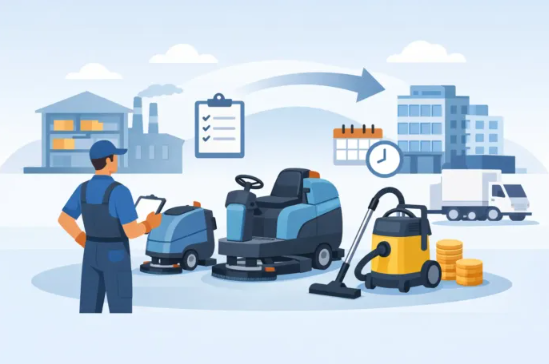
Hiring is often the stronger option when the requirement is temporary, when a site needs to validate a solution before purchase, or when a business wants to avoid immediate capital outlay. It can also make sense where a specialist machine is only needed for occasional tasks, such as deep extraction during annual shutdowns.
Buying usually becomes more attractive where the equipment will be used daily, where cleaning is a routine part of production, or where a machine needs to be fully integrated into site workflows. Permanent ownership can provide better long-term value when utilisation is high and the specification is already clear.
Between those two sits contract hire or lease purchase, which can be especially relevant for businesses that need dependable access to industrial-grade equipment but want to spread cost and preserve capital. For many operations teams, that balance of control and flexibility is more useful than a simple hire-or-buy comparison.
What to expect from a serious hire partner
Not all suppliers approach industrial cleaning equipment hire in the same way. Some simply send out a machine and leave the customer to work around its limitations. In demanding environments, that approach causes downtime, operator frustration and avoidable safety issues.
A specialist partner should begin with the application, not the stock list. They should ask what material is being recovered, how often, over what distance, in what volume, and under what site conditions. They should also be clear about duty requirements, filtration needs, discharge arrangements and power availability.
Support matters just as much as the hardware. If a hired machine is going into a live industrial environment, delivery times, commissioning support, operator guidance and responsive aftercare all affect whether the arrangement actually improves performance. A cheaper hire rate can quickly become expensive if the machine is not suited to the job or if service response is poor.
This is where a specialist such as Forvac Industrial has a clear advantage. The value is not just access to equipment. It is the ability to match the machine to the application, including heavy-duty portable units, fixed systems and certified options for higher-risk environments.
Common mistakes when hiring industrial cleaning equipment
One common mistake is assuming all vacuum equipment is broadly similar. It is not. Machines designed for light commercial cleaning will not withstand continuous industrial duties, abrasive waste or demanding recovery tasks. The result is usually poor suction performance, excessive wear and frequent interruptions.
Another is underestimating disposal and emptying. Collecting waste is only half the job. If the machine is difficult to empty, awkward to move or not configured for the material being handled, labour time rises and housekeeping standards suffer.
There is also a tendency to focus too narrowly on headline hire cost. The real cost sits in site performance. If the wrong machine lengthens shutdown cleaning, delays maintenance access or leaves dust in critical areas, the operational impact will outweigh any saving on the hire agreement.
When a hire period should become a longer-term solution
A short-term hire can reveal a bigger pattern. Many sites initially bring in equipment for a one-off issue, then discover the same cleaning burden appears every week. That usually points to a wider operational need.
If the machine becomes essential to maintenance routines, uptime protection or health and safety control, it may be time to move beyond ad hoc hire. At that point, the conversation should shift towards long-term hire, lease purchase or a permanent engineered solution. In larger facilities, repeated demand across several areas can even indicate the case for a centralised vacuum system rather than multiple standalone units.
The best outcome is not always the cheapest machine or the shortest agreement. It is the arrangement that gives the site reliable cleaning performance, safe material recovery and predictable operating cost.
A more practical way to think about industrial cleaning equipment hire
The most effective approach is to treat hire as part of operational planning, not just emergency response. When the right equipment is available at the right time, cleaning stops being a reactive burden and becomes part of how the site protects production, manages risk and maintains standards.
If your environment involves dust, swarf, powders, oil, debris or hazardous materials, the decision is not simply whether to hire. It is whether the equipment being hired is genuinely engineered for the reality of your process. Get that right, and hire becomes a useful tool for solving immediate problems while informing better long-term decisions.
For more information on When Industrial Cleaning Equipment Hire Makes Sense talk to Forvac Industrial