 Get Listed

When Do Factories Need ATEX Vacuums on Site?
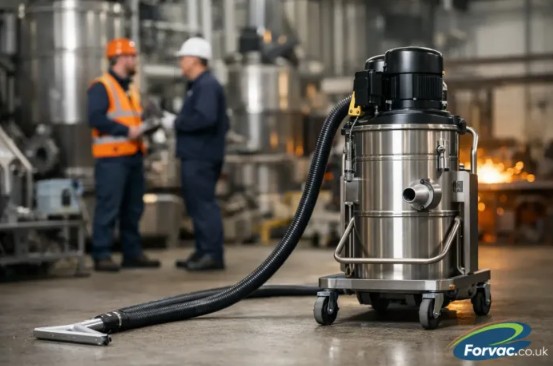
A fine layer of powder around a packing line, a build-up of aluminium swarf near a machining centre or flour dust escaping during transfer may look like a housekeeping issue. In the wrong conditions, it can become an ignition and explosion risk. The question, “when do factories need ATEX vacuums?”, should therefore be answered through a formal assessment of the material, process and area – not by simply choosing the most powerful machine available.
An ATEX-rated industrial vacuum is designed for use where a potentially explosive atmosphere may be present. It is part of a wider approach to controlling combustible dusts, gases and vapours, helping sites recover hazardous material without introducing ignition sources through motors, static electricity, friction or overheated components.
When factories need ATEX vacuums
Factories need to consider an ATEX vacuum when cleaning or recovering material that can form an explosive atmosphere, or when vacuuming must take place inside a classified hazardous area. This commonly includes combustible dust, flammable liquid residues, vapours and certain metal powders. The risk is not limited to visibly dramatic materials such as solvents or petrol. Many everyday production materials can create an explosive dust cloud when dispersed in air.
In Great Britain, the starting point is usually a Dangerous Substances and Explosive Atmospheres Regulations 2002 (DSEAR) risk assessment. This should identify dangerous substances, establish where explosive atmospheres could occur, classify hazardous zones where necessary, and define the controls required. A vacuum is only one control, but it is often a critical one because poor cleaning methods can spread dust or create electrostatic charge.
A conventional industrial vacuum may be suitable for general production dust, swarf or debris in a non-hazardous area. It must not be assumed suitable simply because it is heavy-duty or has metal construction. Where explosive atmospheres are foreseeable, the vacuum’s certification, construction and intended application must match the identified risk.
The zone classification determines the specification
Hazardous area classification is central to selecting the right equipment. For combustible dusts, Zone 20 covers areas where an explosive dust atmosphere is present continuously, for long periods or frequently. Zone 21 applies where it is likely to occur occasionally in normal operation. Zone 22 applies where it is not likely in normal operation, and if it does occur, exists only briefly.
For gases and vapours, the equivalent classifications are Zones 0, 1 and 2. The number is not a measure of how serious an incident would be. It describes the likelihood and duration of an explosive atmosphere being present. A powder filling station may have a Zone 21 area around an open transfer point, for example, while surrounding areas may be classified as Zone 22 or remain unclassified depending on the process and containment.
The vacuum must be suitable for the zone in which it will operate, including where its hose, accessories and recovered material will be located. This is a frequent source of specification errors. A machine may be parked outside the classified area, but if the suction hose enters a zone and collects combustible powder, the full arrangement still needs careful assessment.
ATEX equipment markings provide essential information on intended use, equipment group, category and dust or gas suitability. In Great Britain, UKEX requirements may also apply under the relevant regulations. The right documentation and marking should be checked against the site’s DSEAR assessment rather than treated as a generic badge of safety.
Materials that commonly require closer attention
Combustible dust risk exists across far more sectors than many facilities expect. Food factories may handle flour, sugar, starch, milk powder, coffee and animal feed. Pharmaceutical and chemical sites can generate fine organic powders, active ingredients and additives. Woodworking produces combustible dust, while plastics processing, rubber production and textiles can create fine particulate material with different ignition characteristics.
Metalworking requires particular care. Aluminium, magnesium and titanium dusts can be highly combustible, and their behaviour differs significantly from ordinary steel swarf. A vacuum selected for dry steel chips is not automatically suitable for fine reactive metal dust. Material compatibility, filter design, collection method and disposal arrangements all matter.
Paint finishing, printing, battery manufacturing, petrochemical work and areas handling flammable liquids may present gas or vapour hazards as well as dust hazards. In these environments, the question is not only whether the vacuum can collect the material. It is whether the machine can operate without becoming an ignition source in the atmosphere around it.
ATEX vacuum selection is about the whole recovery process
The correct machine is specified by more than its ATEX classification. A useful industrial solution must also suit the volume, density and condition of the material being recovered. Fine powders may require high filtration performance and a safe, practical emptying arrangement. Dense material, metal chips or continuous recovery may call for a larger hopper, a pneumatic conveying system or a fixed centralised installation rather than a portable vacuum.
Static control is especially important. Conductive components, antistatic hoses and effective earthing arrangements help prevent electrostatic charge accumulation. However, earthing cannot compensate for unsuitable equipment or an incomplete risk assessment. The entire suction path – vacuum, hose, nozzle, filter, collection container and operator procedure – should be considered as one system.
Filter cleaning also deserves attention. A clogged filter reduces airflow and encourages operators to intervene more often, potentially exposing them to dust. Conversely, an aggressive filter-cleaning system may not suit every powder or application. The appropriate design depends on particle size, material behaviour, expected duty cycle and whether recovered material is to be reused, quarantined or disposed of.
For continuous process recovery, a purpose-designed ATEX central vacuum or pneumatic transport system can reduce manual handling and limit dust release at source. For maintenance tasks, spill response or periodic cleaning, a portable ATEX vacuum may be more practical. The most cost-effective option is the one that controls the identified risk while fitting the site’s workflow and maintenance capability.
Situations where an ATEX vacuum is often required
ATEX vacuum specification should be investigated when dust escapes from mixers, bagging machines, conveyors, silos, mills, filling lines or extraction points. It is also relevant where production creates fine dust deposits on floors, ledges, machinery or cable trays. These secondary deposits can be disturbed and become airborne, increasing the scale of a potential dust event.
Machining and maintenance areas may need an assessed solution for combustible or reactive metal dust, especially where fine particles collect around equipment. Workshops handling flammable liquids, resins, coatings or solvents should assess vapour risk before using a vacuum for spills or residue recovery. The same principle applies to cleaning inside process vessels, booths, ducting and enclosed equipment where hazardous atmospheres may be present.
An ATEX vacuum is not necessarily needed throughout an entire factory simply because one hazardous process exists. Over-specifying equipment can add unnecessary cost and complexity. Under-specifying it is far more serious. Defined zoning, controlled work methods and a clear understanding of where the vacuum will be used allow the site to make a proportionate decision.
Avoid the common purchasing mistakes
The first mistake is buying an “ATEX vacuum” without confirming the zone, substance and application. ATEX-rated equipment is not a single universal category. A machine suitable for a Zone 22 combustible-dust housekeeping task may not be suitable for a Zone 21 process area, flammable vapours or reactive metal dust.
The second is treating vacuum collection as a substitute for process containment and local exhaust ventilation. Good recovery equipment supports dust control, but it does not remove the need to prevent releases at source. The third is overlooking discharge and disposal. Collected material remains a hazardous substance, so the container must be emptied, transported and managed safely.
Finally, sites should not rely on certification alone. Equipment must be maintained, inspected and used with the correct accessories. Damaged hoses, unapproved replacement parts, poor earthing or improvised cleaning procedures can undermine the safety features built into the original machine.
Start with the risk, then engineer the solution
A sound specification begins with a site survey and the existing DSEAR assessment. Identify the material being collected, its particle size and combustible properties, the zone classification, required duty cycle, recovery volumes, access constraints and disposal route. That information makes it possible to select an appropriately certified portable vacuum, fixed system or integrated recovery solution.
Forvac Industrial can help translate those operational details into a practical industrial vacuum specification, including ATEX-certified options for demanding production and maintenance environments. The objective is not simply to supply a compliant machine, but to provide a recovery method that operators can use safely and consistently.
Where combustible dust, vapour or reactive material is part of the process, the best time to assess vacuum suitability is before a spill, shutdown or audit exposes the gap. A properly specified system turns routine cleaning into a controlled part of the site’s safety and productivity plan.
For more information on When Do Factories Need ATEX Vacuums on Site? talk to Forvac Industrial