 Get Listed

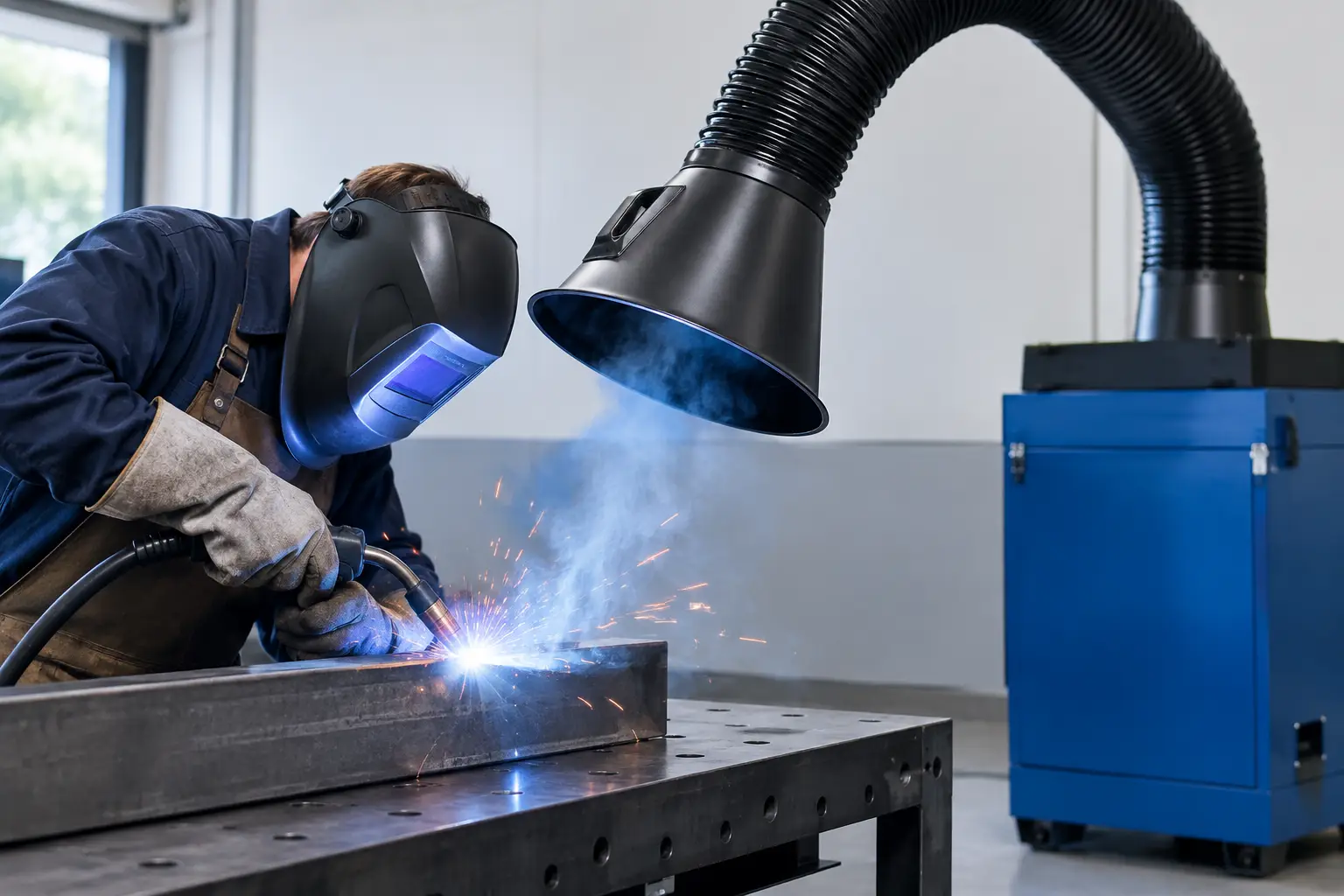
Capturing welding fume close to the arc helps prevent the concentrated plume passing through an operator's breathing zone and spreading into the workshop. General ventilation can support the wider environment, but effective control starts with the position where the fume is produced. Forvac Industrial explains why an extraction system needs to suit the welding process, working position and everyday demands of the production area.
Fume capture also affects housekeeping and maintenance. Material that escapes can settle on machinery, walkways and racking, adding cleaning work and contaminating nearby machining, assembly or finishing operations. Equipment has to remain practical to use: a hood that obstructs the job and is repeatedly pushed aside will not provide dependable control, whatever its rated airflow.
Assess the work before choosing the equipment
Welding fume contains fine particles and gases generated from the metal, consumables and surface coatings. Its composition varies with the process, filler wire, shielding gas and workpiece condition. Stainless steel, galvanised material and coated components can introduce additional hazards, so the assessment should consider the actual materials involved rather than treating every welding operation alike.
Very fine fume particles can remain suspended for long periods and are readily inhaled. Once dispersed throughout a building, they are harder to collect efficiently. Dilution ventilation may help with residual contamination, but the guide treats capture at a fixed or repeatable source as the central design consideration.
The process assessment should include how the job changes over a shift. A station that is convenient for a small component may be less effective when a larger workpiece alters the welder's stance or blocks the intended airflow. Checking extraction against actual tasks provides a more useful basis than a demonstration in an otherwise still workshop.
The size and orientation of components, welding duty cycle and operator position all influence the extraction arrangement. A fixed fabrication bench presents different requirements from a large structural assembly or maintenance work in a vessel. The system should draw the plume away from the welder's breathing zone. Open doors, fans, vehicle movements and other cross-draughts also need consideration because they can disrupt capture in a working factory.
Match capture to the welding station
For repeatable bench work, downdraught or back-draught tables can provide a defined capture area without requiring the operator to move an extraction arm for every weld. Welding booths and partial enclosures can help contain fume, provided opening sizes and airflow are appropriate. Access remains important: an enclosure that makes the task awkward may discourage proper use.
Articulated extraction arms offer flexibility for changing work. Their effectiveness depends on keeping the hood close to the plume and positioning it to capture rising fume before it reaches the operator. Greater distances demand more airflow, while an intrusive hood may be moved out of the way. Arm reach, mounting position and hood design therefore deserve as much attention as the fan specification.
On-torch extraction is another option for repetitive MIG or MAG work, particularly with large components or restricted space. Capture occurs at the point where the fume forms, but torch and hose weight can affect handling. The arrangement must suit the process and shielding gas, with training to help operators adapt their technique.
The capture arrangement should allow the operator to keep a useful working position and view of the joint. On-torch equipment can improve consistency by moving with the weld, but added hose weight and restricted manoeuvrability need attention. A flexible arm can accommodate varied components, but only if its length and mounting allow the hood to remain close without interfering with handling.
Mobile extraction can support repairs, intermittent welding and work where permanent ducting is impractical. A portable unit still needs adequate capacity, stable positioning and sensible hose and cable routes. Larger fabrications may call for screens, local enclosures or planned work zones as well. The aim remains close capture; a single distant hood should not be expected to control fume across a large assembly.
Consider the complete airflow system
A headline fan rating does not establish the airflow reaching the weld. Hose and duct lengths, bends, hood geometry, loaded filters and the distance to the plume all affect performance. A suitable design balances fan pressure, air volume, duct velocity and the capture arrangement. Central systems must account for how many welding stations will operate together.
Replacement air is part of the design too. Removing substantial volumes from an enclosed workshop without adequate make-up air can create draughts and reduce capture performance. Filtration needs to suit fine welding fume, while the installation should avoid unnecessary pressure losses and excessive noise. Monitoring filter condition helps identify falling performance before it becomes a routine operating problem.
Account for heat, materials and maintenance
Collection and filter servicing are part of the same control system. A suitable filter needs to retain fine fume while its cleaning method and waste-handling arrangements allow material to be removed appropriately. Watching the exterior of the unit is not a substitute for checking filter condition and airflow. Accessible service points make these checks more achievable during routine production.
Sparks and hot particles require a suitable protective arrangement, which may include spark arresting, pre-separation, appropriate ducting and collection methods. A general industrial vacuum or dust collector should not be assumed suitable for hot welding debris. Where combustible residues or hazardous-area conditions are involved, equipment selection must follow the site's assessment and match the actual materials, classification and installation.
Day-to-day use remains essential. Operators need to understand hood positioning, airflow controls and signs of a fault. Gauges, indicators or alarms can help reveal blocked filters, damaged hoses and reduced extraction. Routine inspection should cover the arms, hoods, hoses and collection arrangements, supported by planned examination and testing appropriate to the application.
Filters, bins and service points also need to be accessible so maintenance can be completed without avoidable disruption or difficult handling. Forvac Industrial considers these practical requirements when specifying fixed or portable extraction and vacuum equipment, matching the solution to the process and the people operating it.
The starting question is where the fume travels immediately after the arc starts. Understanding that movement helps identify whether an arm, table, booth, on-torch arrangement or combination is appropriate. Designing around real working positions, material flow and maintenance access makes extraction part of the production process.
Source: Forvac Industrial
For more information on How to Capture Welding Fumes at Source Safely talk to Forvac Industrial