 Get Listed

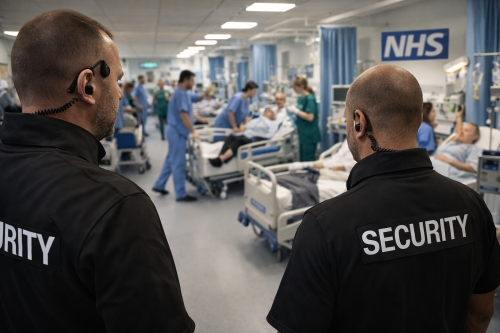
Hospitals are unique environments. They are places of healing, but they are also high-pressure, noisy, and occasionally volatile workspaces. For hospital security teams and paramedics, reliable communication isn't just a convenience—it is a safety requirement.
Whether monitoring a quiet psychiatric ward, managing a crowded A&E waiting room, or coordinating an ambulance arrival at a major event, the ability to communicate clearly and discreetly is paramount. Equipment failure or poor audio quality can lead to delayed responses in critical situations.
This guide explores the specific challenges faced by security personnel and paramedics in hospital settings and recommends the best earpiece solutions to keep your team connected.
Challenges Faced by Security and Paramedics
Working in a large hospital environment or attending medical events presents communication hurdles that standard office equipment simply cannot handle.
Why is the hospital environment so difficult for radio comms?
First, there is the noise. The constant beep of monitors, overhead announcements, and the general hum of a busy hospital can make hearing radio transmissions difficult. For paramedics working at outdoor events or in ambulance bays, wind and traffic noise add to the chaos.
Why is discretion necessary?
On a ward, maintaining a calm atmosphere is essential for patient recovery. A loud radio crackling with security chatter can distress patients and escalate tense situations. Security officers need to communicate with their team without broadcasting the conversation to everyone in the room.
What about hygiene?
In an NHS or private hospital setting, infection control is a top priority. Radio earpieces are often shared between staff on different shifts. If the equipment isn't designed to be easily cleaned or worn hygienically, it becomes a vector for cross-contamination.
Key Features to Look for in a Hospital Earpiece
When selecting equipment for your team, not all earpieces are created equal. Here are the specific features required for healthcare security.
How important is comfort for long shifts?
Hospital security shifts are often 12 hours long. An earpiece that rubs, pinches, or falls out constantly will eventually be removed by the user, leaving them offline. You need lightweight designs that sit securely without causing ear fatigue.
Does audio quality matter?
Absolutely. Instructions regarding patient restraint, medication, or location must be heard clearly the first time. There is no room for ambiguity. Earpieces must provide crisp audio even in environments with high background noise.
Is durability a factor?
Hospital security often involves physical intervention. Earpieces need to withstand sudden movements, being grabbed, or getting snagged. For paramedics, equipment must be resistant to rain, dirt, and wear and tear.
How easy are they to clean?
To maintain hygiene standards, earpieces should be made of materials that can be wiped down with alcohol swabs without degrading. Alternatively, designs that sit on the outside of the ear (rather than inside the canal) are often preferred for multi-user scenarios.
Recommended Earpieces for Hospital Security
Based on durability, hygiene, and audio clarity, here are the top three recommendations for hospital environments.
1. The D-Ring Covert Earpiece
For staff who share radios across shifts, the D-Ring is often the industry standard.
What makes it good for hospitals?
The D-Ring loops around the outside of the ear rather than inserting into it. This makes it significantly more hygienic for multi-user environments. It provides a secure fit that won't fall out during a physical altercation or a sprint to an emergency. The D-Ring Covert Earpiece features a flexible rubber D-shape for comfort and an in-line microphone with a Push-to-Talk (PTT) button, allowing for covert communication without lifting the radio.
Key Benefits:
- Hygiene: Does not enter the ear canal, making it safer to share.
- Security: Fits securely around the ear during movement.
- Discretion: In-line mic allows for subtle communication.
2. The G-Shaped Earpiece
If comfort is the primary concern for your ward staff, the G-Shape is a strong contender.
What makes it good for hospitals?
This design uses a soft rubber curve that hooks gently over the top of the ear. It is generally considered less intrusive than other models. The G-Shaped Earpiece offers excellent audio quality and is designed so it does not intrude into the ear, which again assists with hygiene and long-term comfort.
Key Benefits:
- Comfort: ideal for 12+ hour shifts.
- Stability: The "G" shape anchors well to the ear.
- Usability: Includes a lapel clip PTT with microphone.
3. Heavy Duty Remote Speaker Microphone (RSM)
For paramedics, ambulance bay marshals, or security working external patrols/events, a standard earpiece might not be enough.
What makes it good for hospitals and paramedics?
Sometimes you need rugged durability over covertness. The Heavy Duty RSM is IP68 rated, meaning it is waterproof and dustproof—perfect for paramedics working in the rain. It features a powerful speaker that cuts through siren noise and a large metal-reinforced clip. Crucially, it includes a 3.5mm jack, so you can plug an earpiece into it if you need to switch to private listening.
Key Benefits:
- Durability: IP68 waterproof rating for heavy-duty outdoor use.
- Volume: Powerful speaker for noisy environments.
- Versatility: Can be used as a loudspeaker or paired with a listen-only earpiece.
How to Choose the Right Earpiece for Your Needs
Selecting the right tool depends on the specific role of the staff member.
Who should use the D-Ring or G-Shape?
These are best for internal security, ward staff, and reception security.
If a security officer is stationed on a mental health ward or patrolling corridors, they need to appear approachable and non-threatening. The D-Ring and G-Shape offer the discretion needed to communicate without causing alarm. Because they sit on the outside of the ear, they are the best choice for radios that are handed over from the day shift to the night shift.
Who should use the Heavy Duty RSM?
This is best for paramedics, parking enforcement, and external event security.
If you are working outside the hospital entrance directing traffic, or you are a paramedic at a rainy festival, a delicate earpiece might fail. You need the rugged protection of the RSM. The ability to wipe it down thoroughly also makes it excellent for high-infection risk zones.
Enhancing Safety with the Right Tools
In a hospital, communication breakdown is not an option. Whether it is a "Code Red" fire alarm or a request for immediate assistance in A&E, the message must get through.
By equipping your team with the correct earpieces—prioritizing hygiene for ward staff and durability for paramedics—you ensure that your security operations run smoothly. The right equipment allows staff to focus on their primary job: keeping patients, visitors, and medical professionals safe.
For more information on Critical Comms: Best Earpieces for NHS Hospital Security & Paramedics talk to Earpieceonline