 Get Listed

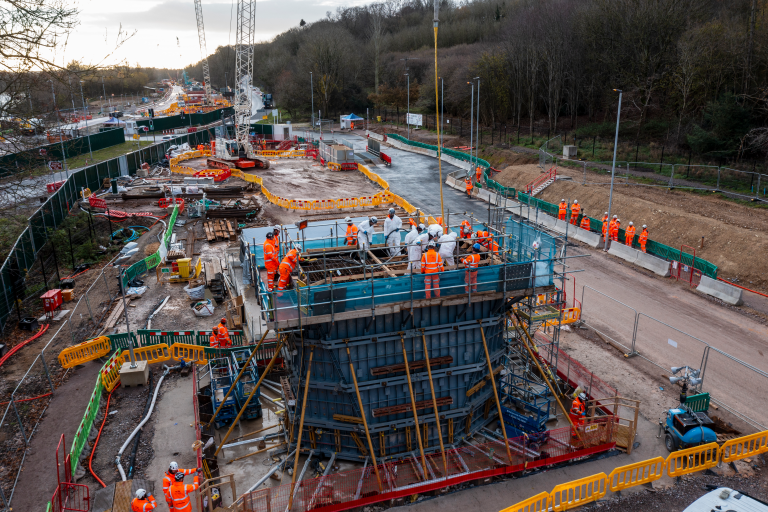
The UK’s longest rail bridge, the Colne Valley Viaduct, is beginning to take impressive form as the first 56 giant piers are now in place. Once complete, the viaduct will stretch for an extraordinary 3.4 kilometres, carrying high-speed trains travelling at up to 200mph from the edge of Hillingdon, along the M25 corridor, and on to Birmingham and beyond.
The colossal concrete piers, each weighing up to 370 tonnes and standing six metres tall, are being cast on site by a dedicated team of engineers. These initial 56 piers form the foundation of the viaduct, with many more to be added. The structure will rise over a chain of lakes on the outskirts of west London, with the piers acting as the bridge’s main supports.
Each pier is cast using specially designed formwork, which shapes the concrete before being carefully removed over four days to reveal the finished structure. They rest on deep-set foundations made up of concrete piles reaching 55 metres into the ground, providing the necessary strength to support the weight of the deck above. In total, the completed viaduct will incorporate 292 piles and 56 pile caps.
The work is being carried out by Align JV – a partnership between Bouygues Travaux Publics, Sir Robert McAlpine and VolkerFitzpatrick – in collaboration with Kilnbridge.
David Emms, Project Client for HS2 Ltd, commented:
“The Colne Valley Viaduct will be one of HS2’s most iconic structures and it’s great to see how much has been achieved already. I’d like to thank the whole team for the huge amount of work they’ve done to get us to this point.”
Architecturally, the viaduct draws inspiration from the image of a stone skipping across water. Its design features graceful spans of up to 80 metres, with the structure skimming just 10 metres above the surface of the River Colne and Grand Union Canal, creating a sleek, fluid silhouette as it stretches across the landscape.
Environmental considerations have also been at the forefront of the design and construction process. Through efficient design methods, the project has cut carbon emissions by a third. Over the past six years, HS2 has worked closely with the Environment Agency and Affinity Water to monitor water quality and agree on working methods that minimise ecological disruption.
Although the full HS2 line is not expected to open until between 2029 and 2033, this latest milestone is a significant step forward. The scale, ambition and engineering involved in this project mark it as one of the most exciting infrastructure developments currently underway in the UK.
For more information on The UK’s longest rail bridge takes form, as the first 56 giant piers are raised for HS2 talk to Amelec Instruments