 Get Listed

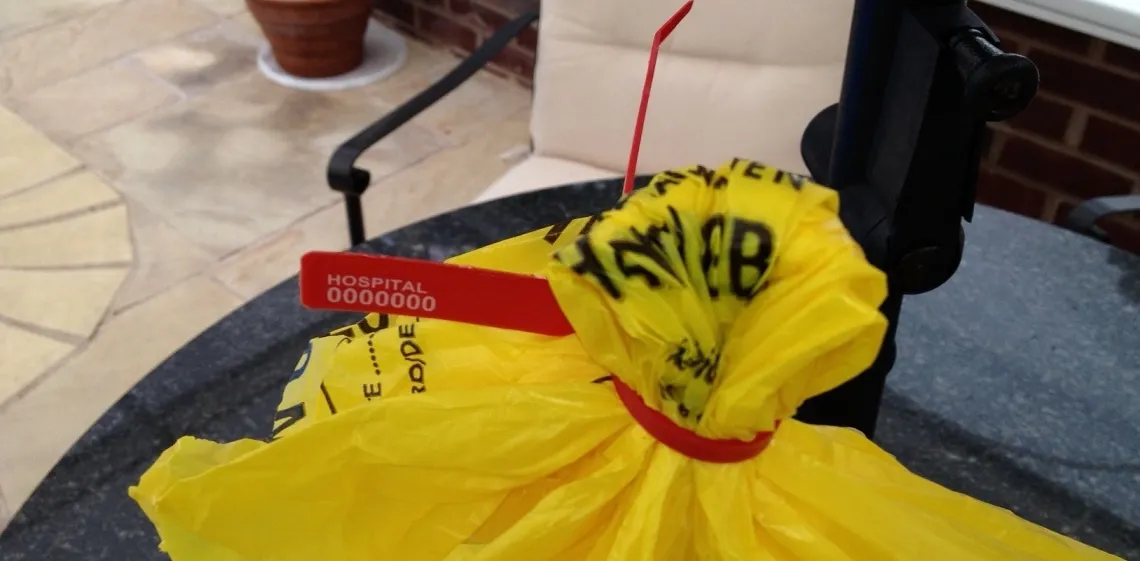
Clinical waste ties are used across NHS hospitals and healthcare facilities to seal clinical waste bags securely at the point where waste is generated. This helps ensure safe containment, safer handling and compliant internal movement before treatment or disposal.
They support NHS healthcare waste procedures and local Trust policies, which require waste to be correctly segregated, securely contained and safely managed from the clinical area through to collection and final disposal.
This guide explains how clinical waste ties are used in day-to-day NHS settings, why correct closure matters, and how printed identification with sequential numbering can support traceability, issuing control and auditing.
How clinical waste is managed in hospitals
Within NHS facilities, clinical waste is segregated at the point of production, such as wards, theatres and outpatient departments. Waste is placed into the correct colour-coded stream according to local procedures.
Common examples include orange bags for infectious waste requiring treatment, and yellow bags for highly infectious waste or waste requiring incineration.
Waste should be placed directly into the correct bag at the location where it is generated, in line with Health Technical Memorandum (HTM) 07-01: Safe Management of Healthcare Waste and local Trust waste procedures.
When and how clinical waste bags are sealed
In typical NHS practice, clinical waste bags are filled to around two-thirds capacity to allow safe handling. Bags are then sealed at the point of generation before being removed from the clinical area.
A recognised method used across NHS Trusts is the “swan-neck” closure technique. The neck of the bag is twisted once full, folded over to form a loop, and then secured with a clinical waste tie. The tie is pulled tight to prevent reopening or leakage.
This method helps contain infectious material, reduce the risk of spillage, support safer handling during internal transport and maintain compliance with local waste procedures.
Making clinical waste ties work properly in practice
Clinical waste ties do more than simply close a bag. In many NHS settings, they also form part of a control and traceability process, helping link clinical waste back to its point of origin and supporting audit and accountability.
This is usually achieved through printed identification and sequential unique numbering.
Why printed identification matters
Depending on Trust policy and operational practice, clinical waste ties can be printed with details such as the hospital or site name, Trust name, ward, department or cost centre reference.
This makes it easier to identify where waste was generated and can help reinforce correct segregation at source.
Why sequential numbering matters
Sequential numbering gives each sealed bag a unique reference. This can support issuing control, audit trails, internal reporting, incident investigation and a clearer link between the point of generation and internal handling stages.
In simple terms, a numbered tie can act as a low-cost traceability marker at the start of the clinical waste journey. Number ranges can be allocated by ward, department, building or cost centre depending on local Trust policy.
Two practical approaches to traceability
NHS Trusts typically use one of two methods.
The first is site or ward-specific printed ties. In this approach, the location of waste generation is printed directly on the tie, such as “Ward 3A”, “Theatres” or “Outpatients”, alongside sequential numbering. This provides immediate visual identification, keeps administration on the ward to a minimum and supports strong accountability by area of origin. The main consideration is that multiple print variants may need to be managed across different sites or departments.
The second approach is generic printed ties with allocated number ranges. These may carry a Trust or site print, while traceability is managed by recording which number ranges are issued to each ward or department using a spreadsheet, database or internal stock control system. This keeps procurement simpler, scales well across multi-site Trusts and provides strong traceability when issuing records are maintained. The key requirement is consistent logging and stock control discipline.
After sealing
Once tied, bags may be labelled in accordance with local Trust policy before being transferred to designated secure waste storage areas. Waste is then collected by authorised waste contractors for treatment or disposal.
Where numbered ties are used, the tie number can be referenced within local processes to support auditing, internal control and incident investigation.
Compliance considerations
Clinical waste ties support NHS compliance by helping ensure secure closure before internal transport, supporting infection prevention and control procedures, reducing the risk of accidental exposure or spillage, and helping meet the requirement for waste to be safely contained and securely packaged.
When used with printed origin details and/or sequential numbering, they also provide a practical route to improved traceability.
Summary
In NHS hospitals, clinical waste ties are a small but important part of the healthcare waste management chain. They are used to securely seal clinical waste bags at source, supporting safe storage, internal transport and compliant disposal.
Where ties are printed and sequentially numbered, they can also help link waste back to its origin — either through ward-specific printed ties or through controlled allocation of number ranges to wards and departments.
Need printed or sequentially numbered clinical waste ties?
Universeal can supply clinical waste ties with Trust or site printing, ward and department references, and sequential unique numbering. For a quotation or sample, share your required number of digits, print layout and estimated annual usage.
For more information on Clinical Waste Ties in the NHS: Secure Bag Closure & Traceability talk to Universeal (UK) Ltd