 Get Listed
Why Substation Commissioning Matters
Substation commissioning is the final, critical stage of verifying that electrical equipment — such as transformers, circuit breakers and protection relays — has been installed correctly, operates as designed, and is safe to put into service before the system is energised.
At the centre of this process are primary and secondary current injection testing. These essential methods are used to validate protection schemes, confirm system integrity and ensure each component performs as intended under real operating conditions.
The role of commissioning in power systems
Substations are complex environments where multiple systems must work together reliably. Protection relays, current transformers (CTs), circuit breakers and control wiring form part of a coordinated protection scheme.
Commissioning helps ensure protection systems operate correctly under fault conditions, CT ratios and polarity are confirmed, trip circuits function as expected, timing characteristics meet design requirements, and wiring or configuration errors are identified before energisation.
Without thorough testing, even small issues can lead to nuisance tripping, equipment damage, or failure to operate during a fault.
Secondary injection testing: precision at relay level
Secondary injection testing focuses on the relay and control circuit. Low-level currents and voltages are injected directly into the relay so engineers can verify functionality without involving the primary system.
This approach is typically used for verifying relay settings and calibration, functional testing of protection schemes, timing tests (trip, reset and reclose), and controlled fault simulation.
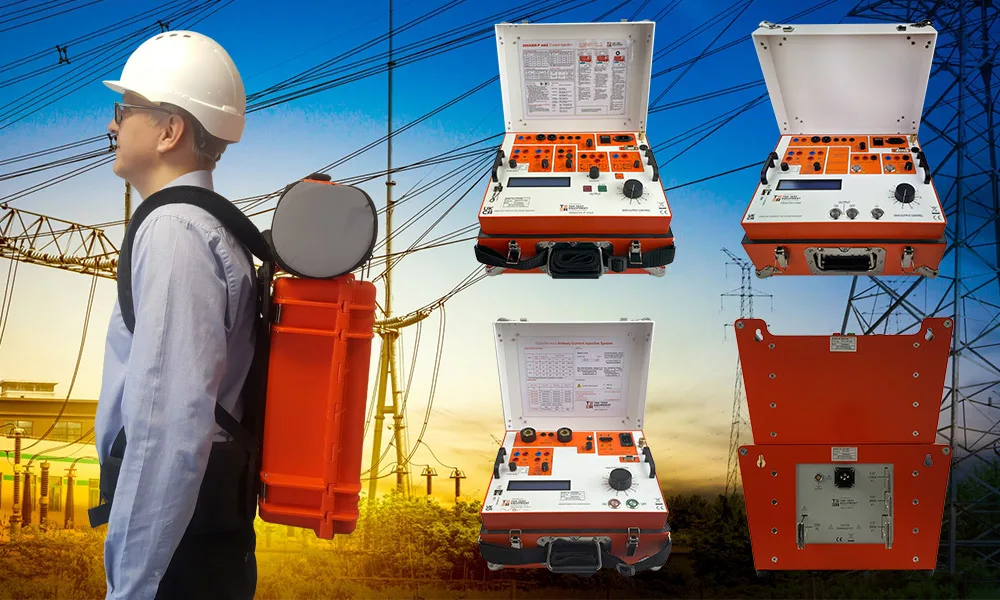
Instruments such as the 50ADM-P and 200ADM-P are well suited to this stage. Features including true RMS measurement, single-cycle capture and advanced timing support accurate, repeatable testing. The ability to store results, waveforms and harmonic data also supports analysis and reporting, which is increasingly important in modern commissioning work.
Primary injection testing: end-to-end system validation
While secondary injection proves relay performance, primary injection testing validates the entire protection chain.
By injecting high current into the primary circuit, engineers can test CT performance under load, verify the protection path from CT through relay to breaker, assess circuit breaker trip operation, and confirm system response under fault scenarios.
Primary injection is essential for detecting issues that secondary testing alone may not reveal, such as wiring faults, incorrect CT connections or mechanical problems within circuit breakers.
High-current systems such as the 750ADM Mk4 are designed for this work, providing the output, control and data capture needed to simulate real conditions. With flexible timing and multiple output ranges, they support accurate, efficient end-to-end verification.
Preventing failures before they happen
Injection testing is crucial because the consequences of undetected issues can be significant.
Without proper commissioning, a relay may fail to trip during a fault, a circuit breaker may operate too slowly or not at all, CT errors may produce incorrect readings, or protection schemes may fail to coordinate correctly. Any of these can lead to equipment damage, extended outages or safety risks.
Thorough testing with the right equipment helps ensure faults are identified and resolved before the system is energised.
Choosing the right tools for the job
Effective commissioning depends on both the testing method and the capability of the equipment used.
Instruments such as the 50ADM-P, 200ADM-P and 750ADM Mk4 offer a practical balance of accuracy and repeatability, flexible output ranges, advanced timing and measurement, data storage and reporting, and robust designs suited to field conditions.
These capabilities support modern substation commissioning, where testing requirements are increasingly demanding and documentation is more critical than ever.
Supporting safe and reliable networks
Substation commissioning isn’t just a procedural step — it’s a safeguard for the wider power system.
Primary and secondary injection testing helps ensure protection schemes operate correctly, systems remain stable during fault conditions, and infrastructure can be energised with confidence.
With the right approach and the right tools, engineers can move from uncertainty to certainty — ensuring that when a fault occurs, the system responds exactly as designed.
If you want to strengthen your commissioning process, explore how injection testing solutions from T&R Test Equipment Ltd can support accurate, efficient and dependable substation testing.
Our full product range is available through partners in the UK, including Acutest, Alpha Electronics, Cuthbertson Laird, Norwich Instrument Services and PASS Ltd. Outside Great Britain, instruments can be ordered through our worldwide distribution network.
For more information on Why Substation Commissioning Matters talk to T&R Test Equipment Ltd