

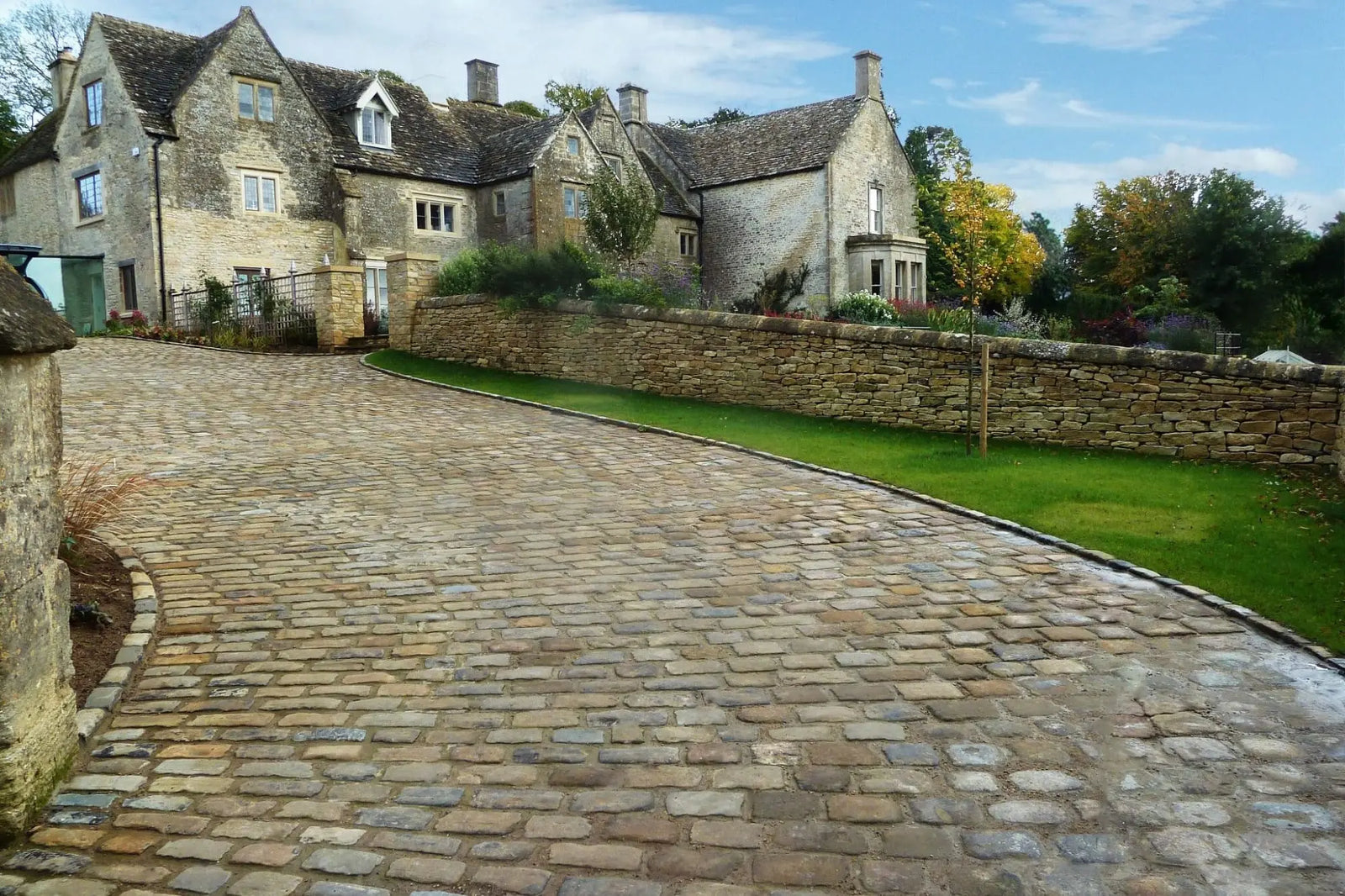
Reclaimed stone cobble tops are one of the most structurally reliable and visually distinctive paving materials available for driveways, courtyards and commercial hard-landscaping schemes. While the stone itself is exceptionally durable, long-term performance depends just as much on correct specification, ground preparation and professional installation as it does on the quality of the material.
At Britannia Stone Company, we support homeowners, landscapers, architects and developers across the UK in sourcing and installing high-grade reclaimed stone products for demanding environments. This guide explains how cobble tops should be specified and installed to ensure structural stability, visual consistency and decades of reliable service.
Understanding What Cobble Tops Are
Cobble tops are produced by cutting down original full-depth reclaimed stone setts so that only the naturally worn upper surface remains. This allows projects to benefit from the historic patina, softened edges and time-aged texture of traditional cobbles, without introducing excessive depth or unnecessary structural weight into the build-up.
Unlike modern concrete block paving, reclaimed cobble tops are natural stone products that were originally quarried for heavy-duty industrial use. Their long service history is part of their performance profile, having already survived decades of vehicle and foot traffic before being repurposed for modern paving.
For projects requiring a refined yet characterful stone surface, products such as reclaimed smooth granite cobble tops offer the perfect balance between traditional appearance and practical modern installation.
Correct Sub-Base Preparation
The sub-base is the single most important structural element of any cobble top installation. Even the best reclaimed stone will fail prematurely if laid onto an insufficient foundation.
For trafficked areas such as driveways, the ground must be excavated to an appropriate depth to accommodate a fully compacted Type 1 MOT sub-base. This should be installed in controlled layers to prevent long-term settlement. Where weaker sub-soils or clay ground conditions exist, the addition of a geotextile membrane beneath the sub-base is strongly recommended to stabilise the formation layer and prevent migration.
Where commercial vehicle loading is expected, increased sub-base depth and enhanced compaction become essential. This is particularly important for shared access routes, barn conversions and landscaped courtyard developments serving multiple properties.
Choosing the Right Bedding Method
Cobble tops can be installed using either mortar bedding or flexible sand systems, depending on the structural demands of the site.
A full mortar bed delivers maximum rigidity and is regularly specified for steep driveways, high-traffic applications and commercial environments. This method permanently locks each stone into position and provides excellent resistance to shear forces and braking loads.
Flexible sharp-sand installation is more commonly specified for domestic driveways where ground conditions are stable. This approach allows minor ground movement to be absorbed naturally within the bedding layer without cracking or surface distortion.
Where sustainable drainage regulations apply, permeable bedding structures can also be integrated, allowing surface water to infiltrate gradually rather than flowing directly into linear drainage runs.
Jointing & Structural Locking
Jointing plays a critical role in load distribution and surface stability. Mortar jointing remains the most structurally reliable option for trafficked areas and prevents lateral movement between stones under repeated load. It also produces a clean, architectural finish that suits structured driveway layouts and formal access routes.
Resin-bonded or polymeric grit joints are often selected for lighter-duty domestic schemes where flexibility and surface permeability are key requirements. While these systems offer a softer visual appearance, they must still be correctly compacted and maintained to ensure structural integrity over time.
Whichever jointing method is selected, appropriate joint width must always be maintained to accommodate seasonal movement and settlement without surface distortion.
Drainage & Surface Water Management
Although natural reclaimed stone itself is impervious to water damage, incorrect drainage will always compromise the surrounding structure over time. Standing water accelerates joint erosion, saturates bedding layers and weakens the supporting sub-base, especially during repeated freeze-thaw cycles.
Correct surface falls should be designed to direct water away from thresholds and structural foundations. Channel drainage systems and permeable jointing solutions may also be incorporated into larger schemes to manage surface run-off efficiently.
In heritage courtyards and conservation projects, cobble tops perform exceptionally well within permeable paving designs that meet modern SuDS requirements without sacrificing traditional character.
Pattern Layout & Design Application
Cobble tops provide significant design flexibility. Random coursing creates a soft, organic flow that works beautifully within rural settings and heritage landscapes. Linear banding, mixed coursed widths and framed edge detailing produce a more contemporary architectural feel suited to modern properties.
Designers frequently combine smooth granite cobble tops with reclaimed stone kerbs, York stone flags and sett borders to create visually zoned paved environments across larger landscaped areas.
For designers and contractors planning wider stone schemes, Britannia Stone’s reclaimed paving collections provide complementary materials that maintain tonal consistency and performance alignment throughout the project.
Thickness Tolerance & Professional Grading
As reclaimed materials, minor dimensional variation is entirely normal with cobble tops. Professional grading ensures thickness tolerances remain within acceptable installation limits, preventing excessive bedding compensation and reducing the risk of uneven settlement.
At Britannia Stone Company, reclaimed smooth granite cobble tops are carefully inspected prior to dispatch to confirm suitability for modern paving tolerances and expected traffic loading classifications.
This grading process is critical to ensuring installation efficiency and long-term pavement performance.
Maintenance & Long-Term Performance
One of the principal advantages of reclaimed stone is its exceptionally low maintenance demand. Unlike concrete alternatives that fade, chip and chemically degrade, natural stone cobble tops remain visually stable for several decades.
Routine aftercare normally consists of occasional pressure washing, light joint top-ups where required, and standard weed management if permeable jointing has been used. Where oil exposure is likely, breathable sealers can be applied if desired, although many clients choose to allow natural ageing to enhance visual warmth over time.
Why Professional Specification Matters
Incorrect stone selection, inadequate groundwork preparation and poorly detailed jointing remain the most common causes of pavement failure. Cobble tops should always be sourced from a specialist reclaimed stone supplier with full understanding of grading tolerance, load classification and material behaviour.
At Britannia Stone Company, we provide technical support on stone selection, installation build-ups and project-specific performance requirements for both domestic and commercial paving projects.
Final Thoughts
Reclaimed stone cobble tops deliver exceptional longevity, structural reliability and visual depth when properly specified and professionally installed. Their ability to combine genuine historic surface character with modern construction performance makes them one of the most versatile paving materials available in the UK today.
With correct sub-base construction, suitable bedding selection and professional grading, cobble tops will continue to perform flawlessly for generations.