 Get Listed
Sign In

CAN Bus Explained Part 2
29/07/2026
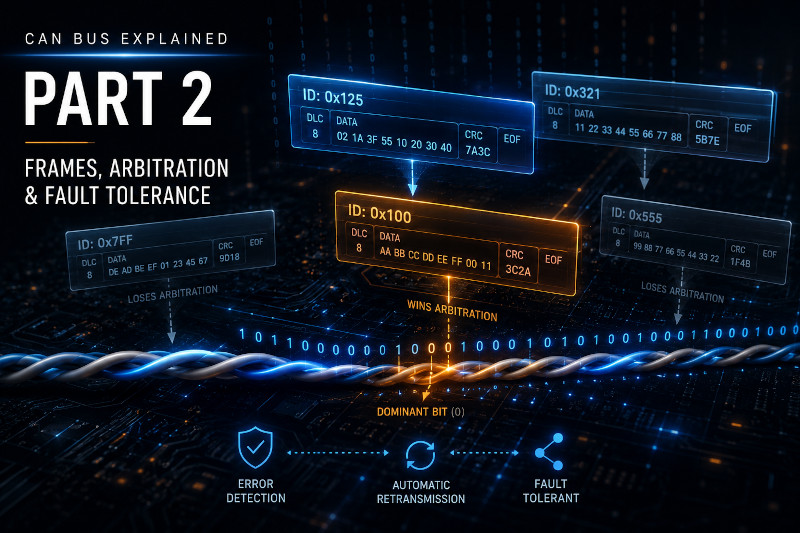
The second part of the CAN Bus series moves from the physical layer to the protocol itself, explaining how messages are structured and how several nodes can share the same bus without conventional collisions.
CAN uses data frames with standard or extended identifiers, while non-destructive bitwise arbitration allows the highest-priority message to continue when two nodes begin transmitting together. Lower numerical identifiers receive higher priority, making identifier planning an important part of network design.
The article also covers bit timing, bit stuffing and the protocol’s layered approach to fault handling. CRC checks, bit monitoring, retransmission and fault confinement work together to make CAN dependable in electrically noisy and safety-critical environments.
CAN uses data frames with standard or extended identifiers, while non-destructive bitwise arbitration allows the highest-priority message to continue when two nodes begin transmitting together. Lower numerical identifiers receive higher priority, making identifier planning an important part of network design.
The article also covers bit timing, bit stuffing and the protocol’s layered approach to fault handling. CRC checks, bit monitoring, retransmission and fault confinement work together to make CAN dependable in electrically noisy and safety-critical environments.
For more information on CAN Bus Explained Part 2 talk to Kanda
Welcome back to FindTheNeedle.
Not registered? Get listed — most visitors don't have an account yet.
List your company on FindTheNeedle.