 Get Listed


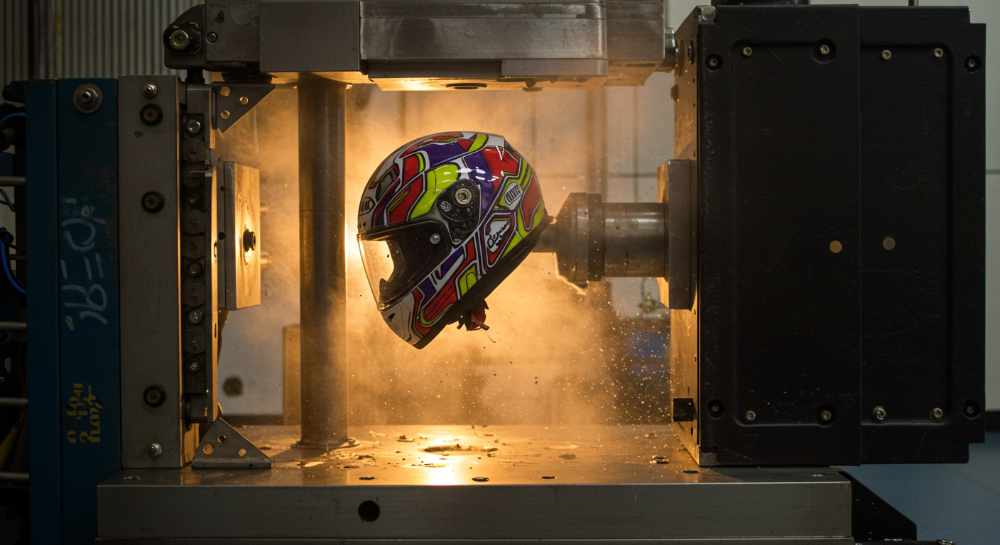
When it comes to head protection, the stakes couldn’t be higher. Traditional helmet testing methods—using drop tests and accelerometers—measure peak acceleration forces during an impact.
While this provides valuable safety data, it doesn’t reveal how those forces are distributed across the head. A helmet might pass certification while still allowing dangerous localised pressure “hot spots” that increase the risk of injury.
This is where pressure mapping comes in. By capturing detailed pressure distribution inside the helmet during impact, manufacturers gain a deeper understanding of how their designs perform—far beyond the limits of standard testing.
Going Beyond Traditional Testing
Conventional certification standards for helmets—whether bicycle or motorcycle—focus on criteria such as peak headform acceleration, chinstrap strength, penetration resistance, and roll-off stability. While effective, these tests often provide only part of the picture.
Pressure mapping, using systems such as the XSensor High Speed (HS) Impact System combined with thin, conformable sensor arrays, allows engineers to measure:
- Peak and mean pressure across the headform surface.
- Contact area and movement of high-pressure zones.
- Pressure gradients, which can indicate areas of concentrated load.
- Pressure-time integrals, showing cumulative load during impact.
The result is precise, high-resolution data that highlights how impact energy is distributed—and where helmet designs can be improved.
Testing Bicycle vs Motorcycle Helmets
Bicycle Helmets
Standards such as CPSC (USA), EN 1078 (Europe), and AS/NZS 2063 (Australia/New Zealand) require impact testing at lower velocities (around 5–6 m/s). Tests include drop impacts onto flat, hemispherical, or kerbstone anvils, as well as retention and roll-off checks.
While these methods set minimum safety requirements, pressure mapping provides an extra layer of insight—helping designers reduce concentrated load points, improve liner optimisation, and enhance comfort.
Motorcycle Helmets
Motorcycle helmets are subject to more demanding standards, including DOT FMVSS 218 (USA), ECE 22.06 (Europe and beyond), Snell M2020, and JIS T 8133 (Japan). These involve higher-energy impacts (7–8 m/s), penetration tests, multiple impact sites, rotational impact studies, and environmental conditioning (hot, cold, wet).
Here, pressure mapping demonstrates particular value, as it can reveal localised high-pressure zones even when overall acceleration readings remain within limits. This is especially relevant in modern rotational injury studies and for validating computational helmet models.
Global Standards Snapshot
Helmet manufacturers face a wide landscape of safety regulations:
- CPSC (USA) – mandatory for all bicycle helmets sold in the U.S.
- EN 1078 (Europe) – covers bicycles, skateboards, and roller skates.
- AS/NZS 2063 (Australia/NZ) – generally more stringent.
- DOT FMVSS 218 (USA) – self-certified motorcycle helmet standard.
- ECE 22.06 (Europe/International) – includes oblique/rotational testing.
- Snell Standards (Voluntary) – stricter impact and penetration criteria.
- FIM Racing Homologation – for professional racing, includes advanced rotational and environmental tests.
Pressure mapping is not yet mandated by these standards, but it is rapidly becoming a critical tool in R&D for manufacturers seeking competitive advantage in safety, performance, and rider comfort and ultimately and most importantly rider safety.
Why Manufacturers Should Adopt Pressure Mapping
For helmet makers, the benefits are clear:
- Better product differentiation through enhanced safety and comfort.
- Faster R&D cycles, with accurate data guiding design refinements.
- Improved confidence when validating helmets against global standards.
- Insight into rotational and localised impact behaviour that traditional methods cannot provide.
By integrating XSensor’s HS Impact System and flexible, durable sensor mats into their testing process, manufacturers can push beyond compliance and towards innovation—delivering helmets that not only pass certification, but also provide superior protection where it matters most.
Helmet testing pressure mapping – find out more
For more information on Pressure Mapping: Transforming Helmet Impact Testing for Manufacturers talk to Interface Force Measurements Ltd