 Get Listed


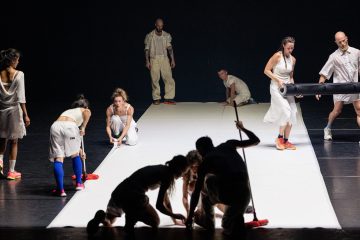
Backstage at the Théâtre de la Ville in Paris, we met choreographer, Emanuel Gat, shortly after the premiere of Freedom Sonata. A chance to discuss his creative vision, his collaboration with dancers and the importance of performing on a Harlequin dance floor.
Where Music Meets Movement
Emanuel Gat began his career in music, later turning his attention to choreography. He discovered dance by chance during an amateur workshop, and very quickly felt at home. He joined a company and realised that his true passion was not in performing, but in creating, which sparked a lifelong devotion to choreography.
Freedom Sonata: A Stage in Motion
In Freedom Sonata, Emanuel Gat delivers a piece where roles are inverted and the dance floor itself becomes a choreographic partner.
Physically demanding, Freedom Sonata keeps dancers on stage for 80 minutes in a continuous flow of motion. No two performances are the same, as the piece evolves nightly, shaped by the chemistry between the dancers.
Emanuel Gat explained: “There’s a real connection between the dancers and the audience. At times, the dancers even step off the stage and move into the auditorium, inhabiting the space typically reserved for spectators.”
Choreography That Keeps Changing
Freedom Sonata is the latest example of Emanuel Gat’s evolving approach to choreography. As early as 2013, during Montpellier Danse, he began opening rehearsals to the public, questioning the very definition of a finished piece. Is the work found in the process? The rehearsal? The performance?
Since its June debut, Emanuel says that Freedom Sonata has evolved by 70%. He adds: “In choreography, you can’t create a finished object. It’s not a painting or a film.”
Each Freedom Sonata performance becomes a one-off show, a dialogue between the dancers, audience and space.
The Dance Floor as Co-Creator
The dance floor plays a pivotal role in Freedom Sonata. Over the course of the performance, the dancers gradually lay down rolls of Harlequin Reversible performance vinyl floor on top of the existing surface. This action becomes a choreographic gesture in itself, transforming the stage from black to white, mirrored by a costume shift from white to black.
Emanuel said: “What interests me is the human side of action, how a stage transitions from one state to another.”
The dancers faced the technical challenge of mastering the art of laying the Harlequin Reversible vinyl floor smoothly and efficiently. Emanuel Gat emphasised how essential a Harlequin floor is to enable dancers to move both effortlessly and safely. He explained: “Dancers are highly sensitive to the surface beneath them. It’s our primary tool, alongside the body. Texture, rebound and glide all matter enormously.
“The dancers got so good at it, they were laying the floor faster and more efficiently than the technicians!”
Following the recent staging of Freedom Sonata at the Festspielhaus Bregenz on 3 May, Emanuel Gat’s work returns to the stage with LOVETRAIN2020, set to appear at the Tanec Praha Festival in Prague on 26 June.
For more information on Emanuel Gat’s Freedom Sonata at the Théâtre de la Ville in Paris talk to Harlequin Floors (British Harlequin plc)