 Get Listed

Kevlar Cabling in Radio Earpieces Explained
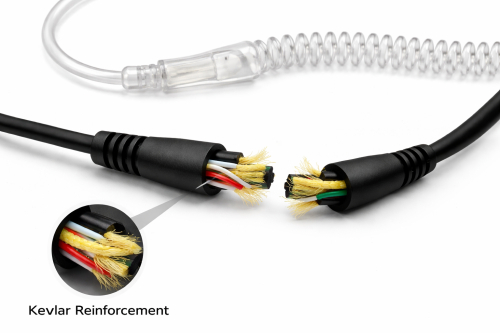
When you rely on a two-way radio for your daily work, the weakest link in your communication setup is rarely the radio itself. It is almost always the wiring. Earpiece cables catch on door handles, get crushed under heavy protective vests, and undergo constant stretching during long shifts. Basic rubber and copper wires simply cannot withstand this level of daily abuse.
This is where advanced materials step in to solve a widespread problem. Kevlar cabling has transformed the way manufacturers design tactical and covert audio accessories. By borrowing technology from the aerospace and body armour industries, designers have created communication lines that can survive intense physical stress.
This guide explains exactly what Kevlar cabling is, how it protects internal wiring, and why it has become an essential feature for professionals working in security, event management, and emergency services.
The importance of durability in professional radio communications
Standard cables fail rapidly due to repetitive stress. When a security professional turns their head hundreds of times a day, the copper wires inside their earpiece experience constant bending. Over time, this repetitive motion causes metal fatigue. The copper strands become brittle, fray, and eventually snap, leading to crackling audio or a total loss of signal.
Equipment failure is not an option when personal safety is on the line. You need to know that your requests for backup will transmit clearly and that incoming instructions will not cut out at a critical moment. Replacing broken earpieces every few weeks is also a frustrating and costly exercise for businesses managing large teams.
To combat these issues, manufacturers began looking for ways to reinforce the fragile audio cables without making them bulky or uncomfortable. The solution was found in synthetic polymer fibres, specifically Kevlar, which could be integrated directly into the wire's internal structure.
What is Kevlar cabling?
Kevlar is a heat-resistant, immensely strong synthetic fibre. Best known for its use in ballistic body armour, it boasts a tensile strength-to-weight ratio roughly five times greater than steel.
When applied to communication devices, Kevlar cabling refers to earpiece wires that feature these synthetic fibres woven directly into their core. Rather than just coating copper wires in a thick layer of rubber or plastic, manufacturers run Kevlar strands alongside the fragile electrical conductors.
A prime example of this technology in action is the Good Quality Motorola Covert 2-Pin Earpiece. This specific acoustic tube setup features Kevlar cabling running directly through the wire. This internal reinforcement acts as a physical shock absorber. When the cable gets pulled or snagged, the immense strength of the synthetic fibre takes the brunt of the force, completely protecting the delicate copper wiring inside.
Strength and longevity: Preventing internal wire breakage
The primary job of Kevlar in an earpiece is to prevent snapping under tension. You might accidentally drop your radio, leaving it dangling by the earpiece cable. A standard wire would likely tear internally under the weight of the radio battery. A Kevlar-reinforced cable easily supports the sudden weight, preventing a frustrating breakage.
This structural support also helps with the daily wear and tear of storing the device. People tightly wrap cords around their radios at the end of a shift. This creates sharp bends and pressure points that quickly destroy standard cables. The synthetic fibre core provides a level of stiffness and memory that helps prevent these extreme pinches.
Ultimately, this translates to longevity. An earpiece reinforced with this material will significantly outlast a standard PVC-coated alternative, providing excellent value for money and reliable performance in the field.
The professional benefits of 220-strand Kevlar coatings
For extreme environments, some earpieces utilise highly advanced construction, such as 220-strand Kevlar coatings. This means the protective layer consists of hundreds of microscopic synthetic fibres woven tightly together around the audio cables.
This density offers exceptional resilience against abrasion. Security and tactical officers often wear heavy vests equipped with rigid plastic clips, metal zips, and abrasive Velcro patches. When a cable routes through this gear, the constant friction can chew through standard resin coatings in a matter of days.
High-strand Kevlar coatings easily resist this friction. The dense fibre weave acts as a microscopic shield, ensuring the internal wires remain completely isolated from the harsh external environment. This level of engineering is crucial for high-stakes environments where officers simply cannot afford to look down and check if their equipment is still intact.
Balancing comfort and discretion
One of the greatest challenges in earpiece design is making a cable tough without making it thick. Covert operations require gear that blends into clothing and remains unnoticed by the public. Thick, heavy cables are difficult to hide under a shirt and restrict natural movement.
Kevlar allows manufacturers to strike the perfect balance. Because the fibre is so incredibly strong, designers can use very little of it to achieve the required durability. This means the overall diameter of the cable remains exceptionally thin.
These super-thin, Kevlar-reinforced wires are nearly invisible when routed correctly under clothing or behind the ear. Furthermore, the material remains highly flexible. Softness against the skin is a vital factor for personnel working 12-hour shifts. Stiff, unyielding cables cause chafing and discomfort around the neck and ear. Kevlar-reinforced cables remain supple and comfortable, moving naturally with the wearer's body without applying irritating tension to the ear canal.
Kevlar and braided fibre vs standard air tube earpieces
The market offers many different styles of earpieces, and it helps to understand how advanced materials compare to standard options.
Many standard acoustic air tube earpieces use basic, unreinforced PVC wiring connecting the radio to the push-to-talk (PTT) microphone. While the clear acoustic tube provides excellent discretion, the lower wiring often lets the product down. Basic rubber easily degrades when exposed to sweat, body oils, and extreme weather, eventually hardening and cracking.
Upgrading to an earpiece with resin-coated wires and Kevlar reinforcement solves this problem entirely. The resin coating provides superior waterproofing and chemical resistance, while the internal fibre core handles all physical stress.
For even greater protection, some high-end setups encase the Kevlar-reinforced wire inside a braided fibre cloth jacket. Braided nylon cloth provides an extra layer of defence against cutting and friction. It also prevents the cable from catching on clothing, allowing it to slide smoothly across fabric as the wearer moves. While a standard air tube earpiece might last a few months under heavy use, an earpiece featuring Kevlar cabling and a braided outer layer is built to survive years of demanding service.
Investing in reliable gear for the field
Purchasing communication equipment is an investment in safety and operational efficiency. Choosing cheap, unreinforced earpieces almost always results in a false economy, as the frequent replacement costs quickly add up. Furthermore, the operational downtime caused by failing equipment can cause serious disruptions during live events or security patrols.
By selecting products engineered with internal strength, you eliminate one of the most common points of failure in radio communication. The Good Quality Motorola Covert 2-Pin Earpiece demonstrates how Kevlar cabling dramatically improves the lifespan of acoustic tube designs, offering clear audio without the constant fear of wire damage.
When you need to know your equipment will perform reliably from the start of your shift to the very end, Kevlar-reinforced wiring is an absolute necessity. Choose gear that works as hard as you do, and enjoy the peace of mind that comes with unbreakable communication lines.
For more information on Kevlar Cabling in Radio Earpieces Explained talk to Earpieceonline