 Get Listed

7th August 2026
The number of DC fast charging (DCFC) systems being installed is expanding rapidly, alongside the worldwide demand for Electric Vehicles. DCFC systems convert three-phase AC power into high-voltage DC for vehicle batteries. Capacitors are vital to that process, providing energy storage, filtering, voltage stability, ripple current handling and switching protection.
In basic terms – DC capacitors enhance the efficiency of the systems by reducing loss of power and enhancing overall performance. Suppressing voltage oscillations and minimising both energy loss and heat generation all adds to an overall more economic and environmentally friendly solution – as it means less energy is lost through conversion or heat, so more energy is put into charging the car.
Capacitors perform six core functions:
EMI Filtering: X and Y safety capacitors, rated for 500+ Vrms, suppress conducted noise at the grid interface.
PFC Bus Stabilisation: Capacitors maintain a steady 650-800 VDC link and absorb switching ripple from the rectifier.
DC Link Ripple Handling: Between stages, capacitors absorb high ripple currents; in DCFC, this is the dominant design constraint.
Resonant Tank Operation: Stable, low-loss capacitors support LLC/CLLC converter performance across frequency and temperature.
Output Filtering: Low-ESR capacitors smooth the final DC delivered to the battery.
Snubbing and Protection: High-voltage capacitors suppress switching transients from SiC and GaN devices.
Selecting capacitors for DC fast charging (DCFC) applications requires evaluating key electrical and thermal parameters such as:
Voltage rating - Must exceed the maximum peak DC bus voltage with a safety margin (e.g., ≥ 1200VDC for 800V architecture systems) to prevent dielectric breakdown during high transients.
Equivalent Series Resistance (ESR) & Inductance (ESL) - Ultra-low ESR and low ESL minimise power losses and suppress dangerous voltage spikes during rapid SiC or GaN semiconductor switching
Ripple current - (High RMS current capability is mandatory to handle high-frequency switching and grid-frequency ripples without excessive internal self-heating)
Thermal performance - to afford long operating hours under continuous load and often located outside with fluctuating temperatures.
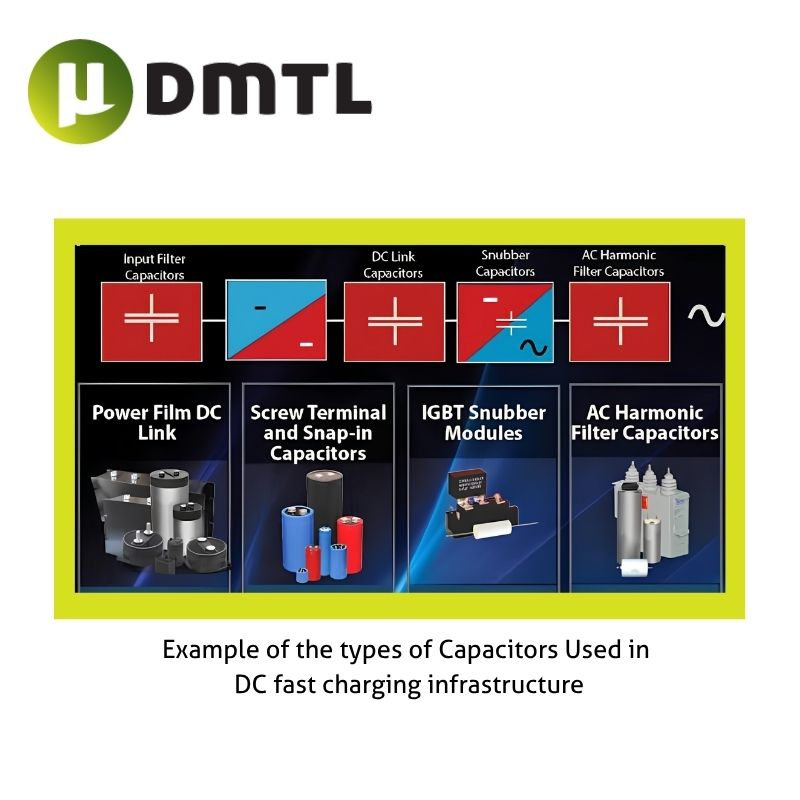
Example of the types of Capacitors Used in DC fast charging infrastructure:
Film Capacitors:
Metallised Polypropylene film offer ultra-low equivalent series resistance (ESR) and equivalent series inductance (ESL)
High-voltage stability: Rated from 500VDC up to 1200VDC to match 400V to 800V fast charging architecture.
Snubber types placed across semiconductors to suppress dangerous voltage overshoots and transient spikes.
Aluminium Electrolytic Capacitors:
High Bulk Capacitance: Applied on input filter and primary DC-bus stages to handle bulk energy storage and smooth out low-frequency rectification ripple
Cost-Effective Density: Provides high capacitance per unit volume at lower cost thresholds compared to film technologies, though with a shorter operational lifespan
High Ripple Current Handling: Specialised screw-terminal or snap-in types are engineered to tolerate heavy continuous ripple currents at elevated internal temperatures
Ceramic Capacitors (Filtering & High-Frequency Decoupling)
Multilayer Ceramic (MLCC): Employed for high-frequency noise suppression, electromagnetic interference (EMI) mitigation and precise decoupling near control ICs.
Advanced Dielectrics: Specialised formulations like PLZT help maintain stable capacitance under heavy DC bias voltage constraints.
To talk to our experienced team about your requirements and what products would be best for your application from our portfolio of capacitor manufacturers, click the button below, email email info@dmtl.co.uk or call us on +44 (0) 1276 33391
For more information on Selecting capacitors for DC Fast Charging applications talk to DMTL Ltd