 Get Listed


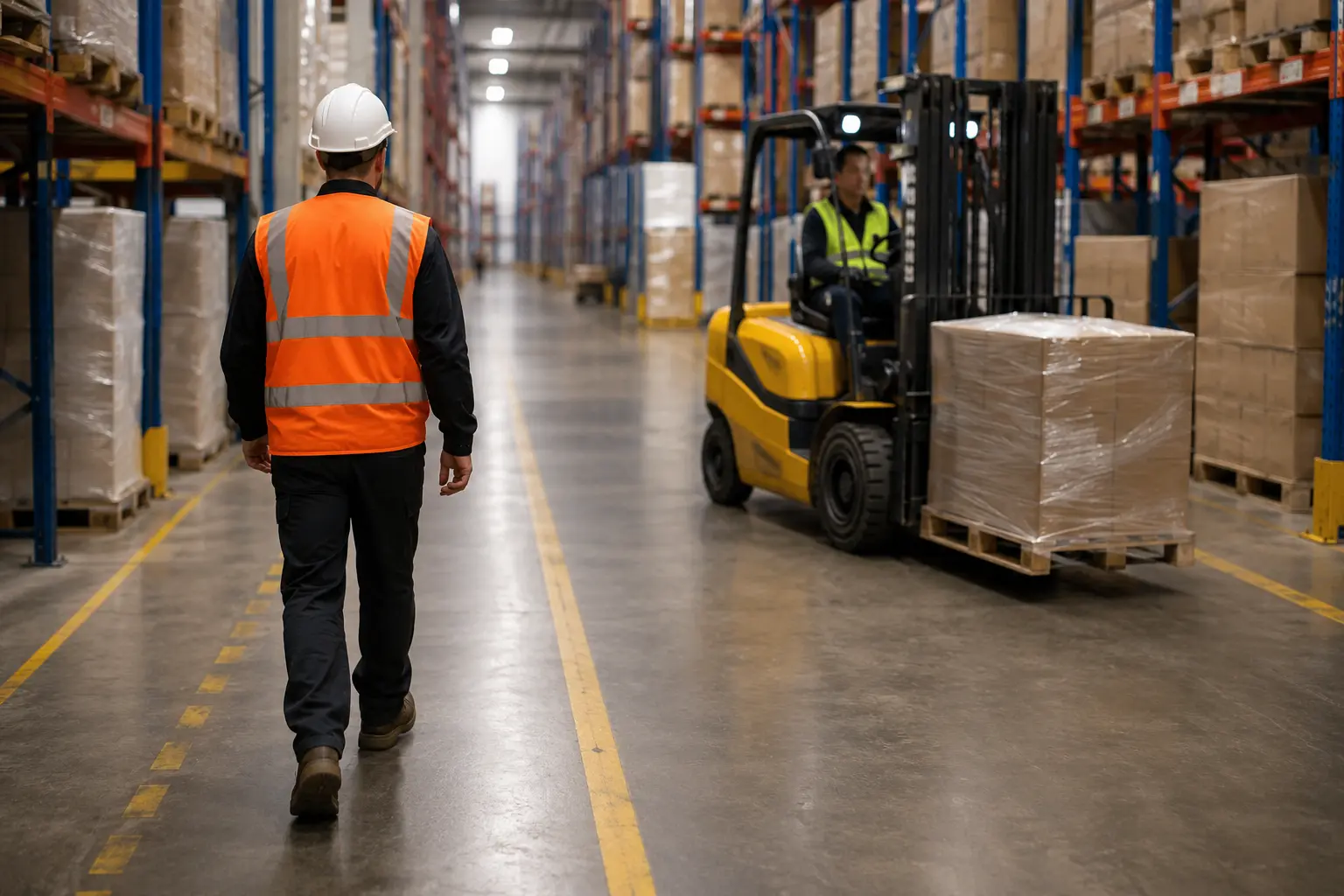
Keeping people safe in a busy warehouse requires careful planning.
Moving vehicles and pedestrians often share the same spaces, which creates a high risk of accidents. Forklift pedestrian safety is therefore an important part of any warehouse safety strategy.
At Billington Safety Systems, we understand the challenges involved in creating safe, secure working environments. This guide explains how to lay out safety barriers effectively, helping you separate traffic, protect staff and reduce the risk of accidents.
Understanding warehouse traffic management
Industrial workplace safety depends on clear rules and well-planned routes.
Forklift traffic management involves directing vehicles and pedestrians safely through the workplace. Walking staff are vulnerable in areas where heavy machinery is operating, particularly when forklifts are moving quickly or carrying large loads.
Good planning keeps these two groups apart.
This proactive approach helps prevent forklift collisions in warehouses and supports a safer working environment for everyone on site.
The risks of poor pedestrian safety around forklifts
Failing to separate pedestrians and forklifts in warehouses can lead to serious consequences.
Forklift pedestrian accidents can cause severe injuries, costly disruption and long-term operational problems.
A lack of clear boundaries creates confusion. Workers may step into the wrong area, while drivers may not see someone approaching a corner or crossing a route unexpectedly.
Without a clear forklift traffic management plan, a facility remains exposed to avoidable risk.
Preventing forklift accidents should therefore be a priority for every operations manager.
Comparing safety solutions: painted lines vs physical barriers
Many facilities try to save money by painting lines on the floor.
While painted markings can help indicate routes, they do not provide physical protection. For higher-risk areas, physical barriers are the safer and more reliable option.
Painted lines
Painted lines offer limited visibility and no physical protection.
They also require regular repainting, especially in busy warehouses where surfaces are exposed to vehicle movement, foot traffic and cleaning.
Most importantly, painted lines have no stopping power.
Physical barriers
Physical barriers provide a clear, visible boundary and can physically protect pedestrians from moving vehicles.
They require minimal maintenance and offer high impact resistance, making them a far more effective option for separating forklifts from walking routes.
Steps to lay out your safety barriers
Improving warehouse pedestrian safety requires a logical approach.
The following steps can help you plan a safer, more effective layout.
1. Conduct a warehouse risk assessment
Start by mapping out the entire floor plan.
Identify areas where pedestrians and vehicles cross paths, paying particular attention to doorways, junctions and blind corners.
These are high-risk zones and should be reviewed carefully.
2. Designate pedestrian walkways
Create dedicated pedestrian walkways that warehouse staff can use safely.
These routes should lead from entrances to key work areas and connect clearly with warehouse offices.
Wherever possible, pedestrian walkways should be kept entirely separate from vehicle lanes.
3. Install industrial safety barriers
Place strong, reliable safety barriers along the edges of pedestrian routes.
These barriers should physically stop or deflect a moving vehicle, helping to protect staff from forklift impacts.
High-visibility colours are also recommended, as they clearly mark the boundary for forklift operators.
4. Create pedestrian exclusion zones
Some areas are simply too dangerous for walking staff.
Define clear pedestrian exclusion zones where only vehicles or authorised equipment are allowed.
Mesh partitioning can be used to enclose active robotic areas, heavy lifting zones or other high-risk operational spaces.
5. Secure machinery and storage areas
A good layout should also protect static equipment.
Machine guarding can help shield valuable assets from accidental vehicle impacts, reducing damage and downtime.
Further guidance is available in Billington’s detailed guides on what safety fencing can be used for.
A practical example: loading bay safety
A standard loading bay is a common high-risk area.
Delivery drivers may step out of their vehicles while forklifts are loading or unloading pallets. This creates a serious hazard because pedestrians and forklifts are working in the same space.
One solution is to install a designated driver waiting cage.
The driver remains safe inside the enclosure while the forklift operator completes the loading process without having to manage unexpected foot traffic.
This simple layout change can significantly improve loading bay safety.
Common mistakes in warehouse safety
Many facilities make similar layout errors.
Avoiding these common mistakes is essential for improving forklift and pedestrian safety.
Ignoring blind spots
Stacking goods too high near walkways can block visibility and make it harder for drivers and pedestrians to see each other.
Overcrowding spaces
Forcing pedestrians and forklift drivers through narrow aisles increases the chance of accidents and near misses.
Relying only on signs
Warehouse safety signs are helpful, but they do not physically stop a heavy vehicle.
Signs should support a wider safety system, not replace physical protection.
Skipping training
Forklift safety training for warehouse staff is essential.
Everyone on site should understand the layout, the rules and the importance of keeping pedestrian routes and vehicle lanes separate.
Final thoughts on workplace safety
Warehouse health and safety requires constant attention.
The challenge of pedestrians and forklifts sharing the same working environment can be managed with the right layout, clear rules and suitable physical protection.
A well-planned barrier system helps protect your team, reduce risk and keep operations running smoothly.
Key takeaways
Always separate walking routes from vehicle lanes.
Use physical barriers rather than relying only on painted lines.
Enforce strict pedestrian exclusion zones where required.
Train all staff on forklift safety rules.
Review your layout regularly so it continues to suit the way your warehouse operates.
For more information on Pedestrians vs Forklifts: How to Safely Layout Industrial Barriers talk to Billington Safety Systems Ltd