 Get Listed
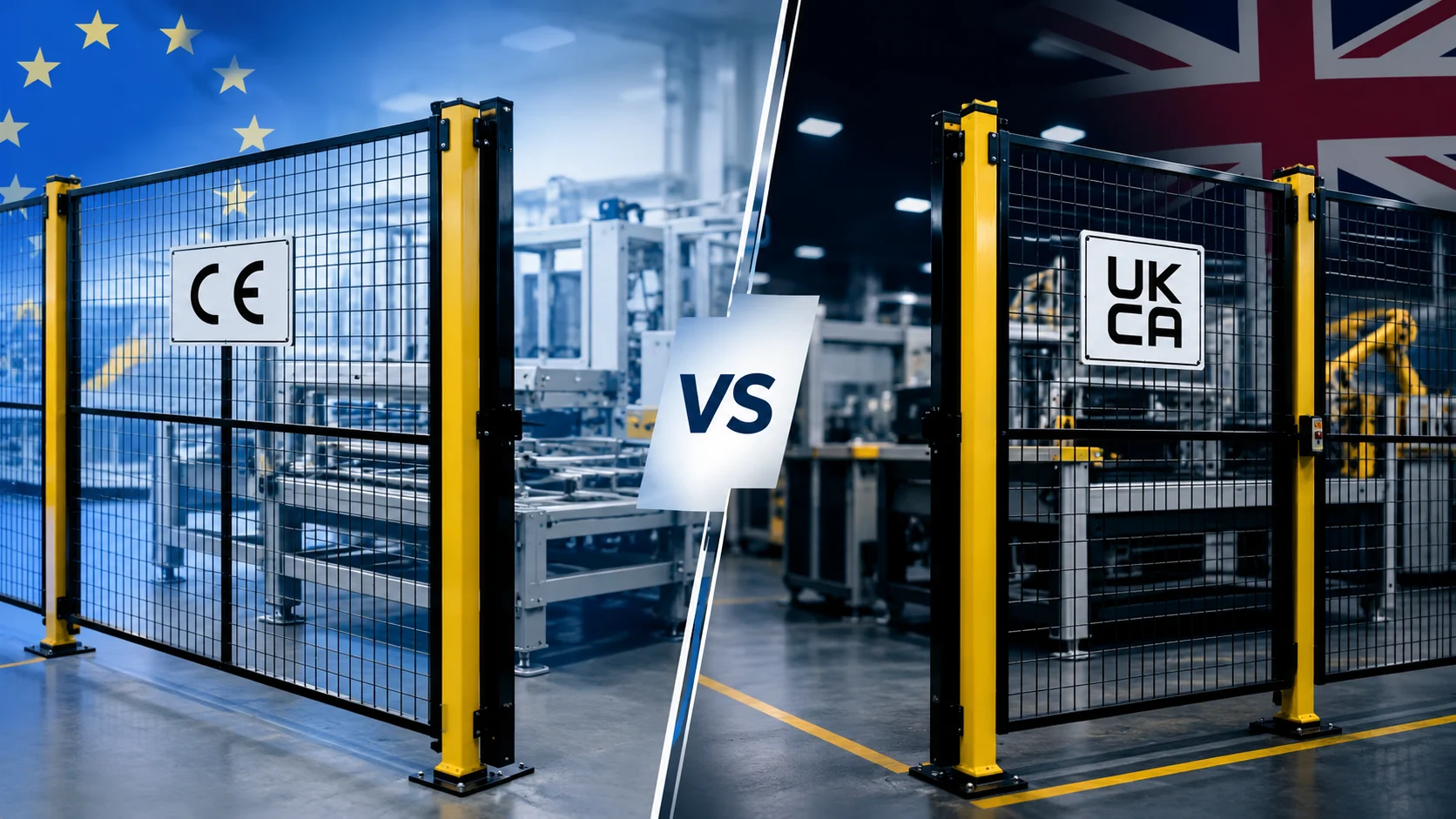
CE Marking vs UKCA Marking
A practical guide to post-Brexit compliance for machine safety fencing and industrial guarding
If you supply or install machine safety fencing, machinery guards or industrial partitioning in the UK, the question of which product marking applies is more than a technical formality.
It directly affects whether your products can legally be placed on the market. Getting it wrong can lead to costly recalls, enforcement action or loss of market access.
This guide explains what CE and UKCA marking mean, how they differ, which marking may apply to your situation, and what the current rules mean for businesses operating in Great Britain in 2026.
What is CE marking?
CE marking stands for Conformité Européenne, which translates as European Conformity.
When a product carries the CE mark, it shows that the manufacturer has assessed it against the relevant EU directives and regulations, and that it meets the required safety, health and environmental standards.
The CE mark is mandatory for a wide range of product categories placed on the market within the European Economic Area. These include machinery, personal protective equipment, low-voltage electrical equipment, pressure vessels, radio equipment and other regulated products.
For machinery, compliance is governed by the EU Machinery Directive, which sets out the essential health and safety requirements that relevant equipment must satisfy.
It is important to note that CE marking is not a quality endorsement or a guarantee of superior performance. It is a manufacturer’s declaration that the product meets the minimum legal requirements for placement on the EEA market.
The mark itself does not automatically mean that a third party has tested or approved the product, although higher-risk categories do require independent conformity assessment by a recognised Notified Body.
What is UKCA marking?
UKCA stands for UK Conformity Assessed.
It was introduced following the UK’s departure from the European Union and became law on 31 December 2020 as part of the post-Brexit regulatory framework.
The UKCA mark applies to products placed on the market in Great Britain, meaning England, Scotland and Wales.
It was designed to mirror CE marking in terms of scope and process, covering the same broad categories of regulated products. The underlying technical standards were largely adopted from EU standards when the scheme was launched, which means many of the requirements remain very similar on paper.
One important distinction is that UKCA marking does not apply to Northern Ireland.
Under the terms of the Northern Ireland Protocol, products sold in Northern Ireland must continue to carry the CE mark, as that market remains aligned with EU single market rules.
Why this matters for machine safety fencing
For anyone supplying or installing machine guarding and industrial safety systems in the UK, product marking is a core compliance issue.
Safety fencing, modular machine guarding systems and machinery guards installed in UK manufacturing or warehousing environments are subject to the UK Supply of Machinery (Safety) Regulations.
These regulations set out essential safety requirements for machinery and guarding systems, and require relevant equipment to carry the appropriate conformity marking before being placed on the market.
If your guarding system is imported from an EU supplier with a CE mark, whether that mark remains valid in the UK is a practical question affecting purchasing decisions, compliance documentation and liability.
The current position: CE or UKCA in 2026?
This is where many businesses are understandably confused, as the rules have changed more than once since 2021.
The original plan was to phase out CE marking in Great Britain entirely, requiring all relevant products to carry the UKCA mark from a set deadline.
However, on 1 August 2023, the UK Government reversed course. It announced that CE marking would continue to be recognised indefinitely in Great Britain across 21 product regulation areas, covering the vast majority of consumer and industrial goods, including machinery and PPE.
This means that, as of 2026, manufacturers and suppliers generally have a genuine choice for most product categories.
A product carrying a valid CE mark can legally be placed on the Great Britain market. Businesses do not need to obtain a separate UKCA mark if the product already meets CE requirements, provided the relevant regulation is covered by the indefinite recognition policy.
The UKCA mark remains fully valid and can still be used voluntarily.
For businesses manufacturing exclusively for the UK market with no need to export to the EU, pursuing UKCA certification may still make sense. However, for most businesses trading across both markets, CE marking is usually the more practical route.
CE vs UKCA at a glance
CE marking applies to the EU and EEA markets, while UKCA marking applies to Great Britain: England, Scotland and Wales.
For Northern Ireland, CE marking is required and UKCA marking is not valid.
CE marking is part of a long-established EU framework. UKCA marking was introduced on 1 January 2021 following Brexit.
CE marking is based on EU Harmonised Standards. UKCA marking uses UK Designated Standards, which were initially aligned with EU standards.
Where third-party assessment is required, CE marking must involve an EU Notified Body. UKCA marking must involve a UK Approved Body.
In Great Britain, CE marking is currently accepted indefinitely for most goods. UKCA marking remains voluntary for most goods, but is still fully valid.
For export to the EU, CE marking is required. UKCA marking is not accepted for EU market access.
How the conformity process works
Whether pursuing CE or UKCA marking, the process follows a broadly similar structure.
Understanding each step helps businesses plan for compliance without unnecessary delays.
Step 1: Identify the applicable regulations
Start by confirming which legislation applies to your product.
For machine safety fencing and industrial guarding, this is typically the UK Supply of Machinery (Safety) Regulations for UKCA, or the EU Machinery Directive for CE marking.
Your product may also fall under additional regulations depending on its specific features.
Step 2: Assess the risk and conformity route
Next, determine whether your product can be self-declared as compliant or whether it requires third-party assessment.
Higher-risk machinery and guarding systems often require independent testing.
For UKCA marking, this must be carried out by a UK Approved Body. For CE marking, an EU Notified Body is required.
Step 3: Compile technical documentation
Both routes require a technical file demonstrating how the product meets the relevant essential requirements.
This will typically include design drawings, risk assessments, test reports and a Declaration of Conformity.
Step 4: Apply the mark
Once conformity has been established and documented, the relevant mark can be applied to the product.
The UKCA mark must be at least 5mm high, clearly visible, legible and permanently attached.
Step 5: Maintain your documentation
Compliance is not a one-off exercise.
Regulations can change, and documentation must remain current and accurate throughout the product’s market life.
What happens if UK and EU standards begin to diverge?
At present, UK and EU technical standards remain closely aligned because the UK adopted existing EU standards when it left the European Union.
However, the UK now has the freedom to amend its standards independently. Over time, there is a real possibility that differences may emerge.
For businesses relying on a single CE-marked product to serve both the GB and EU markets, this should be monitored closely.
If the UK introduces requirements that differ from the EU Machinery Directive, a product designed only to CE standards may eventually fall short of UK requirements, and the reverse may also apply.
Compliance documentation should be reviewed whenever UK standards are updated, particularly for categories such as machinery and guarding systems where technical requirements can be detailed.
Practical examples for UK manufacturers
UK manufacturer supplying only the domestic market
A fabricator producing safety barriers and machine guarding panels exclusively for UK customers can currently choose between CE and UKCA marking, as both are accepted in Great Britain.
If the business has no intention of exporting to the EU, investing in UKCA certification may simplify future compliance if standards eventually diverge.
EU supplier selling into the UK
A European manufacturer supplying mesh partitioning or machine enclosures to UK buyers can continue placing CE-marked products on the GB market without needing UKCA certification, under the current indefinite recognition policy.
Manufacturer selling to both UK and EU customers
A business supplying industrial partitioning across both markets must ensure CE marking for EU sales.
Because CE marking is also accepted in Great Britain, maintaining a single CE-marked product range is usually the most practical approach. This avoids the cost and administrative effort of dual certification for most product lines.
Common mistakes to avoid
It is easy to misread or oversimplify the current rules, especially given how often the policy has changed.
Assuming UKCA is now mandatory in the UK
UKCA marking is not currently mandatory for most products in Great Britain.
CE marking is accepted indefinitely in Great Britain for the vast majority of regulated product categories, including machinery and safety guarding systems.
Forgetting that Northern Ireland is different
UKCA marking is not valid in Northern Ireland.
Products sold there must carry the CE mark, even if customers elsewhere in the UK accept UKCA-marked goods.
Using a UK Approved Body for CE marking
UK-based conformity assessment bodies are no longer authorised to carry out CE mark assessments for EU market placement.
If CE marking is needed for EU export, the assessment must be carried out by an EU-recognised Notified Body.
Neglecting documentation
Carrying the correct mark is not enough without the supporting technical file and Declaration of Conformity.
Both are required, and the documentation must align with the applicable regulations of the target market.
Assuming standards will never diverge
The UK has the legislative freedom to update its standards independently.
Businesses that treat compliance as a completed task rather than an ongoing obligation risk falling behind if technical requirements change.
How Billington Safety Systems can help
Billington Safety Systems supplies and installs machine guarding, safety fencing and industrial partitioning solutions built to meet UK compliance requirements.
Whether you are specifying a new installation, reviewing an existing set-up or simply trying to understand what applies to your facility, the team can help you make sense of your obligations.
If you are unsure whether your current guarding set-up meets the latest regulatory requirements, or if you are planning a new installation and want to get compliance right from the start, get in touch with the Billington Safety Systems team.
They can help you understand your responsibilities and find the right solution for your site.
Contact Billington Safety Systems today to discuss your machine guarding and safety fencing requirements.
For more information on CE Marking vs UKCA Marking talk to Billington Safety Systems Ltd