 Get Listed


Water quality monitoring, air quality analysis and recycling sorting may appear to be very different applications, but they share one important requirement: reliable optoelectronic technology.
The instruments used across these sectors depend on spectrometers, LEDs, infrared emitters and detectors that can deliver accurate and repeatable performance outside controlled laboratory environments.
Choosing the correct component is therefore an important part of system design. An unsuitable spectrometer, detector or light source can contribute to measurement drift, inconsistent sorting results or costly redesign work later in the development process.
AP Technologies works closely with instrumentation manufacturers and OEMs to identify suitable technologies for their applications, using its extensive network of manufacturers and industry contacts to help source the right solution.
Key Takeaways
- Spectrometers, LEDs, infrared emitters and detectors are widely used within water quality, air quality and recycling monitoring equipment.
- Spectrometers covering wavelengths from 155nm to 2500nm can support applications ranging from water contaminant detection to gas absorption analysis.
- LEDs from UVC wavelengths of around 230nm through to NIR can be used for gas detection, moisture analysis, fluorescence monitoring and material sorting.
- Silicon Photodiodes and Silicon Photomultipliers provide reliable detection for absorption, scattering and fluorescence applications.
- Lead sulfide and lead selenide detectors, available in cooled and uncooled formats, provide consistent infrared detection for gas monitoring applications extending towards MIR wavelengths.
- Equipment designed for field use must balance accuracy, size, power requirements and overall project budget.
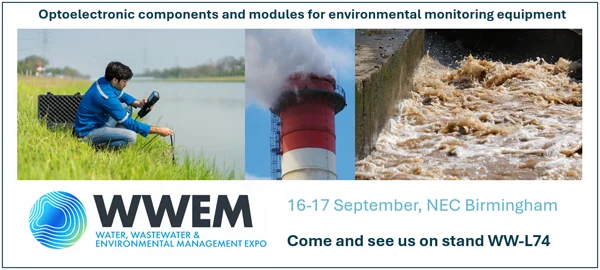
- AP Technologies will exhibit at WWEM 2026 on stand WW-L74 at the NEC Birmingham on 16-17 September.

Spectrometers for Water and Air Monitoring
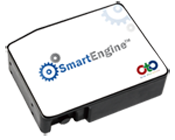
Visitors to WWEM will be able to see a selection of spectrometers from OtO Photonics, manufacturer of the widely used SmartEngine spectrometer family.
The range includes devices operating from deep ultraviolet wavelengths of approximately 155nm through to short-wave infrared wavelengths reaching 2500nm.
This broad spectral coverage makes the technology suitable for numerous monitoring applications, including detecting contaminants within water and analysing gas absorption characteristics in air quality equipment.
When selecting a spectrometer, engineers will typically consider several practical requirements:
- The physical size available within portable or embedded monitoring equipment.
- Power consumption and the available power supply.
- The level of measurement accuracy required.
- The overall development and production budget.
OtO Photonics product families include SmartEngine, HummingBird, PocketHawk, SilverBullet, SideWinder, GoldenBullet and RedBullet. These ranges use optical cavities based on variations of the traditional Czerny-Turner design.
UltraMicro and RedSparrow models use a patented MEMS grating-collimator architecture, allowing a smaller and more economical design while offering a reduced spectral range and higher levels of stray light compared with some larger alternatives.
These technologies are particularly useful for instrumentation expected to operate in practical field environments where vibration, movement and changing conditions must be considered.
Further information about OtO Photonics spectrometers is available here.
LEDs for Monitoring and Detection

AP Technologies supplies a broad selection of UVC, visible and near-infrared LEDs from manufacturers including Opto Diode Corporation, Silanna, SETi and Edison Opto.
Products are available in both surface-mounted and through-hole formats, with options selected according to wavelength, output power, packaging and the requirements of the final instrument.
AP Technologies can also use its wider industry network to identify specialist solutions outside its standard supplier portfolio where required.
Typical options include:
- UVC LEDs for applications including disinfection and fluorescence-based detection.
- Visible and NIR LEDs for sensing contaminants, particles and other target materials.
- Surface-mounted and through-hole packages to suit different mechanical and thermal designs.
- Different drive currents and power requirements to suit portable and field-based monitoring systems.
Further details can be found within the LED product section.
Infrared Detectors and Emitters
Cooled and uncooled IR emitters

Infrared detector selection will often be determined by the wavelength range required for a particular application.
Lead sulfide detectors typically operate across approximately 1 to 3.1µm and provide strong spectral response within this shorter infrared range.
Lead selenide detectors extend the available wavelength range from approximately 1µm through to 5.5µm, making them suitable for applications requiring longer wavelength detection.
Both detector types are available in a selection of hermetically sealed TO-style packages, with cooled and uncooled options and different window materials available depending on the sensitivity and spectral requirements of the system.
These detectors can also be combined with Opto Diode steady-state or pulsed blackbody thermal infrared sources.
The PIREplus pulsed driver provides another option for OEMs developing systems for gas sensing, moisture detection and material identification, including equipment used within waste management and recycling environments.
More information is available within the Detector and Emitter section.
Supporting Better Component Selection
The performance of monitoring equipment can often be influenced by decisions made during the earliest stages of development.
Selecting suitable components from the outset can help reduce the risk of technical problems appearing later, particularly when equipment is expected to operate continuously in demanding environments.
Whether engineers are developing systems for water monitoring, air analysis or recycling sorting, working with a supplier that understands both the individual components and their wider application can simplify the development process.
AP Technologies works with established manufacturers including OtO Photonics, Silanna, Edison Opto and Opto Diode to provide technologies with an established history of use within optical and sensing applications.
Component reliability becomes particularly important within regulated, industrial or safety-related monitoring systems, where inconsistent performance could affect measurement accuracy, data quality or compliance.
AP Technologies can also provide access to samples, evaluation products, late-stage prototypes and selected early-release technologies.
This gives OEMs the opportunity to test and validate components before committing to larger production quantities.
Evaluating products during the development stage can help identify integration issues earlier, reduce design risk and allow engineering teams to make better-informed decisions before progressing towards manufacture.
This consultative approach forms an important part of AP Technologies' wider offering, combining technical knowledge with industry-wide connections to help customers identify technologies suited to their individual engineering requirements.
Meet AP Technologies at WWEM 2026
AP Technologies will exhibit at WWEM 2026 on 16-17 September at the NEC Birmingham as part of ESS Expo, alongside the co-located AQE and RWM exhibitions.
Visitors can meet the team on stand WW-L74 to discuss monitoring applications, component selection and individual project requirements.
AP Technologies will also be exhibiting later in the month at Photonics UK, part of Microelectronics UK, at the Excel Centre in London on 29-30 September. The team can be found on stand C35.
OtO Photonics Sales Manager Kevin Cheng will attend both exhibitions and will be available to discuss the company's spectrometers and light source technologies.
At the Excel Centre event, AP Technologies will also be joined by Robbie Charters, VP of Operations at Silanna, who will be available to discuss the company's 230nm to 255nm UVC LED technologies.
Tickets for WWEM can be obtained by registering here.
Frequently Asked Questions
Q: What should be considered when choosing a spectrometer for field monitoring equipment?
A: Several factors should be considered, including the available installation space, power consumption, required measurement accuracy and project budget. Equipment designed for portable or field applications may also need to withstand vibration and changing environmental conditions, which can influence the type of spectrometer selected.
Q: What is the difference between lead sulfide and lead selenide infrared detectors?
A: The main difference is their wavelength coverage. Lead sulfide detectors typically operate up to approximately 3.1µm and provide strong performance at shorter infrared wavelengths. Lead selenide detectors can extend detection to approximately 5.5µm, making them better suited to applications involving longer wavelength absorption features. The target gas, material or moisture absorption band will normally determine the most appropriate detector.
Q: Can components be evaluated before placing a production order?
A: Yes. Samples and evaluation units are generally available for proof-of-concept and development work. This allows OEMs to test integration, performance and suitability before committing to larger production quantities, helping reduce development risk and avoid costly changes later in the project.
For more information on AP Technologies to Exhibit Monitoring Technologies at WWEM 2026 talk to AP Technologies Ltd