 Get Listed

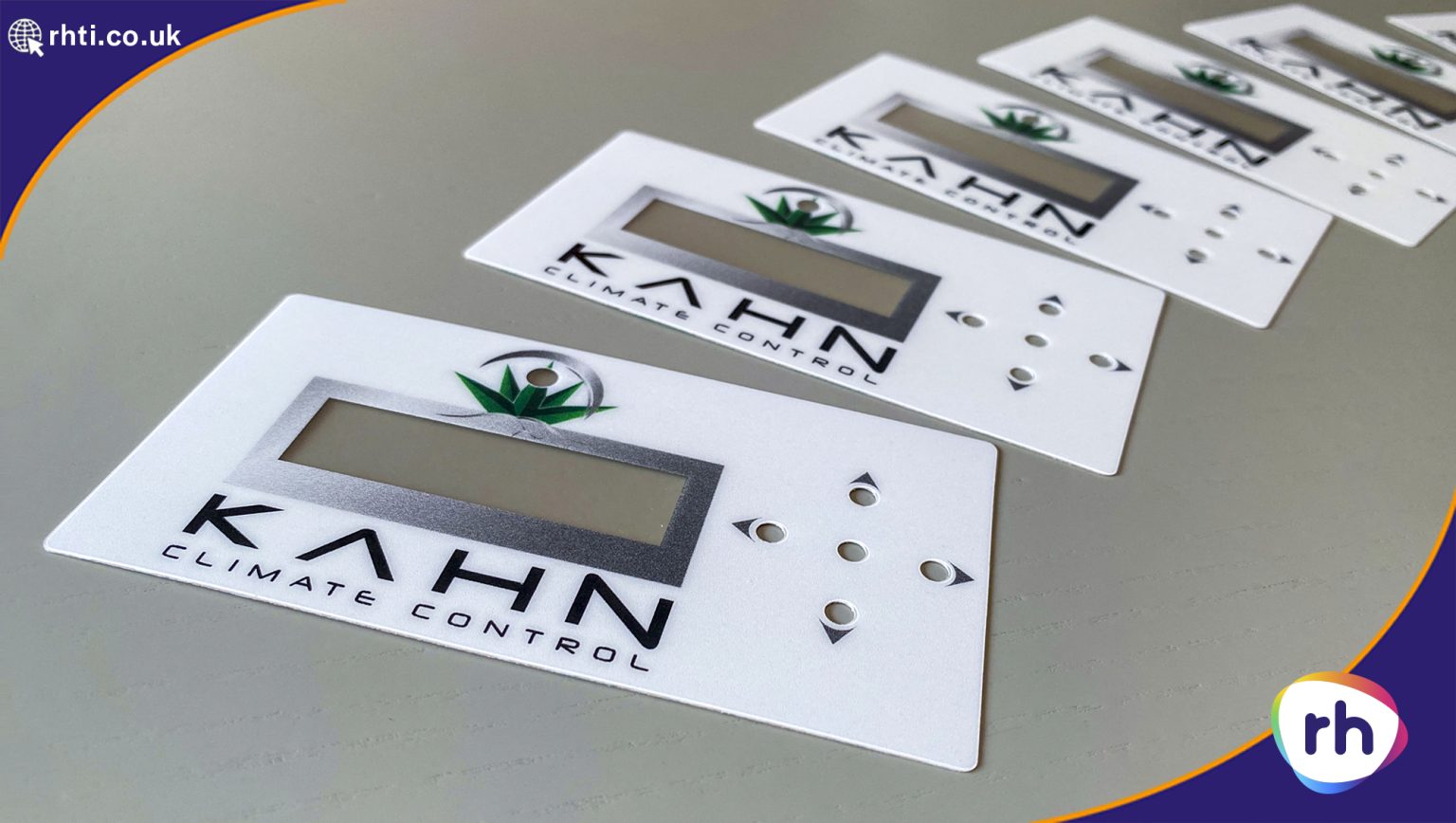
RH Technical Industries is highlighting how advanced digital printing can help UK manufacturers improve the appearance, precision and durability of graphic overlays, control panels and other industrial interfaces.
For manufacturers, the appearance of a machine or piece of equipment can be closely connected to perceptions of its overall quality. Control panels and user interfaces are often among the first components an operator sees and touches, meaning details such as sharp typography, accurate colours and correctly positioned display or LED windows can make an important difference.
Modern flatbed digital printing provides manufacturers with greater control over these details while also offering the durability required for demanding industrial environments.
Digital Printing for High-Precision Industrial Graphics
Traditional screen printing uses physical screens to deposit ink, whereas modern digital printing can control the size and placement of individual ink droplets.
RH Technical Industries' digital printing technology uses variable-dot piezo technology, with droplets ranging from approximately 6 to 42 picolitres depending on the application.
At the smaller end of this range, micro-droplets can be used to reproduce intricate details including warning symbols, wiring information, fine text and smooth colour transitions.
Larger droplets can deposit denser, higher-opacity areas of colour. This can be particularly useful for solid backgrounds and applications where unwanted light from LEDs beneath an interface needs to be controlled.
Protecting Graphics with Subsurface Printing
Industrial control panels and graphic overlays can encounter oils, cleaning chemicals, UV exposure and regular physical contact throughout their working lives.
One way RH Technical Industries addresses this is through subsurface printing, where graphics are printed onto the reverse of a clear polycarbonate or polyester material.
The printed graphics are therefore viewed through the material rather than being directly exposed on its outer surface. This allows the plastic substrate itself to provide a protective barrier against everyday abrasion and contact.
High-opacity white inks can also be incorporated into the digital printing process.
Spot white backing can be positioned behind selected coloured areas while leaving LCD or display windows transparent. Multi-layer printing using combinations of CMYK, white and black can also be used to produce dead-front displays, where symbols remain hidden until illuminated from behind.
These techniques allow visual design and functional requirements to be incorporated into the same industrial interface.
Instant UV Curing Speeds Up Production
Modern digital flatbed printing can also reduce the time between printing and subsequent manufacturing operations.
Rather than relying on solvent inks requiring extended drying periods, RH Technical Industries uses LED UV curing, which polymerises the ink as it is deposited.
Once printed, sheets can therefore progress into secondary manufacturing processes such as adhesive lamination, embossing and digital cutting without a lengthy drying stage.
The cold-curing characteristics of LED UV technology are also useful when working with relatively thin or heat-sensitive synthetic substrates, reducing the risk of distortion caused by high-temperature curing processes.
UV-cured inks additionally provide the resistance required for industrial environments where overlays and labels may encounter regular cleaning or challenging operating conditions.
Large-Format Digital Printing for Prototypes and Production
Digital printing also provides flexibility when moving between prototype and production quantities.
Conventional screen printing requires physical tooling for individual colours and designs. With digital printing, artwork can instead progress directly from CAD files to production without creating a new set of screens each time a design changes.
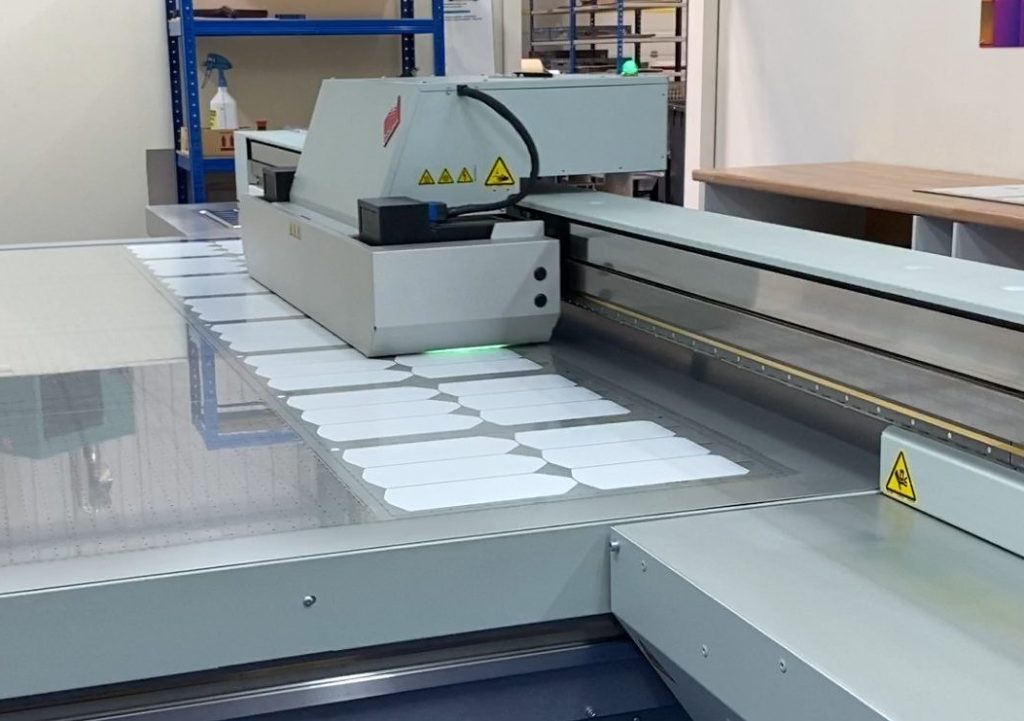
RH Technical Industries operates a 2500mm x 1250mm flatbed digital vacuum table, which holds material securely during printing to support accurate positioning.
The large bed size allows the company to produce sizeable industrial fascias as well as nest multiple smaller graphic overlays or labels across a single sheet.
Single-row print head configurations can be used where fine detail and precise alignment are particularly important, while double-row configurations provide increased efficiency for larger production quantities.
This gives RH Technical Industries flexibility to manufacture anything from small prototype batches for testing and development through to production runs numbering in the thousands.
Digital Printing Compared with Traditional Screen Printing
The choice between digital and screen printing will depend on the particular application, quantity, materials and required finish. However, digital production can provide several advantages where designs are complex or likely to change.
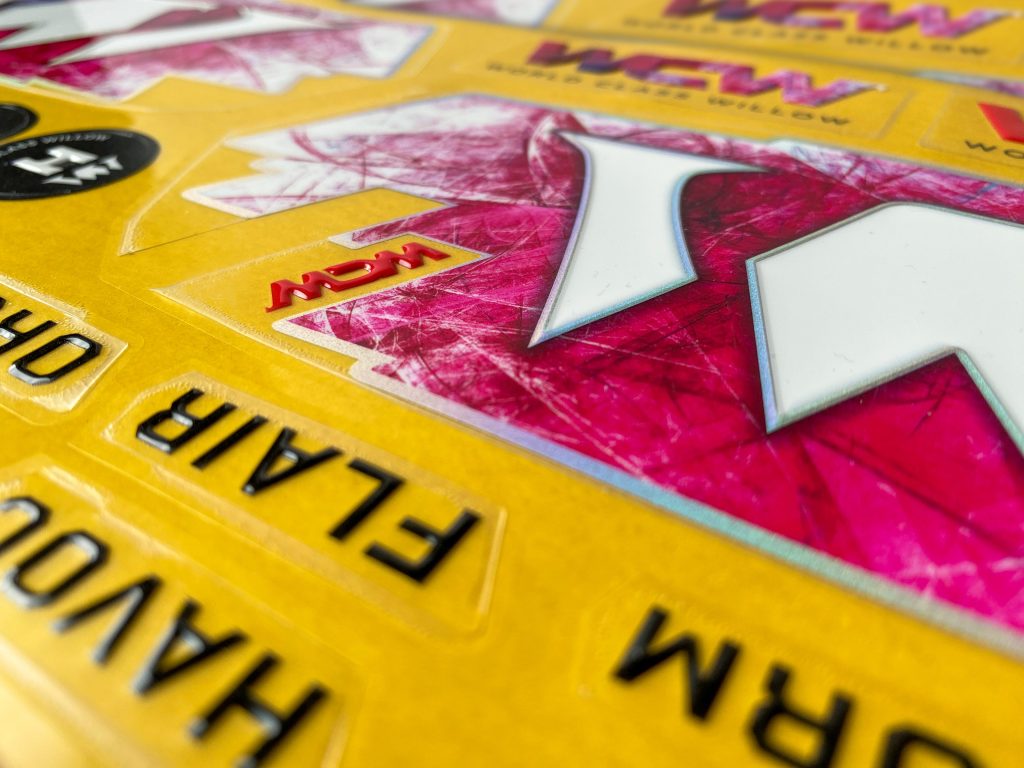
Physical screens are not required, reducing tooling requirements and making artwork revisions easier to accommodate. Digital technology can also reproduce variable information such as sequential serial numbers, barcodes and QR codes without manually changing physical tooling.
Another important difference is turnaround. Removing the need to manufacture new screens and wait for solvent inks to dry can shorten the route from approved artwork to finished component, particularly during prototype and development stages.
Digital printing also enables automated spot, flood and multi-layer white ink application, providing additional flexibility when creating illuminated interfaces and clear display areas.
Combining Aesthetics with Engineering Requirements
For RH Technical Industries, improving product aesthetics is not simply about making an interface more visually attractive.
Industrial graphics also need to communicate information clearly, withstand the intended operating environment and integrate accurately with the electronics and mechanical components beneath them.
The company's digital printing capability is therefore supported by in-house CAD review, material specification and adhesive selection, helping ensure the complete interface is appropriate for its intended application.
Further in-house finishing capabilities include laser cutting, custom die-cutting, tactile dome embossing and selective surface texturing.
Digital Printing from RH Technical Industries
By combining modern flatbed digital printing with its experience in industrial interfaces, RH Technical Industries can manufacture bespoke graphic overlays, membrane keypads, control panels and industrial labels for UK manufacturers.
The technology provides the flexibility to produce detailed prototypes without extensive physical tooling before scaling into larger production quantities when required.
For manufacturers developing a new control interface or looking to improve an existing product, digital printing provides another way to combine precise graphics, durable construction and high-quality aesthetics within a component engineered for its working environment.
For more information on How can digital print help UK manufacturers create better-looking aesthetics? talk to RH Technical Industries Ltd