 Get Listed

Onsite Versus Virtual Wellbeing: What Works?
A wellbeing programme can look impressive on paper yet reach only a small proportion of the workforce. The practical question in onsite versus virtual wellbeing is not which format is inherently better. It is which option removes the most barriers for your employees, while giving HR a manageable way to deliver, measure and improve support.
For many UK employers, the answer is not a single format. Office-based teams may respond strongly to a visible health screening day or a lunchtime yoga class, while home-based and multi-site colleagues need digital access that fits around their working pattern. The strongest programmes use each channel for the job it does best.
Onsite versus virtual wellbeing: the practical difference
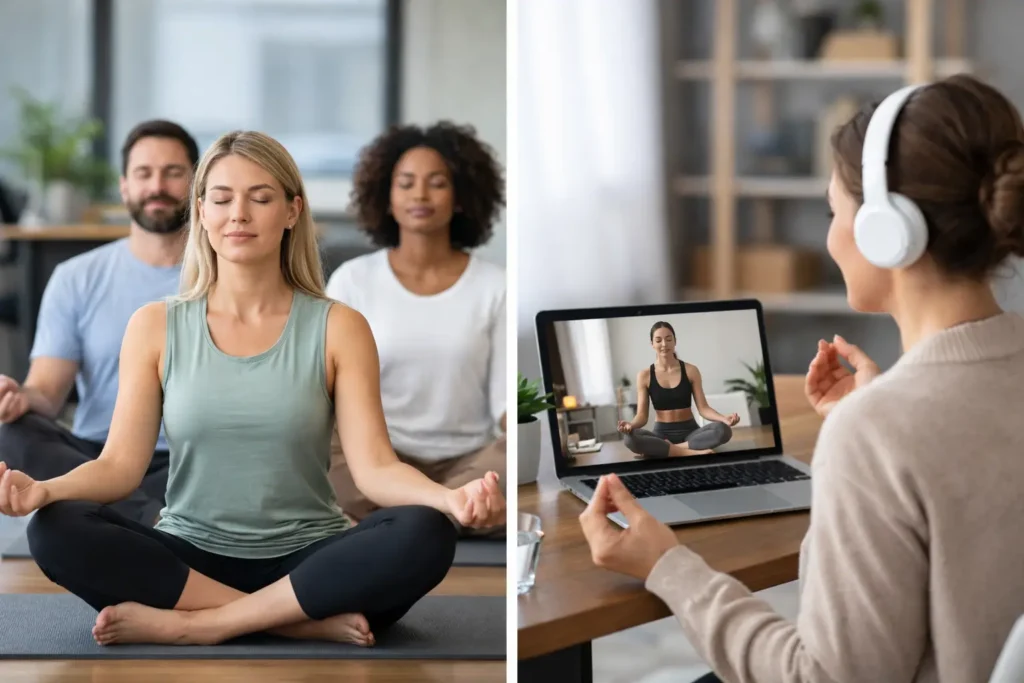
Onsite wellbeing brings a service directly into the workplace. It can include health screening kiosks, massage, movement sessions, workshops or in-person mental wellbeing training. Employees see the activity happening around them, can take part during the working day and often need little more than a few free minutes.
Virtual wellbeing is delivered through webinars, online courses, live online classes and digital resources. It gives employees greater flexibility over when and where they participate. It is particularly useful for hybrid, remote, field-based and geographically dispersed workforces where bringing everyone to one location would be costly or impractical.
The distinction matters because participation is rarely only about interest. It is affected by time, visibility, privacy, location, manager support and the effort required to get started. A programme that is convenient for the organiser but difficult for employees to access will struggle to create meaningful engagement.
Where onsite wellbeing has the advantage
Onsite activity is particularly effective when the objective is immediate participation. A health screening kiosk positioned in a suitable shared area gives people the opportunity to complete a basic check during the working day, without arranging an appointment or travelling to a clinic. That convenience can make a significant difference to uptake.
A workplace kiosk can capture height, weight, BMI, blood pressure, pulse and body fat percentage, then print results immediately. For employees, this creates a straightforward ‘know your numbers’ moment. The assessment takes minutes, and the printed outcome gives them a private record they can consider in their own time.
For employers, the value is in creating a visible preventative-health initiative without a heavy scheduling process. Subject to suitable space and a power supply, a rental kiosk can be delivered, installed and supported by trained engineers. This reduces the operational pressure on HR teams, particularly where an initiative must be delivered across several sites.
Onsite services can also create a sense of permission. A manager may intend to encourage wellbeing, but employees can still feel they should remain at their desk. When a class, screening point or session is physically present and clearly supported by the organisation, people are more likely to see participation as an acceptable use of work time.
There are limits. Onsite delivery depends on people being present, so it may not reach remote colleagues equally. It also requires coordination around site access, available space, peak working hours and internal communications. A well-attended screening day or workshop is valuable, but it should not be the only wellbeing support offered to a hybrid workforce.
Best uses for onsite delivery
Onsite wellbeing is usually the right choice when an employer wants to drive a specific event, improve visibility or make a basic health check easy to access. It works well for office-based teams, manufacturing or operational sites, staff away days and seasonal wellbeing campaigns.
It is also useful where employers need a measurable activity. With the right data arrangements in place, anonymised usage information can help indicate overall engagement levels and guide future wellbeing planning. Individual results should remain private, while organisation-level insight can show whether employees are using the service.
Where virtual wellbeing delivers more value
Virtual wellbeing gives employers reach. A live webinar on stress, sleep or resilience can be offered to colleagues in different offices, at home or on the road without requiring them to travel. Recorded learning and online courses can then extend the opportunity to employees who could not attend at a set time.
This format is especially helpful for subjects that benefit from repetition and reflection. Mental health awareness, nutrition, posture and sleep are not issues solved in one session. Digital learning allows employees to revisit material when it becomes relevant, rather than relying on them to remember a single presentation months later.
Virtual delivery can also provide greater discretion. Some employees may be more comfortable attending a session on managing stress from home than discussing the subject in a workplace meeting room. Others may prefer an online course that can be completed privately, at a pace that suits them.
The challenge is that convenience does not guarantee engagement. A webinar link in a busy inbox can be ignored, and self-directed learning may be postponed indefinitely. Virtual programmes need clear promotion, manager encouragement and an easy route to access. Offering too much content at once can be as unhelpful as offering too little.
Best uses for virtual delivery
Virtual wellbeing is a strong fit for year-round education, dispersed workforces and topics where regular reinforcement matters. It can give a national employer a consistent message across locations and create a dependable baseline of support for new starters, hybrid staff and teams with varied shift patterns.
It is often the most cost-effective way to provide broad access, but it should be planned around working realities. A live session at 10am may suit office staff but exclude customer-facing teams. Recording sessions, offering varied time slots and allowing protected learning time can make access fairer.
Choosing the right format for your workforce
Start with the outcome, not the service. If the priority is helping employees understand basic health measures, an onsite screening solution offers a direct and time-efficient route. If the priority is improving knowledge around stress, sleep or mental health, a programme of webinars and online learning may provide better ongoing coverage.
Then consider where people work. A single-office organisation can gain a great deal from visible onsite activity. A workforce spread across homes, client locations and regional sites will normally need virtual provision as a core element. For organisations with both, the question becomes how to offer comparable support rather than identical experiences.
Operational capacity should also shape the decision. Ask how much administration the initiative will create. Will employees need individual appointments? Who will set up equipment, resolve technical issues or manage consumables? Can the provider handle delivery, installation, maintenance and basic training? The simpler the deployment, the more likely the programme is to run as intended.
Finally, think about privacy. Health screening results are personal, and employees should understand what is measured, what they receive and how information is handled. For broader wellbeing activity, confidential access and clear communication help build trust. Participation should feel supportive, never intrusive.
Build a combined wellbeing programme
A combined approach gives employees different ways to engage. An employer might use an onsite health screening kiosk during a wellbeing month, follow it with online sessions on nutrition, sleep and stress, then bring in office yoga or massage at key pressure points during the year. Each activity has a clear purpose rather than becoming a collection of disconnected perks.
This structure also helps maintain momentum. Onsite events create attention and encourage initial participation. Virtual courses and webinars keep useful information available after the event has passed. Regular communications can point employees towards the next relevant service, rather than asking them to absorb an entire programme in one go.
For a multi-site employer, services can be phased. A kiosk can visit priority locations while webinars remain open to all employees. This avoids treating smaller offices or remote staff as an afterthought, while making practical use of onsite resources where they will have the greatest impact.
Relaxa supports this model with UK-wide onsite health screening kiosk delivery and support, alongside bookable workplace sessions and online wellbeing learning. The aim is to make participation straightforward for employees and administration manageable for the people responsible for the programme.
Measure what helps you improve
Wellbeing measurement does not need to be complicated, but it should be purposeful. Monitor participation by location and service type, attendance at live sessions, completion of online learning and employee feedback on relevance and accessibility. These indicators show whether the programme is reaching people, not whether an individual is healthy.
Use the findings to adjust delivery. Low attendance at lunchtime webinars may point to workload pressures or unsuitable timing. Strong kiosk usage at one site may justify a repeat visit or related nutrition content. If remote teams are less engaged, communications or manager support may need to change.
The most effective wellbeing programme is one employees can actually use. Give people a convenient moment to check their health, practical learning they can return to, and visible evidence that their employer has made time for both.
For more information on Onsite Versus Virtual Wellbeing: What Works? talk to Relaxa Posture Group