 Get Listed

Employee Pulse and BMI Checks for Workplaces
A wellbeing day can attract plenty of interest, but appointment lists, limited occupational health capacity and busy diaries can quickly reduce participation. Employee pulse and BMI checks offer a practical alternative: staff can take a few minutes during the working day to understand key health measures and leave with immediate results.
For employers, the value is not in collecting personal health information. It is in making preventative health support easy to access, giving people a prompt to consider their lifestyle, and demonstrating a visible commitment to wellbeing. An on-site health screening kiosk can make that process straightforward across offices, sites and shift patterns without creating a major administrative task for HR.
What employee pulse and BMI checks measure
Pulse and BMI are two familiar measures, but they mean different things. Used alongside other basic screening readings, they can help employees build a clearer picture of their current health and identify when it may be sensible to speak with a GP or qualified healthcare professional.
Pulse
A pulse reading shows how many times the heart beats per minute. It can be influenced by activity, stress, caffeine, medication, illness and the time of day, so one reading is a useful snapshot rather than a diagnosis. Employees should ideally take the assessment when they have had a chance to sit quietly, rather than immediately after climbing stairs or rushing between meetings.
A screening result can help start a constructive conversation with oneself: is this typical, has it changed, and are there everyday factors worth reviewing? If a result causes concern, the appropriate next step is to seek professional medical advice rather than self-diagnose.
BMI
Body Mass Index, or BMI, uses height and weight to indicate whether an adult’s weight is broadly within a healthy range for their height. It is a widely used population-level measure because it is quick and simple to calculate.
However, BMI does not measure body composition. A muscular employee, for example, may have a higher BMI without having a high level of body fat. It can also be less informative for some ethnic groups and for people with particular health conditions. This is why BMI works best as one part of a wider health check, not as a label or judgement about an individual.
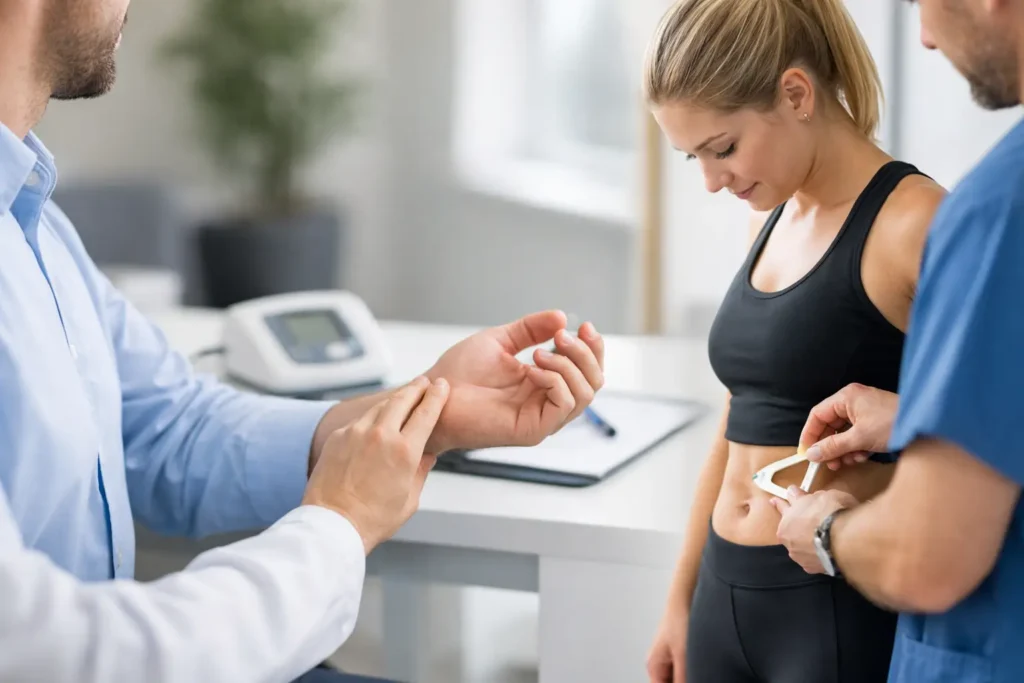
When a kiosk also records height, weight, blood pressure and body fat percentage, employees receive a more rounded set of numbers to consider. The goal is awareness and informed next steps, not a workplace verdict on health.
Why workplace checks improve engagement
Employees often intend to arrange a health check but put it off. Booking a GP appointment can feel unnecessary when someone has no symptoms, and private appointments are not always accessible or affordable. Bringing basic screening into the workplace removes several of those barriers.
A kiosk-based assessment is available where people already are. There is no appointment diary to manage, no need for a clinician to see every participant, and no need to take time away from work to travel elsewhere. Staff can use it during a wellbeing event, lunch break or quieter part of a shift, depending on how the workplace chooses to run the activity.
This matters particularly for large, hybrid or multi-site organisations. A single programme that depends on scheduled appointments may work for a small office, but becomes harder to administer when participation needs to reach hundreds or thousands of employees. Self-service screening allows higher uptake while keeping the process consistent.
Immediate printed results also make the interaction more useful. Rather than filling in a questionnaire and waiting for an outcome, employees receive their readings at the point of assessment. They can retain the printout privately and decide whether to make changes, monitor trends or seek advice.
How to run employee pulse and BMI checks well
The most successful workplace screening activity is clear, voluntary and simple. Communications should explain what will be measured, how long the check takes, and what employees will receive. They should also be explicit that screening is not a medical diagnosis and that individual results are private.
Position the activity as a chance to know your numbers, not as a weight-management campaign. The difference is significant. A supportive message encourages a broad range of employees to take part, whereas language focused narrowly on weight can discourage people or create unnecessary anxiety.
Choose a location that is visible enough to encourage uptake but provides appropriate discretion. A quiet wellbeing room, meeting room or screened area is often suitable. Think about footfall, access for different employees, queueing space and when people are likely to be available. For shift-based teams, keeping the kiosk available over more than one day may be more practical than concentrating activity into a single lunchtime session.
Before delivery, confirm the available space and power supply. A health screening kiosk is designed to be an operationally simple workplace solution, but it still needs a suitable, accessible position and a standard power connection. Planning these basics in advance prevents last-minute changes on the day.
It is also worth assigning a named workplace contact. They do not need to interpret results or supervise every assessment. Their role is to coordinate access, share internal communications, answer practical questions and direct employees to the appropriate support if they need help after their check.
Privacy and data: set expectations early
Health information is personal. Employees are more likely to participate when they understand that their individual readings are for them and are not being reviewed by their manager or used to assess performance, attendance or suitability for work.
Employers should avoid requesting individual results from staff. Instead, if reporting is required, anonymised usage data can show overall engagement with the initiative without identifying anyone. This might help an HR or wellbeing team understand how many people used the service, which sites engaged most strongly, or whether a repeat event would be worthwhile.
The practical rule is simple: separate personal health results from workplace reporting. Make this clear before the kiosk arrives, in launch communications and in any follow-up messages.
Turning a one-off check into year-round support
Pulse and BMI checks can create a useful moment of attention, but the strongest wellbeing programmes give employees options for what happens next. Someone who wants to improve sleep, manage stress or move more regularly may benefit from education and accessible activities rather than a generic instruction to “be healthier”.
Employers can follow screening with sessions on nutrition, sleep, resilience, mental health awareness, posture or movement. Office yoga, movement classes and on-site massage can provide practical ways for employees to build recovery and physical activity into their working week. Online webinars and training courses can extend the support to remote colleagues and sites where an in-person session is not possible.
The right mix depends on the workforce. An office-based team may respond well to lunchtime movement and posture sessions. A dispersed workforce may need digital learning available on demand. A manufacturing, logistics or customer-facing environment may benefit from carefully timed on-site activity that fits around operational cover. Screening should fit the organisation’s reality, rather than becoming another initiative that only a small group can access.
What employers should avoid
Do not present basic screening as a substitute for clinical care, or imply that a normal result guarantees good health. Equally, avoid treating an unexpected reading as an emergency diagnosis. Give employees clear signposting to their GP, NHS services or occupational health arrangements where appropriate.
Avoid pressure. Participation should be voluntary, and employees should be able to use the kiosk without explaining their results to colleagues or managers. Finally, do not let the event disappear without acknowledgement. A short, supportive follow-up can remind staff of available wellbeing resources and reinforce that taking an interest in personal health is worthwhile.
Relaxa’s Health Screening Kiosks are delivered, installed and supported by UK-wide technicians and engineers, with basic training provided so organisations can offer self-service checks without adding complex administration. Employees can measure height, weight, BMI, blood pressure, pulse and body fat percentage, then print their results immediately.
A well-planned screening day does not need to be intrusive to be effective. Give employees a convenient opportunity to pause, check their numbers privately and choose their own next step. That small, practical moment can make wellbeing feel less like a policy and more like support people can actually use.
For more information on Employee Pulse and BMI Checks for Workplaces talk to Relaxa Posture Group