 Get Listed

Minimum Continuous Safe Flow (MCSF)
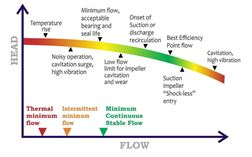
Minimum Safe Continous flow or MCSF is the lowest flow rate at which a centrifugal pump can operate safely. Staying above this level helps prevent cavitation—where low pressure creates damaging vapor bubbles—as well as recirculation, turbulence, and mechanical stress within a pump.
At the best efficiency point (BEP), flow through a pump is smooth and balanced. However, as flow drops below the BEP, the flow pattern becomes unstable and some of the liquid begins to recirculate. This means fluid enters the impeller, exits, and returns in an uneven way. As flow reduces further, this recirculation increases and becomes harder to control.
Excessive recirculation can lead to issues such as vibration and pressure fluctuations. To prevent this, pump manufacturers define a minimum flow level based on engineering analysis and experience. This is known as the minimum continuous safe flow (MCSF), and it typically falls between 10% and 80% of the BEP flow rate.
From a theoretical perspective, MCSF is based on fluid dynamics principles. These include the Navier–Stokes equations, which describe how fluids move, the Bernoulli principle, which relates pressure and velocity, and the continuity equation, which ensures mass is conserved in steady flow.
Importance of MCSF
Maintaining the minimum continuous safe flow (MCSF) is important for keeping fluid handling systems stable and safe. If a pump operates below this level, it can cause cavitation, vibration, and overheating, which can quickly damage pump parts. High temperatures and cavitation can lead to the destruction of components such impellers and volutes, and even affect the alignment of the pump casing.
Ensuring flow remains steady is also important in applications involving chemical processing and water treatment, where changes in flow can lead to inaccurate readings and inconsistent product quality. In critical applications involving circulation such as cooling, maintaining MCSF is essential to avoid overheating and for system protection.
Historical Development
Early engineers relied on practical experience and conservative estimates to define safe pump operating flows. In industries such as oil & gas and municipal water supply, the focus was on avoiding visible damage and maintaining basic reliability.
As fluid mechanics and pump design improved, more accurate ways of determining MCSF were developed. Techniques such as computational fluid dynamics (CFD) made it possible to model flow behaviour in detail and predict safe operating limits more precisely. These advances were especially valuable in demanding applications, such as fuel transfer systems.
In recent years, improved material knowledge and real-time monitoring have further refined how MCSF is applied. Today, industries like pharmaceuticals and power generation use it as a key design and operating parameter, supported by advanced calculations and sensor systems that continuously monitor and adjust flow conditions.
Determining MCSF
Traditionally, centrifugal pump manufacturers set conservative minimum flow limits. Modern approaches are more precise, taking into account different operating conditions such as continuous or intermittent use, as well as allowable temperature rise.
MCSF is typically determined using a combination of factors, including manufacturer experience, levels of recirculation at the suction or discharge, radial forces, temperature increase, cavitation damage, and changes in pressure or power.
In some cases, vibration limits define the lowest safe flow within the operating range. For high-energy pumps, factors like cavitation damage and liquid temperature are especially important to prevent issues such as flashing. However, certain designs—such as vertical turbine jockey pumps used in fire sprinkler systems—can safely operate at very low or even zero flow for short periods.
Assuming a pump casing temperature rise of (9-10°C) 15°F, the minimum required water flow can be estimated as follows:
q = PBHP / 2.95 cp SG
Here:
q = minimum flow rate (gpm)
PBHP = power input (BHP)
cp = specific heat of fluid (Btu/lb oF)
SG = specific gravity of fluid
Tools and Technologies
Modern MCSF calculations often use software such as ANSYS Fluent for CFD and Bentley HAMMER for transient analysis. ANSYS Fluent models fluid flow in detail, showing pressure distribution and cavitation zones using advanced meshing and solvers. Bentley HAMMER helps analyze water hammer and surge effects in transient flow systems to determine the minimum continuous safe flow.
Regulatory Standards
MCSF is covered in certain pump design standards such as API 610 and ISO 5199. API 610 applies to centrifugal pumps in petroleum, petrochemical, and natural gas industries, requiring MCSF to prevent vibration and maintain thermal stability.
ISO 5199 focuses on chemical process pumps, using MCSF to avoid mechanical seal failures and ensure sufficient cooling. These standards often define the flow, pressure, and temperature conditions used in MCSF calculations.
Challenges and Limitations
Calculating and maintaining MCSF can be technically challenging. Accurate results depend on detailed knowledge of system hydraulics, including pipe roughness, pump curves, and system demand.
Implementing monitoring solutions requires SCADA systems capable of handling transient conditions and fluctuating loads. Complex control algorithms and predictive maintenance are needed to manage multiple pumps operating in parallel or series. Hardware and software updates to meet industry standards add further complexity.
Environmental and Economic Considerations
Balancing safety with cost is important. High-precision sensors, data analysis tools, and backup systems can be expensive—backup pumps alone may cost three times the initial capital. Maintaining MCSF also increases energy consumption, raising utility costs.
Environmental impacts must also be considered. Industrial water use for MCSF can cause thermal pollution in cooling systems, harm aquatic life, lower groundwater tables, and even cause land subsidence. Compliance with regulations like the Clean Water Act requires significant resources. Variable frequency drives can improve efficiency and reduce energy use but have high upfront costs.
For more information on Minimum Continuous Safe Flow (MCSF) talk to North Ridge Pumps Ltd