 Get Listed

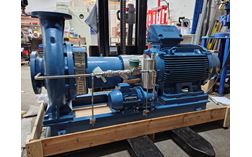
In this latest case study, North Ridge Pumps explain more about a recent commission where they had to supply a self-priming seawater intake pump.
The customer was using submersible pumps for seawater cooling but were having ongoing operational problems with the installation. They contacted North Ridge Pumps asking for help and advice on the best possible solution to the issue.
There were 3 pumps installed with 2 units acting as duty / standby with a third as back up, however all was not working as planned, the pumps were submerged within a port, where the seawater was being used for the cooling of process equipment.
Seawater abstraction is the process of taking water from the sea usually for large-scale industrial cooling, power generation or processing. In many applications, the seawater is returned to the ocean after use sometimes at a higher temperature. Abstraction generally means taking water from any source such as rivers, streams or groundwater for agriculture or drinking. Any stretch of offshore water or a larger ocean is a vast, stable and naturally cold heat sink. This offers much better efficiency and lower operating costs than conventional cooling methods.
Using seawater for cooling is a highly efficient, cost-effective and environmentally friendly alternative to traditional cooling methods in coastal regions with access to deep, cold-water sources.
Submersible Pumps & Corrosive Liquid Issues
The main issue with submersible pumps when used in corrosive environments is that they encounter multiple issues typically caused by seal failure – either on the pump or the motor itself, accelerated pump wear or long periods of downtime due to availability of spare parts. These are also issues faced when handling flammable liquids, which only comes to light after pump installation.
The submersible pumps were suspended from a pier, and were controlled by an integrated inverter to ensure the required cooling capacity was met. The pumps were immersed in 6-7M of seawater and pumping up to the main pier, before pipework travelled a few hundred meters horizontally into the production plant.
There are often several challenges when using submersible pumps with corrosive liquids, mainly due to submersible pump design, meaning such issues are entirely unavoidable.
Submersible pumps used in corrosive environments often have major issues caused by seal failure – either on the pump or the motor itself. This is down to faster pump wear or because of long periods of downtime because of lack of spare parts.
There can also be problems when handling flammable liquids, which only come to light after the pump has been installed.
For example, the motor casings of submersible pumps are often only available in a handful of materials. Stainless steel motor casings are highly resistant to corrosion but can be very expensive or only available for certain pump models. This is why submersible pump motor casings are usually manufactured in cast iron.

Cable Gland Entry Point
The cable entry point in a submersible pump is one of the weakest, most easily damaged and vulnerable points of such designs. If units are not handled correctly, the cable can inadvertently be used as a lifting point damaging the cable or casing joint leading to water ingress and motor failure.
Furthermore, as the cable entry point in this design was through a mild steel outer casing prone to corrosion, as the entry point within the casing wears, the clearances enlarge meaning it becomes increasingly difficult to create a seal or maintain its integrity and keep the motor and its windings free from water ingress.
The motor by design relies on the casing being filled with oil for cooling and to ensure moisture is kept away from windings. One issue that frequently occurs when a pump is removed from service to be maintained, is that when it is reinstalled the motor casing can begin to leak via the cable gland leading to the motor failing. This then means the motor needs to be drained, rewound and refilled with oil prior to startup which is a labour intensive, costly and time-consuming process.
Excessive wear
It is common for submersible pumps to be located on seabed’s which due to tidal movements of water, and use of bow thrusters by large offshore support vessels, sediment such as sand, stone and other debris is repositioned in ports and or agitated in seawater, leading it to enter pump inlets causing significant corrosion to casings, damage to mechanical seals and cavitation.
Availability of parts
The main issue with availability of parts for submersible pumps is that such designs utilise bespoke manufactured parts which are only available from the pump manufacturer itself. In industrial centrifugal pumps where pumps are crucial to process applications, parts such as replacement motors, or couplings are widely available worldwide, reducing the potential for downtime.
This electric self-priming pump built in Duplex Stainless Steel will seamlessly replace a seawater submersible pump, by being pontoon mounted to perform a 5-6M suction lift. It will deliver over 240M³H, drawing seawater via its baseplate mounted priming pump. To ensure the pump will not suffer corrosion from seawater salt spray and the corrosive atmosphere it has been coated in C5 marine coating to remain resistant to the elements.
The specific challenges facing our client
For this application, the client had three pumps installed with two units acting as duty/standby with a third as back-up.
The seawater intake pumps were suspended from a pier and controlled by an integrated inverter to ensure that the required cooling capacity was met. In addition, the pumps were immersed in 6m to 7m of seawater and pumping up to the main pier. From there, pipework was transferring the seawater a few hundred metres horizontally into the production plant.
However, the pumps were suffering extensive wear and tear, and needing large amounts of regular maintenance, which is why our client contacted us.

Sacrificial anodes reduced corrosion but needed regular maintenance
In the client’s pump installation, the motor casings were made from mild steel which isn’t compatible with seawater. This meant that they were fitted with sacrificial anodes to ensure that the casings didn’t corrode prematurely.
Sacrificial anodes are made from reactive metal alloys such as zinc or aluminium. These provide cathodic or galvanising protection, where a more active metal is intentionally corroded to protect the steel. This means that the seawater attacked the sacrificial anodes not the motor casing.
But this created another problem. As these anodes are sacrificial, they had to be replaced every three months to guarantee that the mild steel motor casings are protected from corrosion.
What’s more, as the pumps were suspended from a pier this meant that the pumps had to be removed to replace the sacrificial anodes This was done using a crate so that the pumps could be accessed.
There were other issues with our client’s pumps. The cable gland entry point in this design was through a mild steel outer casing which was prone to corrosion.
This meant that as the entry point within the casing wears, the clearances become bigger, making it increasingly difficult to create a seal or maintain its integrity. This makes it harder to keep the motor and its windings free from water getting in and stopping the motor operating.
What did we specify for our client?
At North Ridge Pumps, we’re not experts in just one type of pump. As the UK’s biggest pump supplier with over 25 years of industry experience, we can specify the best, most cost-effective type of pump for every project brief.
To meet this client’s strict requirements, we specified an electric high-flow self-priming pump made from duplex stainless steel to seamlessly replace the existing submersible seawater intake pumps.
Duplex stainless steel is a high-performance alloy combining approximately equal parts austenite and ferrite to deliver high strength and superior corrosion resistance, enabling reduced material thickness, lower weight and cost, and reliable performance in harsh, chloride-rich marine environments. The pontoon-mounted pump provides a 5–6 m suction lift and delivers over 240 m³/h of drawing seawater via its baseplate-mounted priming pump. To stop the high-flow priming pump being corroded by the seawater spray and the corrosive atmosphere we protected it with C5 marine coating. This is a high-performance, industrial-grade protective coating system designed for extremely corrosive environments and is specifically classified under the standard ISO12944 for high-salinity coastal offshore areas.
If you have an application that requires a rethink and need expert, impartial help and advice, speak to North Ridge Pumps to see how we can help.
For more information on High-Performance Self-Priming Pump for Seawater Cooling talk to North Ridge Pumps Ltd