 Get Listed

What is Surface Plasmon Resonance?
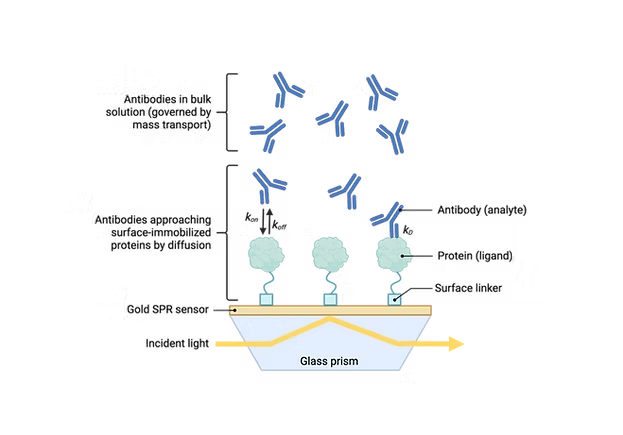
Surface plasmon resonance (SPR) is an optical technique used to investigate biomolecular interactions in real time, without the need for labelling. It is highly surface-sensitive and well-suited to complex biological environments. In a standard SPR experiment, ligands are immobilised onto the surface of a sensor chip, which is then exposed to a flowing solution containing analytes via a microfluidic channel.
The sensor typically consists of a glass prism coated with a thin metal film, such as gold or silver. Monochromatic, plane-polarised light is directed onto the metal layer. At a specific angle or wavelength, this light excites surface plasmons—collective oscillations of free electrons—at the interface between the metal and the sample medium.
When an analyte binds to an immobilised ligand, the local refractive index at the sensor surface changes. This alters the resonance conditions, causing a measurable shift in either the angle or wavelength of the reflected light, depending on the detection method. This change is recorded in real time and plotted as a sensorgram.
Understanding Sensorgrams
Sensorgrams provide valuable kinetic and affinity data about the interactions between ligands and analytes. They can also reveal specificity and concentration-dependent behaviours based on the magnitude of the SPR response. A typical sensorgram consists of five key phases:
Baseline
This is the initial phase, where a running buffer flows across the sensor surface to establish a stable baseline signal and ensure the system is functioning correctly.
Association
During this phase, the analyte is introduced into the flow channel and begins to bind to the immobilised ligands. This results in a sharp increase in the SPR signal, ideally forming a single exponential rise.
Steady State
At this point, the system reaches equilibrium—the rate of association equals the rate of dissociation—and the sensorgram flattens into a plateau.
Dissociation
Once the analyte flow is stopped and replaced with a buffer, the bound analytes begin to dissociate from the ligands. The signal decreases as a result.
Regeneration
A regeneration buffer, often a low pH solution such as glycine, is introduced to fully dissociate any remaining bound analytes and return the sensor surface to its initial state, ready for a new cycle of analysis.
SPR is widely used in fields such as drug discovery, immunology and biochemistry due to its ability to deliver precise, real-time information about molecular interactions.
For more information on What is Surface Plasmon Resonance? talk to Meritics Ltd