 Get Listed

Do You Know What Chemicals.
Hidden Contamination Risks Inside Your Data Hall: The Chemicals You Bring In!
There has been extensive discussion in recent years regarding airborne contamination within data centres, particularly particulate contamination and corrosive gaseous contaminants entering from the external environment.
Excellent articles such as Air Quality in Data Centres: Humans vs. the Machines and What’s Creeping Around in Your Data Centre? by Christopher Muller have highlighted the significant risks posed by atmospheric contaminants entering mission-critical environments.
However, there is another source of contamination that receives far less attention—the contaminants we introduce ourselves.
After more than 24 years of cleaning and testing mission-critical environments, I have encountered numerous examples where routine maintenance activities have inadvertently introduced corrosive contaminants directly into live Data Halls.
Floor Sealers – A Hidden Source of Corrosive Gases
One of the most common examples is the application of liquid floor sealers (often incorrectly referred to as floor polish) onto raised access floors.
These products undoubtedly leave an attractive, high-gloss finish, but appearance should never take precedence over contamination control.
Many commercially available floor sealers contain ammonia or ammonia-based compounds. A review of the Safety Data Sheet (SDS) for one widely used product clearly identifies ammonia as one of its ingredients.
As the coating cures, it releases ammonia vapour into the Data Hall atmosphere.
Ammonia is a recognised corrosive contaminant for copper and copper alloys. Once airborne, it can circulate throughout the cooling system and eventually come into contact with printed circuit boards (PCBs), connectors, contacts and other sensitive electronic components.
In environments containing millions of pounds worth of IT infrastructure, introducing a corrosive gas simply to achieve a shinier floor is an unnecessary and avoidable risk.
Cleaning Chemicals Can Create Their Own Airborne Contamination
Another issue I have encountered involved a contractor using a chlorine-based cleaning product within the cold aisle.
The operative sprayed the chemical directly onto a cloth immediately in front of the server air intakes.
Although the spray initially exists as liquid droplets (particulate contamination), these droplets are quickly drawn into the servers by high airflow cooling fans.
Once inside the equipment, the liquid evaporates, leaving chlorine gas free to circulate within the server.
Chlorine is highly corrosive to copper and many other metals used in electronic assemblies. Even relatively low concentrations can contribute to corrosion, reliability issues and premature equipment failure over time.
Equally concerning is the practice itself. Spraying any chemical within the airflow of live IT equipment is poor contamination control practice and should never be permitted inside an operational Data Hall.
Chemical Risk Assessments Matter
Professional Data Centre cleaning is about far more than removing dust.
Every chemical, wipe, cleaning process and application method should be assessed for its suitability within a mission-critical environment.
A competent technical cleaning contractor should be able to provide:
Safety Data Sheets (SDS) for every chemical used.
COSHH assessments where applicable.
Risk assessments detailing how contamination risks will be controlled.
Evidence that products have been assessed for compatibility with sensitive electronic equipment.
Cleaning methods that prevent chemicals or particulates entering live IT equipment.
If these documents cannot be provided, or the contractor cannot explain why a product is suitable for use within a Data Hall, alarm bells should ring.
Questions Every Data Centre Manager Should Ask
Before any cleaning work begins, consider asking your contractor:
What chemicals will be used?
Can I see the Safety Data Sheets?
Have these products been assessed for use around critical IT equipment?
Could any ingredient release corrosive gases during use or curing?
How will chemicals be prevented from entering server airflow?
What measures are in place to minimise contamination during cleaning?
These are simple questions, but they can prevent expensive mistakes.
Contamination Control Is About More Than Dust
When people think about contamination in a Data Hall, they naturally focus on airborne dust.
However, chemical contamination introduced during maintenance and cleaning activities can be equally damaging—and in many cases, completely avoidable.
The products used inside your Data Hall should never compromise the reliability of the equipment they are intended to protect.
Choosing an experienced technical cleaning specialist that understands contamination control, chemical compatibility and mission-critical environments is one of the simplest ways to reduce this risk.
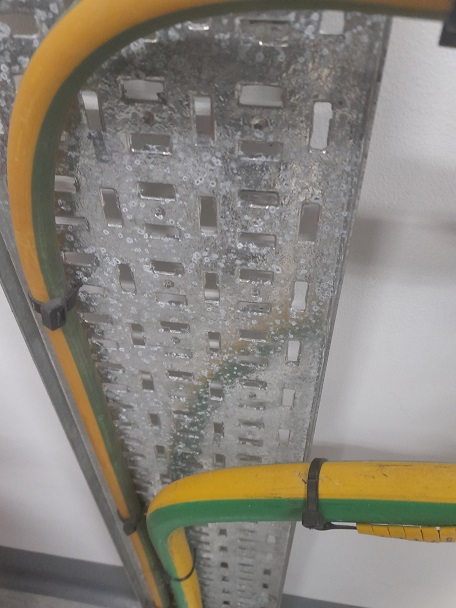
The photograph below illustrates the effect a chlorine-based cleaning chemical had on galvanised steel. The spray pattern clearly shows where overspray missed the cloth and landed directly on the surface. If this level of corrosion can occur on galvanised steel, it raises an important question: what could the long-term effects be on sensitive electronic equipment operating continuously within the same environment?
For more information on Do You Know What Chemicals. talk to IT Cleaning Ltd