 Get Listed

How to Polish Aluminium Professionally
Aluminium has a reputation for being easy to polish.
It is soft, light and relatively easy to shape, but that reputation can be misleading.
Aluminium is actually one of the more difficult metals to bring to a true mirror finish.
If you are specifying it for a sculpture, architectural feature or restoration where the finish will be examined closely, it is important to understand why.
Much of the information available online about aluminium polishers in the UK comes from aluminium suppliers offering polishing as an additional service alongside material supply.
That works well for standard sheet and extrusions.
Specialist workshop polishing is a different process and can produce a different level of finish.
This article explains why aluminium behaves the way it does under the polishing wheel, how alloy type affects the result, the finish grades we work to and when a specialist workshop is the better choice.
If you are planning a sculpture, architectural feature or restoration in aluminium, it should help you brief the work properly.
Why aluminium is deceptively difficult
Aluminium behaves very differently from stainless steel under the polishing wheel.
Stainless steel fractures at a microscopic level as the abrasive passes over it.
Aluminium tends to smear.
Because the material is highly ductile, it can move sideways rather than being cut away cleanly.
This means a surface can look glossy after polishing while still carrying subsurface roughness that may become visible later, particularly after anodising or under strong side lighting.
Oxidation is another factor.
Aluminium forms an oxide layer within seconds of being exposed to air.
Every polishing stage removes this layer, only for a new one to form almost immediately.
Applying excessive pressure does not speed up the process.
It heats the surface, disrupts the oxide layer unevenly and can produce a poorer result than working with a lighter touch.
A workshop that treats aluminium in the same way as stainless steel may produce a finish that looks acceptable initially but disappoints under closer inspection.
Alloy type changes everything
Aluminium is not one single material.
It is a family of alloys, and the particular alloy being used has a major effect on what can be achieved.
Wrought alloys in the 5000 and 6000 series are among the most common in architectural and structural applications.
They tend to polish predictably and can take a bright finish well.
Cast aluminium behaves differently.
Cast alloys contain silicon and often have porosity within the surface.
They can still be brought to a strong shine, and we have polished cast pieces to a genuine mirror finish where the casting quality has allowed it, but this should not be assumed at the specification stage.
The internal structure of the material needs to be suitable.
Sculptors working with cast aluminium should discuss this with the polishing workshop before the finish is written into the specification.
Softer 1000-series alloys polish easily but also scratch easily.
Anything that is being transported or handled after polishing needs proper protection, and contact with the surface should be planned carefully.
Before quoting an aluminium job, we want to understand the material we are dealing with.
That usually means discussing the alloy grade, where known, the form of the material, whether cast, extruded, sheet or fabricated, and where the finished piece will be installed.
Those three factors can influence the whole process.
Finish grades in aluminium polishing services
We use the same named finish grades on aluminium as we do on stainless steel: Orbital Sand, Satin, Bright, Mirror and Superior Mirror.
However, each grade can look slightly different on aluminium because the underlying material reflects light differently.
Satin and Bright
Satin and Bright are common choices for architectural aluminium.
They work well for applications such as window sections, cladding details, handrails and interior fittings.
Both finishes provide a clean and uniform appearance and are suitable for areas subject to normal levels of wear.
Mirror and Superior Mirror
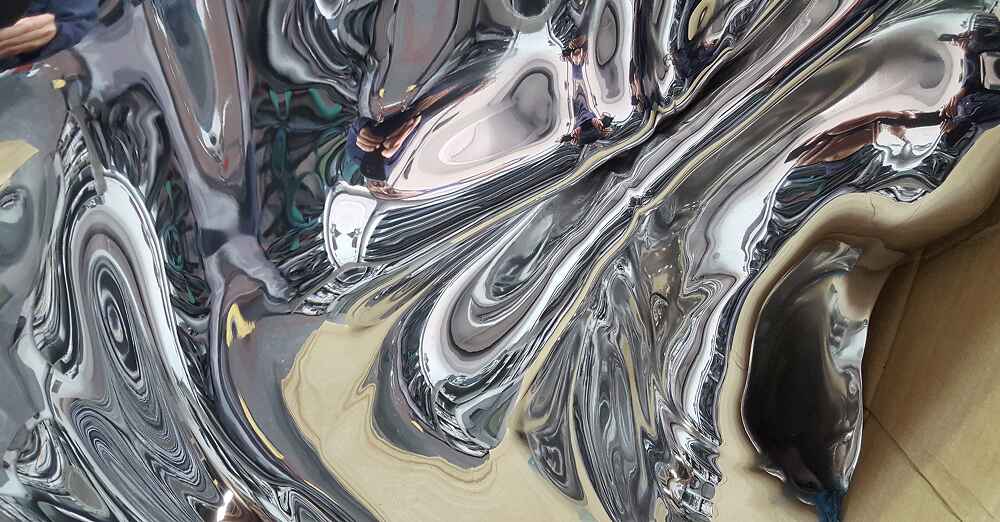
Mirror and Superior Mirror finishes are generally specified for sculpture, feature panels and display work where reflectivity is a key part of the design.
They take longer to achieve on aluminium than on stainless steel because of the way aluminium smears during polishing.
Skipping stages in the grit sequence to save time will usually become visible in the final result.
Orbital Sand
Orbital Sand gives aluminium a directional pattern that can work well in certain architectural applications.
It is particularly suitable where a warmer, less clinical appearance is preferred to the look of satin stainless steel.
What specialist aluminium polishing does differently
Aluminium suppliers’ polishing lines are designed for volume.
Sheet or extrusions pass through the process with a consistent grade and predictable output.
For a run of standard extrusions requiring a satin finish, that is often the right approach.
Specialist workshop polishing becomes more relevant when the job does not fit that model.
This might include:
-
A sculpture with compound curves
-
A restored architectural feature that must match adjacent original work
-
A one-off piece using client-supplied material and bespoke geometry
-
A Mirror or Superior Mirror finish that will be viewed at close range
Much of the difference comes down to hand finishing.
Complex forms need to be worked manually, section by section, with the operator judging how one area transitions into the next.
A flatbed polishing line is not designed for this.
Hand finishing also allows defects to be identified and corrected before they become more serious.
An experienced polisher can spot developing scratches or smeared areas and adjust the process before the problem becomes fixed into the surface.
We also regularly work with free-issue material, where the client supplies the aluminium and we carry out the finishing.
This is useful where fabrication has taken place elsewhere or where an existing piece is being restored.
Protecting the finish
Freshly polished aluminium is chemically reactive.
The oxide layer reforms within seconds, but under normal atmospheric conditions it may not form evenly and the surface can begin to lose its brightness over time.
Fingerprints can etch the surface, coastal air can cause pitting and rainwater can leave marks.
There are three main ways to deal with this.
Lacquering
Lacquering provides an immediate protective coating.
It has a limited lifespan and can yellow over time, so it is generally better suited to interior pieces or short-to-medium-term protection rather than prolonged outdoor exposure.
We do not carry out lacquering in-house, but we work with trusted partners and can arrange the process as part of the job or refer clients directly where appropriate.
Anodising after polishing
Anodising creates a controlled oxide layer over the polished surface.
It is durable and long-lasting, but it can slightly soften the appearance of the highest gloss finishes.
For many architectural applications, this trade-off is acceptable.
For display sculpture where maximum reflectivity is the main objective, it may not be.
Anodising is also carried out by specialist partners.
We can advise on suitable suppliers and how the anodising stage should be coordinated with polishing.
Ongoing maintenance
The third option is to leave the aluminium untreated after polishing and maintain the finish through periodic re-polishing.
This can work for interior sculpture that is not regularly handled.
It is generally less suitable for pieces installed outdoors.
The right choice depends on where the finished piece will be used and what level of maintenance the client is prepared to carry out.
That decision should be made before the job starts rather than afterwards.
When to use specialist metal polishers
If the job involves a run of standard extrusions to a satin finish, an aluminium supplier’s polishing line is likely to handle it well and may also be more economical.
A specialist workshop becomes more valuable where the project involves:
-
Sculpture or artwork
-
An architectural feature or restoration
-
A one-off piece with geometry that cannot sit flat on a polishing bed
-
A Mirror or Superior Mirror finish
-
Aluminium that will be viewed closely in a public setting
For these projects, the choice of polishing workshop can have a major influence on the finished result.
How to brief an aluminium polishing job
If you are specifying aluminium for an upcoming project, a short discussion before committing to the material or finish can save time later.
Provide whatever information you have about the alloy grade, the form of the material, the intended finish, where the finished piece will be installed and any maintenance expectations already agreed with the end client.
For more information on How to Polish Aluminium Professionally talk to High Grade Metal Polishers Ltd