 Get Listed


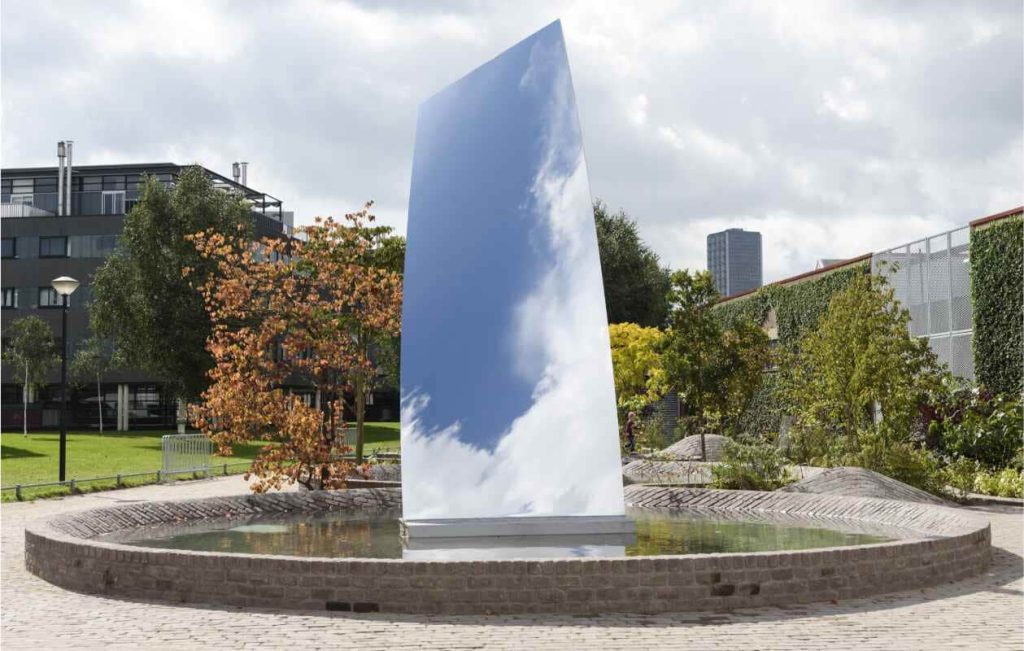
A stainless steel sculpture can look perfect on the day it is unveiled and begin to change within a year.
Faint brown marks may appear along lower edges, while a mirror finish that once reflected the sky can start to show a dull, rusty-looking bloom around welds.
The usual reaction is to blame the polishing, cleaning or weather.
In many cases, however, the real cause was decided much earlier, when the steel grade was chosen.
Selecting the right stainless steel grade for a sculpture is one of the less exciting parts of a commission, but it is also one of the hardest decisions to reverse.
The two grades most commonly discussed are 304 and 316.
They look identical in the workshop, but outdoors over ten or twenty years they can perform very differently.
This guide explains the main differences between them, how surface finish affects performance, what causes tea staining and why the grade should be chosen before fabrication begins.
What actually separates 304 from 316?
Both grades belong to the same family of stainless steels and both are easy to cut, form and weld.
The main difference lies in their composition.
304 contains roughly 18% chromium and 8% nickel and is the most widely used stainless steel in the world.
316 has a similar base composition but also contains around 2% to 3% molybdenum.
That addition is why it is often referred to as marine-grade stainless steel.
Chromium is what gives stainless steel its corrosion resistance.
It reacts with oxygen to form a very thin, invisible passive layer on the surface.
This layer protects the metal underneath and can repair itself if scratched.
Molybdenum strengthens that protection when salt is present.
Salt contains chlorides, and chlorides are one of the main threats to stainless steel outdoors.
You may also see 304L and 316L.
The ‘L’ stands for low carbon.
These grades are often preferred where thicker sections are welded, which is why they are commonly used in large sculptures.
Why ‘stainless’ does not mean ‘rustproof’
Stainless steel resists corrosion, but it is not completely immune to it.
The passive layer can be overwhelmed by salt, dirt, pollution or iron particles left on the surface.
When that happens, even a suitable grade can begin to mark.
The real question is therefore not whether stainless steel can rust, but whether the chosen grade is appropriate for the environment where the sculpture will be installed.
Where the sculpture will live matters most
The correct stainless steel grade depends far more on the location than on the sculpture itself.
The same piece may perform perfectly well in a sheltered inland courtyard but struggle on a seafront promenade.
The main risks include:
Coastal exposure
Sea salt can travel on the wind.
Australian industry guidance recommends using 316 within around 5 km of the sea.
Britain has a long coastline and frequent storms, so many locations are exposed to salt more than may first be apparent.
Roads and public spaces
De-icing salt spread during winter can splash onto plinths and lower surfaces.
This is one of the reasons architects increasingly specify 316 rather than 304 for external work.
Urban pollution
Pollution can settle on exposed surfaces and add to the load the passive layer has to resist.
Sheltered areas
This can be easy to overlook.
Rain naturally washes salt and dirt away from exposed areas.
Undersides, recesses and areas beneath overhangs do not receive the same cleaning action, so they can be among the first places to stain.
Four questions to ask about exposure
Before choosing a grade, consider:
-
How far is the site from the sea?
-
Will nearby roads or paths be gritted during winter?
-
Are there parts of the sculpture that rain will not reach?
-
Will the piece be cleaned regularly after installation?
If the answer to any of the first three questions is ‘close’ or ‘yes’, 316 is usually the more sensible starting point.
Cloud Gate in Chicago, Anish Kapoor’s mirrored sculpture, is a useful example.
Its outer skin is made from 316L plate, while the internal structure, which is protected from the weather, uses 304.
Each grade was selected according to the exposure it would face.
Finish can matter as much as grade
Choosing 316 is a good start, but it does not guarantee a clean surface.
The finish also plays an important role.
Tea staining is the light brown discolouration that can appear on stainless steel outdoors, particularly near the coast.
It is caused by chloride salts settling on the surface and attacking it.
Tea staining is generally cosmetic and does not weaken the metal, but on a sculpture appearance is often the main concern.
Rougher surfaces are more likely to stain because small grooves can trap salt and moisture.
Industry guidance recommends a surface roughness below 0.5 micrometres Ra.
A standard brushed finish may not always achieve this.
One fabricator discovered this after a 316 balustrade with a 320 grit finish began staining in a coastal location.
Testing showed the surface was around three times rougher than the recommended limit.
The grade was correct, but the finish was not.
This is one reason specialist stainless steel polishing matters for outdoor work.
A smoother surface gives salt fewer places to settle.
Mirror, satin and textured finishes outdoors
Mirror finish
A mirror finish is the smoothest option and offers the greatest resistance to tea staining.
It does, however, show fingerprints and marks more easily, so it is better suited to pieces where handling is limited or regular cleaning is planned.
Satin or brushed finish
Satin and brushed finishes are popular because they are visually forgiving.
However, the fine lines can hold salt.
The direction of the grain also matters, with vertical lines tending to shed water more effectively than horizontal ones.
Textured or blasted finishes
Textured and blasted finishes have the roughest surfaces and therefore carry the highest risk in coastal environments.
They can still work well inland or on areas of a piece that are less exposed.
The key point is simple: grade and finish should be chosen together.
Why the decision has to come before fabrication
Once a sculpture has been fabricated, changing the grade means starting again.
There is no treatment or coating that turns 304 into 316.
Several practical factors make early decisions essential.
You cannot tell them apart by eye
304 and 316 look identical.
The only reliable proof is the documentation, so ask for mill certificates when the steel is ordered and keep them with the project records.
Welding has to match
The filler wire and welding process should suit the selected grade.
Mixing grades within one piece, or using the wrong filler, can create weak points where staining may begin.
Contamination is a hidden risk
In workshops where carbon steel is also cut or worked, iron dust can settle on stainless surfaces.
Once the sculpture is installed outdoors, those particles can rust and create brown marks that make it appear as though the stainless steel itself has failed.
Good fabricators keep separate tools and working areas for stainless steel.
The finish affects fabrication
If the brief calls for a mirror finish outdoors, welds and seams need to be prepared with that final finish in mind from the beginning.
William Pye’s water sculpture Vannpaviljong in Norway is a good example.
The piece was fabricated from 5mm 316L stainless steel by Benson Sedgwick Engineering and then mirror polished by our team.
For a sculpture constantly exposed to moving water, the choice of grade formed part of the design from the outset.
What to settle at the design stage
Before fabrication begins, agree:
-
The exact grade, including whether a low-carbon ‘L’ version is required
-
The finish and target smoothness for outdoor surfaces
-
Which areas of the sculpture will be sheltered from rain
-
How the piece will be cleaned and how often
-
Who will retain the mill certificates
These conversations form part of planning any outdoor commission.
They cost very little at the drawing stage and can save a great deal later.
Is 316 always worth the extra cost?
316 costs more than 304 per kilogram, and the difference changes with nickel and molybdenum prices.
It is therefore reasonable to ask whether it is always necessary.
For indoor work, or a piece displayed in a sheltered inland gallery, 304 is often perfectly suitable.
Specifying 316 in those circumstances may increase cost without adding much practical benefit.
For an outdoor stainless steel sculpture expected to last for decades in a public setting, the calculation is different.
The raw material is only one part of the overall project cost.
Fabrication, polishing, transport and installation can cost far more.
If choosing the wrong grade leads to staining and restoration work, the cost of putting it right can quickly exceed the saving made on the steel.
Neither grade is maintenance free.
Even 316 needs washing, particularly near the coast or on sheltered surfaces that rain cannot reach.
Gentle cleaning with mild detergent and clean water helps remove salt before it has time to leave marks.
Planning this maintenance routine at handover is part of protecting the investment.
Get the grade right while it is still a drawing
Choosing a stainless steel grade for sculpture is really a decision about the next twenty years, not just the day of unveiling.
316 contains molybdenum, helping it resist salt from the sea, roads and pollution.
Location should guide the grade, with coastal, gritted and sheltered environments generally pointing towards 316.
A rough finish can still allow 316 to stain, so grade and finish need to be considered together.
Once the steel has been cut and welded, the grade cannot be changed.
Every outdoor piece also needs a cleaning plan, whichever grade is used.
If you are planning an outdoor commission and would like advice on grade and finish before fabrication begins, get in touch with our team.
A short conversation at the design stage can help prevent years of avoidable staining.
For more information on 304 or 316? Choosing the Right Stainless Steel for Outdoor Sculpture talk to High Grade Metal Polishers Ltd