 Get Listed
In-Mould Labelling, A Complete Guide for Beverage Cups and Food Packaging
In-Mould Labelling, usually shortened to IML, is a one-step process that fuses a pre-printed label to a plastic part during moulding. For beverage brands and packers, IML delivers full-wrap graphics with high durability and clean recyclability, with the labelling step seamlessly incorporated into the existing injection moulding manufacturing cycle. This guide explains how IML works, where it outperforms other decoration methods, and how to specify IML cups and containers for production.
The IML Process: Step by Step
-
A pre-printed polypropylene label is picked and placed into the open mould tool, typically by supporting automation and robotics, as part of the manufacturing cell.
-
The injection mould tool closes and molten polymer is injected into the cavity, as part of the traditional injection moulding process. The heat and pressure of the process permanently bond the label to the cup wall.
-
The mould opens and a fully decorated part is ejected, ready for packing. Either ejected directly using pins and release mechanisms on the mould tool, or removed by associated automation, suction cups or robot grippers.
-
After one finished part is removed, another label will be placed in the mould as part of one, smooth process, ready for the next moulding cycle, adding a minimum increase in cycle time and energy use.
-
Because the cup and label are usually the same polymer family, the resulting container or pack is still considered a mono-material, meaning it can be recycled as one item.
Typical substrates are polypropylene (PP) cups with PP labels. The process has a variety of printing methods: offset, flexo or gravure with matt or gloss finishes, spot varnish, metallic effects, clear windows and tactile textures, meaning IML is a highly versatile method for achieving a variety of effects and finishes.
Why Choose IML for Plastic Cups & Containers
-
Durable graphics. Artwork sits within the product wall and resists scuffing, condensation and repeated handling. Suitable for hot or cold cups that are stacked, crated and transported daily.
-
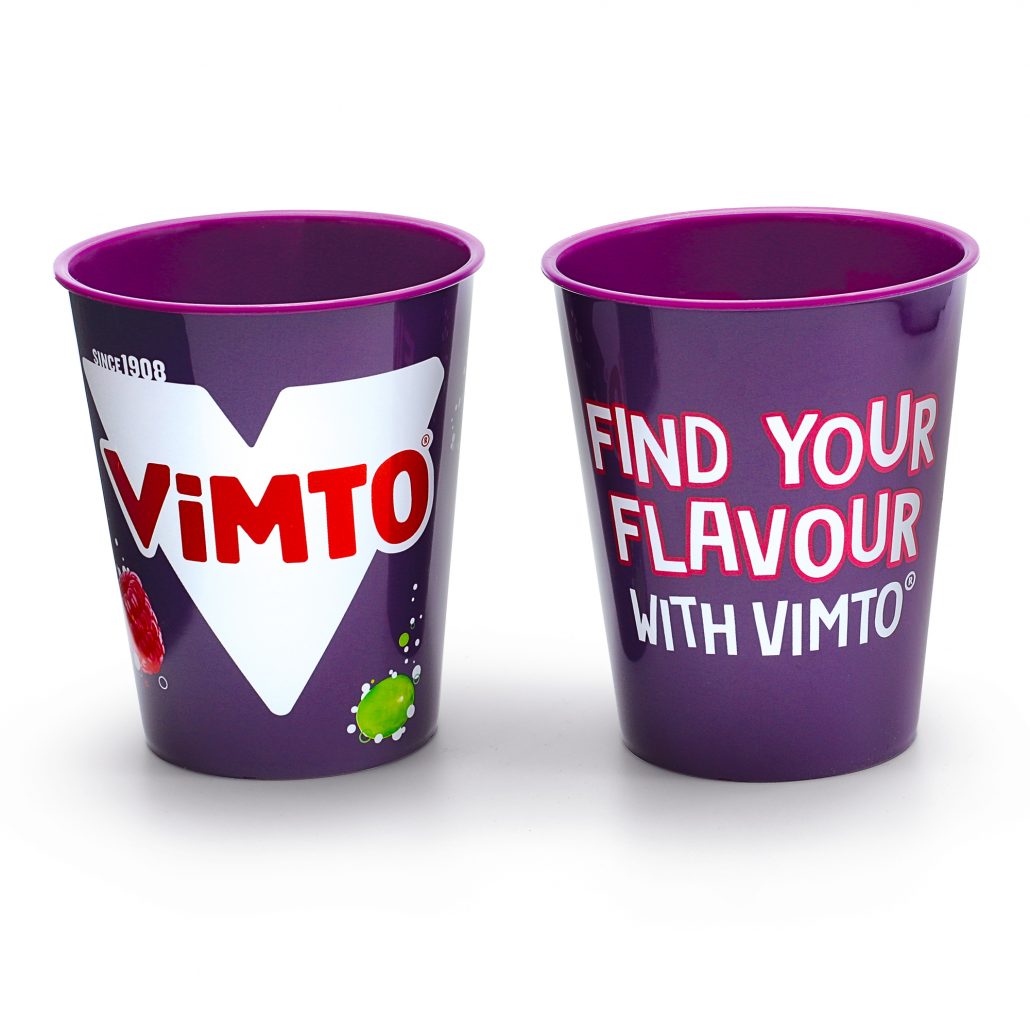
360° branding. Edge-to-edge print with precise registration and consistent colour, ideal for premium brand presentation and compliance artwork.
-
One-step efficiency. Decoration happens inside the mould during the existing moulding process, so there is no secondary labelling line, less handling and fewer rejects.
-
Mono-material recyclability. Using a PP cup plus PP label avoids adhesives and mixed laminates, supporting recycling routes.
-
Traceability built in. Barcodes, QR codes and unique IDs can be printed on the label to support inventory, deposit, loyalty or anti-counterfeit needs.
-
Repeatable quality at scale. Once the tool, label spec and colour approvals are set, large runs hold tolerances and colour consistently.
IML vs the Alternatives
-
Shrink sleeves. Good coverage and fast artwork changes. Usually multi-material with adhesives or inks that complicate recycling. Sleeves can scuff or slip. A lower quality alternative.
-
Pressure-sensitive labels. Lower entry cost. Edges can lift, alignment varies, moisture and ice can degrade adhesion. A shorter term solution.
-
Screen or pad print. Robust spot graphics on small areas. Limited coverage and additional post-mould handling can increase costs. May be more economical depending on volumes and printing specifics.
-
Direct digital print. Flexible and fast for multiple SKUs. Abrasion resistance and unit cost can be limiting for heavy-duty use or very high volumes.
-
Printed glass. Premium look, but heavy and breakable. Higher transport weight and more restrictive in many environments.
Design and Engineering Tips for IML cups
-
Material pairing. Keep the label and cup in the same polymer family, typically polypropylene (PP) for reliable adhesion and maximum recyclability. Consider rPP where permitted, with food-contact compliance.
-
Wall section and geometry. Uniform thickness around the label zone, adequate draft, venting and stacking features that suit automation allow greater cost efficiency in high volume projects.
-
Artwork preparation. Provide vector artwork and pantone references, barcode quiet zones, contrast for low-light scanning. Perform small text legibility checks.
-
Tooling and automation. Label magazines, end-of-arm tooling, cavity count, expected cycle time and changeover plan for variant artworks.
-
Validation. Transport and drop tests, chill-room trials, condensation resistance, abrasion testing, migration and food-contact certification, barcode scan rates.
Commercial Considerations
-
Volumes and economics. IML is strongest from medium to high volumes where the one-step process removes secondary labour. This delivers cost savings per unit, which improve as the project scale increases.
-
Lead times. Allow for label origination, colour standards, tooling and first article approval. Once a solid foundation is completed, an IML project can then quickly scale with thousands of units manufactured per day.
-
Total cost of ownership. IML enables fewer process steps, lower scrap rates, consistent branding across batches and simplified downstream packing, meaning an attractive cost model for high volume projects and a high quality product.
-
Regional supply. Manufacturing in the UK shortens replenishment lead time and reduces transport miles. As well as supporting the UK economy and reducing carbon emissions, this benefits customers for multi-site rollouts and seasonal peaks.
IML Beverage Containers - Use Cases
-
Cold drink cups for restaurants, coffee chains and cafés. Consistent brand presentation across networks, with QR codes for loyalty or deposit workflows.
-
Ready to drink (RTD) beverages and dairy. High surface area for claims, nutrition and multi-language packs, with wipe-resistant finishes.
-
Breweries and soft drinks. Strong colour fidelity for brand assets and sponsors, plus serialisation for promotions.
-
Convenience and foodservice. Clear windows, tamper-evident designs and stackable formats that survive chilled distribution.
-
Outdoor events, festivals or sports stadia. A safe alternative to glass for large scale outdoor events, music festivals or sporting occasions, complete with branding and suitable for a closed-loop return and reuse scheme.
FAQs - Frequently Asked Questions
What is in-mould labelling (IML) for cups and drinks containers?
A one-step production method to manufacture a plastic cup with a 360° label graphic embedded in the surface. A printed label is placed into the mould and embedded to the cup using heat and pressure during the injection moulding cycle, permanently fusing the two materials.
Are IML cups recyclable?
Yes. Good manufacturing practice will use the same polymer for both the label and the material to maximise recyclability. If the cup and label are the same polymer family, typically polypropylene (PP), the pack is mono-material and can be recycled together in traditional recycling facilities.
What styles or colours are available on IML labels?
In-mould labelling enables full edge-to-edge graphics, around 360° of the container's outer surface. This graphic can be multi-coloured and as visually complex as desired to match branding and promotional needs, without impacting the moulding process.
Can I add barcodes or QR codes?
Yes. Codes are printed on the label artwork and survive handling and chilling. Adding barcodes, QR codes or ID numbers enables additional branding opportunities, or facilitates return schemes, inventory management or other data collection.
How durable are IML graphics?
Labels are embedded within the product wall, so they resist scuffs and moisture better than post-applied labels. This leads to a highly durable, dishwasher, handling and chill resistant product that can be reused countless times.
What minimum orders apply?
IML is most cost-effective at medium or high volumes. MOQs depend on tooling, cavity count and label print runs. Contact us to discuss your specific project requirements.
How does IML compare on cost?
Per-unit decoration cost is highly competitive once volumes scale, particularly when you factor in the secondary labelling, handling stages of other processes. With low scrap rates and IML using a highly efficient one stage process (adding a label to the existing injection moulding cycle) then for high volume projects, it is a superior choice for cost as well as quality.
Where Great Central Plastics fits
Great Central Plastics manufactures reusable plastic cups by injection moulding in Northamptonshire, with fully automated, 24/7 injection moulding production capacity from 22 to 160 tonnes. This supports low and high-volume runs of reusable pint cups, reusable half-pint cups and associated formats.
For venues that require smaller measures, reusable shot cups or custom receptacles can be tooled and supplied to spec within a matter of weeks.
With all design, tooling and manufacturing managed in-house in the UK, Great Central Plastics can provide even greater sustainability savings to your project, by keeping the entire process local.
With our in-mould labelling capabilities to our injection moulding factory, Great Central Plastics can seamlessly brand and decorate every reusable container produced, without slowing down production.
Looking to transform the sustainability credentials of your venue, cafe or restaurant chain? Get in touch with the Great Central Plastics team today to be guided through the entire journey, from specification to tooling, moulding, branding and more.
Next steps
If you operate a stadium, arena, theatre, pub group or other food and drinks venue and want to scale a reuse programme, Great Central Plastics can supply eco-friendly drinkware in pint, half-pint and shot formats, with branding and printed features to support deposit or donation models.
Specify your target volumes, desired colours and any barcode or QR requirements, and we will quote for bulk reusable cups with lead times aligned to your fixture or trading calendar.
For more information on In-Mould Labelling, A Complete Guide for Beverage Cups and Food Packaging talk to Great Central Plastics Ltd