 Get Listed

Non-destructive testing (NDT) is an invaluable set of methodologies used across various sectors to ensure the safety, efficiency, and longevity of materials and structures without inflicting any harm. With roots tracing back to the early 20th century in the UK, NDT has evolved from rudimentary methods to sophisticated processes that underpin modern manufacturing, construction, and engineering industries worldwide. This evolution reflects a history of innovation driven by the need to maintain operational safety and material integrity in an ever-changing industrial landscape. NDT is crucial for preempting potential failures and for certifying the ongoing safety of structures and vehicles, hence its indispensable role in quality assurance. This blog explores six effective forms of NDT, highlighting their unique applications, benefits, and advancements, thereby showcasing the indispensable role they play in modern industry.
Visual Inspection:
Visual inspection, while seemingly basic, is a fundamental and highly effective form of non-destructive testing. It leverages human sight, often enhanced with tools like magnifying glasses, endoscopes, or advanced digital imaging technologies, to identify surface anomalies such as corrosion, misalignments, and cracks. The simplicity of visual inspection belies its importance; it often serves as the initial assessment that guides further testing. The advent of 3D scanning and digital recording has revolutionised this traditional technique, providing detailed surface maps and allowing for remote inspections. However, the effectiveness of visual inspection is heavily reliant on the experience and skill of the inspector. Challenges such as limited accessibility and subjective interpretation can impact the accuracy of the inspection. Continuous training and the integration of advanced imaging technologies are essential for overcoming these obstacles and enhancing the precision of visual inspections.
Radiographic Testing:
Radiographic testing, utilising X-rays or gamma rays, offers a deeper look into materials by revealing internal flaws such as cracks, voids, and inclusions. This method is particularly vital in sectors where internal integrity is paramount, like aerospace and automotive manufacturing. However, the application of radiographic testing requires stringent safety protocols due to the potential health risks posed by ionising radiation. Recent advancements, including digital radiography, have significantly improved the safety, speed, and clarity of these inspections. Despite these advancements, the necessity for comprehensive safety measures and the environmental impact of disposing of radioactive sources remain significant considerations. Real-world applications, like the inspection of welds in pipeline construction, highlight the method’s indispensable value despite these challenges.
Ultrasonic Testing:
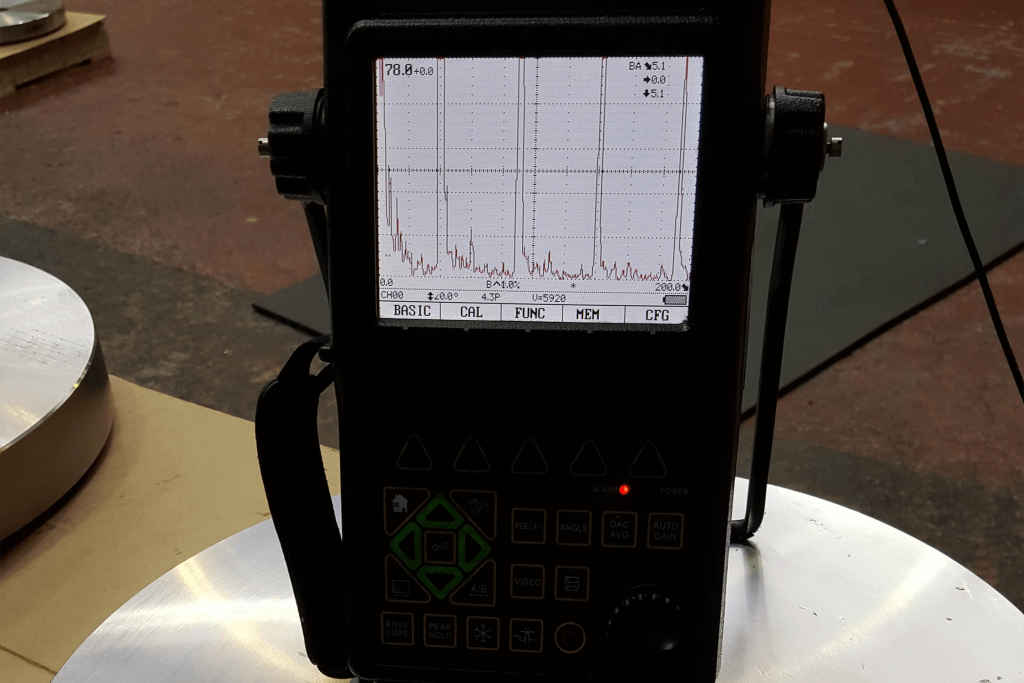
Ultrasonic testing employs high-frequency sound waves to detect internal defects in materials. Distinguished by its depth penetration and precision, it can identify flaws in a variety of materials, including metals, plastics, and composites. The method’s versatility is showcased in applications ranging from detecting de-lamination in fibreglass to assessing the integrity of structural steel. Recent technological advancements, such as phased array ultrasonic testing, have expanded its capabilities, allowing for detailed imaging and greater flexibility in inspecting complex geometries. Yet, the technique’s reliance on equipment calibration and operator expertise means that comprehensive training and experience are crucial for accurate defect interpretation.
Magnetic Particle Testing:
This method is particularly adept at identifying surface and near-surface discontinuities in ferromagnetic materials. The process, which involves the application of magnetic particles to a magnetised surface, is fast and relatively simple, providing immediate visual feedback in the form of defect indications. Despite its effectiveness, magnetic particle testing is limited to ferromagnetic materials and requires careful surface preparation to ensure accurate results. The technique’s adaptability and speed continue to make it a preferred choice for routine inspections, particularly in the inspection of automotive components and heavy machinery.
Dye Penetrant Testing:
Dye penetrant testing is a widely utilised NDT method known for its simplicity and effectiveness in detecting surface-breaking defects in non-porous materials. Its application spans various industries, from aerospace components to energy sector installations, offering a cost-effective solution for quality assurance. Despite its broad utility, the method has limitations, including its ineffectiveness on porous materials and the necessity for meticulous surface cleaning. However, ongoing advancements in dye formulations aim to enhance sensitivity and environmental safety, ensuring the method’s continued relevance in modern industry.
Eddy Current Testing:
Eddy current testing, a technique based on electromagnetic induction, is crucial for inspecting conductive materials for surface and near-surface defects. Its non-contact nature and ability to provide immediate results make it an efficient option for large-scale or continuous inspections, such as in the production of automotive parts or aircraft maintenance. Challenges include the method’s complexity and the need for skilled interpretation of results. Nonetheless, advancements in sensor technology continue to broaden its application range, demonstrating its adaptability and enduring value in NDT.
The Role of NDT in Preventive Maintenance and Life Extension of Machinery and Structures:
Non-destructive testing (NDT) is not just a tool for identifying existing defects; it plays a critical role in the preventive maintenance and life extension of machinery and structures. By detecting issues before they escalate, NDT helps in the formulation of maintenance schedules that prevent catastrophic failures and extend the operational life of assets. This predictive approach to maintenance allows for minor repairs to be conducted in a timely manner, which is far more cost-effective and less disruptive than major repairs or replacements after a failure has occurred.
The role of NDT in preventive maintenance is particularly significant in industries where safety and reliability are paramount, such as aviation, petrochemical, and infrastructure. For example, in the aviation industry, regular NDT checks ensure the integrity of critical components, directly impacting the safety and longevity of the aircraft. Similarly, in the energy sector, NDT inspections of pipelines and structures help prevent leaks and failures that could have severe environmental and economic consequences.
Furthermore, the data collected from regular NDT inspections can be used to predict the future performance of machinery and structures. This predictive analysis helps in planning maintenance activities, optimising resource allocation, and minimising downtime. By integrating NDT with asset management systems, organisations can create comprehensive maintenance strategies that not only extend the life of their assets but also enhance safety and efficiency.
The Importance of Certification and Training for NDT Professionals:
The effectiveness of non-destructive testing is heavily reliant on the skill and knowledge of the NDT professionals conducting the inspections. Therefore, certification and training are crucial components of the NDT field. Certified NDT professionals are equipped with the theoretical knowledge and practical skills required to perform accurate and reliable inspections. They understand the principles behind each testing method, the capabilities and limitations of the equipment, and the safety procedures that must be followed.
In the UK, and indeed globally, there are several certification schemes and standards that govern the training and certification of NDT technicians. These include the PCN (Personnel Certification in Non-Destructive Testing) scheme administered by the British Institute of Non-Destructive Testing (BINDT), and international standards like ISO 9712. These certifications ensure a standardised level of competence and enable technicians to work across different sectors and geographies.
Ongoing training is equally important, as it ensures that NDT professionals stay up-to-date with the latest technologies, methods, and standards. Continuous professional development is essential in a field that is continually evolving, with new materials, testing techniques, and regulatory requirements emerging regularly.
Non-destructive Testing
Ultrasonic Testing Services Being Carried Out
Global NDT Standards and How They Vary from One Region to Another:
While the principles of non-destructive testing are universal, the standards and regulations governing NDT can vary significantly from one region to another. These variations can be attributed to differences in industry focus, regulatory environments, and cultural practices. For instance, the American Society for Nondestructive Testing (ASNT) provides standards widely used in the United States, while the European Union may prefer EN (European Norm) standards.
These regional standards are designed to ensure that NDT services meet local safety, quality, and performance requirements. However, the diversity of standards can pose challenges for multinational companies and professionals working across borders. Understanding and complying with different regional standards require a high level of expertise and adaptability.
The move towards global standardisation, exemplified by international standards like ISO 9712, aims to harmonise NDT practices worldwide. However, even with these international standards, local regulations and requirements still need to be considered. NDT professionals and companies must navigate this complex landscape to ensure compliance and maintain the highest levels of safety and quality.
The Environmental Impact of NDT and Efforts to Make it More Sustainable:
While NDT plays a vital role in ensuring the safety and reliability of industrial operations, it is not without its environmental impact. For instance, radiographic testing uses ionising radiation, which requires strict safety measures to protect both personnel and the environment. Similarly, some methods of NDT, such as dye penetrant testing, involve chemicals that can be harmful if not handled and disposed of properly.
However, there is a growing awareness within the NDT community of the need to minimise environmental impacts. This has led to the development of more sustainable practices and technologies. For example, advancements in digital and computed radiography have reduced the need for hazardous chemicals and materials used in traditional film radiography. Likewise, water-based and biodegradable penetrants are being developed to replace toxic dye penetrants.
Moreover, the very nature of NDT as a preventive maintenance tool contributes to environmental sustainability. By extending the life of machinery and structures and preventing accidents and failures, NDT helps reduce waste and the need for new materials. As the NDT field continues to evolve, sustainability is becoming an increasingly important consideration, driving the development of greener methods and materials.
Ultrasonic Inspection Manchester
Non Destructive Testing Services
Contact The Experts
The field of non-destructive testing is dynamic, with each method offering unique advantages suited to different inspection needs. As industries evolve, so too do the techniques and technologies underpinning NDT, driven by a universal commitment to safety, efficiency, and sustainability. The future of NDT lies in the integration of these traditional methods with emerging technologies, such as artificial intelligence and machine learning, which promise to enhance accuracy, reduce human error, and streamline inspection processes. Embracing continuous improvement and innovation, the NDT community is well positioned to address the challenges of modern industry, safeguarding the integrity of materials and structures worldwide. In the panorama of industrial safety and quality assurance, non-destructive testing remains an indispensable tool, ensuring that the wheels of progress turn smoothly and safely. Find out more about the most efficient uses of non-destructive testing by contacting the experts at Format NDT.
For more information on The Most Effective Forms of Non-Destructive Testing talk to Format NDT Ltd