 Get Listed

The Different Types of NDT
Non-destructive testing, commonly referred to as NDT, plays a critical role in modern industry. Whether it’s inspecting aircraft for fatigue, assessing the structural integrity of bridges, or ensuring oil pipelines are free from corrosion, NDT allows engineers and technicians to evaluate the condition of materials and components without causing any damage. In the UK and across the globe, industries such as aerospace, construction, energy, rail, and manufacturing rely heavily on these techniques to maintain safety, reduce downtime, and meet regulatory standards. Unlike destructive testing, which involves taking a component to failure to understand its performance limits, NDT methods allow for repeated inspections over time. This makes them especially valuable in preventative maintenance and quality control. With that in mind, let’s take a closer look at the different types of non-destructive testing and how they are used in real-world applications.
Visual Testing and Inspection
Visual testing, also known as visual inspection, is the most basic yet arguably one of the most essential forms of NDT. It involves examining a surface visually, often with the help of magnifying tools, cameras, or borescopes. Trained inspectors look for signs of wear, cracking, corrosion, misalignment, or other surface anomalies that could indicate deeper issues. While it may seem simple, visual testing is a skill that requires a keen eye and a solid understanding of the equipment or structure being examined. In many cases, it forms the first stage of an inspection process and helps determine whether more advanced NDT techniques are needed. For example, in the aerospace sector, engineers routinely perform detailed visual inspections of airframes and engine components as part of scheduled maintenance routines. Digital imaging and video tools have also enhanced visual testing in recent years, allowing for better documentation, remote inspection, and image enhancement. In environments such as offshore oil platforms or confined spaces within power stations, robotic cameras are often deployed to provide visual access to hard-to-reach areas.
Ultrasonic Testing
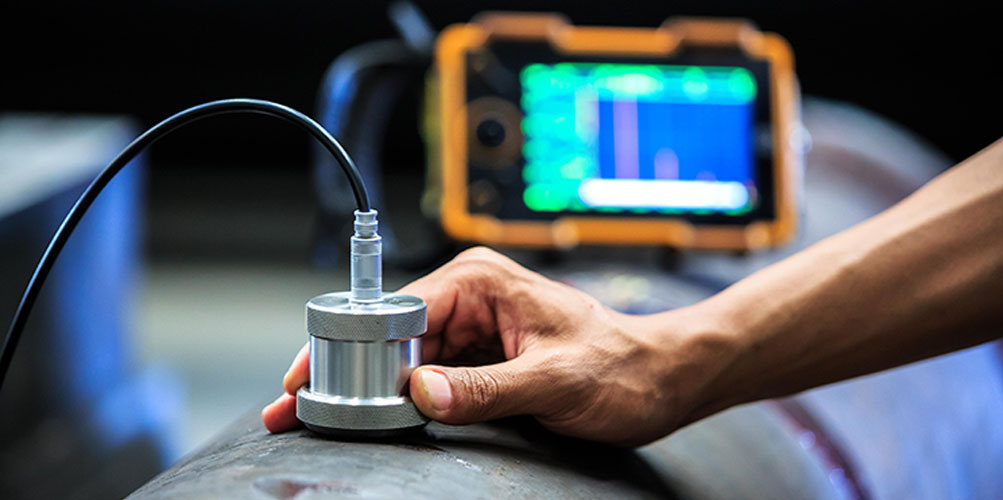
Ultrasonic testing, or UT, uses high-frequency sound waves to detect internal flaws or measure the thickness of materials. A transducer emits sound waves into the material, and the way those waves reflect or pass through the object reveals details about its internal structure. Any interruptions or changes in the signal can indicate cracks, voids, or other defects beneath the surface. In the UK, ultrasonic testing is frequently employed in the railway sector to inspect rails for hidden cracks that could lead to failure. It’s also a cornerstone of pipeline inspection, where engineers assess weld integrity and wall thickness without having to dismantle or disturb the infrastructure. The accuracy of ultrasonic testing is one of its main strengths, particularly when used by experienced technicians. It allows for the detection of very small flaws that might be missed by other methods, making it ideal for high-risk or highly regulated environments. It’s also valued for its portability and ability to provide immediate results on-site.
Radiographic Testing
Radiographic testing involves using X-rays or gamma rays to examine the internal structure of a component. Much like a medical X-ray, the technique works by passing radiation through a material and capturing the image on a special film or digital detector. Differences in thickness, density, or material consistency show up as variations on the image, allowing inspectors to identify internal flaws such as porosity, inclusions, or incomplete welds. In industries such as oil and gas, radiographic testing is a preferred method for inspecting critical welds in pressure vessels and pipelines. It’s also used extensively in aerospace and power generation, where the structural integrity of components is paramount. One of the key advantages of radiographic testing is its ability to provide a permanent record of the inspection, which is useful for auditing, quality assurance, and long-term monitoring. However, because it involves the use of ionising radiation, it must be carried out with strict safety protocols, often requiring exclusion zones and specialist equipment.
Customer representation NDT
Magnetic Particle Testing
Magnetic particle testing, or MT, is specifically designed to detect surface and near-surface discontinuities in ferromagnetic materials. The process involves magnetising the component and then applying fine magnetic particles, either dry or suspended in liquid. If there’s a defect such as a crack, it will disrupt the magnetic field, causing the particles to gather and create a visible indication. This method is commonly used in the automotive, railway, and construction sectors. For example, engineers might use magnetic particle testing to examine the welds on a crane structure or to inspect rail axles for stress fractures. It’s a quick and relatively low-cost method that works particularly well for detecting cracks, laps, seams, and other surface-breaking flaws. Although magnetic particle testing is not suitable for non-magnetic materials like aluminium or stainless steel, its effectiveness on ferromagnetic components makes it a valuable tool in a wide range of applications.
Dye Penetrant Testing
Dye penetrant testing is a widely used method for detecting surface-breaking defects in non-porous materials. The technique involves applying a brightly coloured or fluorescent dye to the surface of the material. The dye seeps into any cracks or flaws through capillary action. After a set dwell time, the excess dye is removed, and a developer is applied, which draws the trapped dye back to the surface to reveal the flaw. Because it’s relatively simple and doesn’t require expensive equipment, dye penetrant testing is often used in manufacturing settings, particularly in the production of castings, forgings, and machined parts. It’s especially good for detecting fine cracks in non-ferromagnetic metals, ceramics, and plastics. Although it’s limited to surface-breaking defects and can be messy to apply, the method remains popular for its versatility and affordability. In the UK, it’s commonly used by maintenance crews across sectors from wind turbines to aircraft maintenance hangars.
Eddy Current Testing
Eddy current testing uses electromagnetic induction to detect flaws in conductive materials. When an alternating current is passed through a coil, it generates a magnetic field. Placing this coil near a conductive material causes eddy currents to form. Any disruption to these currents—caused by cracks, corrosion, or changes in material properties—affects the coil’s response, which can then be measured. This technique is often used to inspect tubing, especially in heat exchangers and condensers found in power stations and chemical plants. It’s also used in the aerospace sector to check for cracks around fastener holes or to measure coating thicknesses. Eddy current testing is highly sensitive and capable of detecting very small flaws, especially in thin materials. It’s also non-contact and doesn’t require the use of couplants like ultrasonic testing does. However, it does require specialist training and calibration, particularly when working with complex geometries or variable materials.
Acoustic Emission Testing
Acoustic emission testing listens for the high-frequency sound waves that are released when a material undergoes deformation, cracking, or other structural changes. By placing sensors on a structure and monitoring these emissions, inspectors can detect flaws as they form in real time. This technique is particularly useful for monitoring large structures such as storage tanks, pressure vessels, and bridges. Instead of scanning point by point, acoustic emission testing can survey large areas continuously, making it ideal for structural health monitoring during pressurisation or load testing. In recent years, the use of this method has grown in the UK’s energy sector, especially in nuclear and offshore oil platforms where early detection of damage is vital. One of its strengths lies in its ability to provide real-time alerts, enabling immediate corrective action when needed.
Thermographic Testing
Thermographic testing uses infrared cameras to detect variations in surface temperature. These differences can indicate underlying problems such as delamination, corrosion, or electrical faults. The technique can be active, where external heat is applied, or passive, relying on the natural thermal patterns generated by the component in use. In the construction industry, thermography is often used to assess insulation and detect moisture ingress in buildings. In electrical maintenance, it helps locate hotspots in circuits, switchboards, and other equipment before they lead to failures or fires. Thermographic testing is valued for its speed and non-contact nature. It’s also highly effective in environments where visual inspection is limited. However, its accuracy can be affected by ambient conditions, surface emissivity, and operator experience, so proper training and calibration are essential.
Guided Wave Testing
Guided wave testing is a specialised ultrasonic technique used primarily for long-range inspection of pipelines. It sends low-frequency ultrasonic waves along the length of the pipe, detecting changes in cross-section or material properties that might suggest corrosion or defects. This method is particularly beneficial in scenarios where access is limited. For example, it allows engineers to inspect buried or insulated pipelines from a single test location, reducing the need for excavation or insulation removal. Though still a relatively niche technique, guided wave testing has seen increased uptake in the UK’s petrochemical and energy sectors. Its ability to cover long distances quickly makes it a cost-effective option for large-scale pipeline inspection and monitoring.
Non Destructive Testing Liverpool
The Importance of Choosing the Right NDT Method
Selecting the appropriate NDT method depends on several factors, including the type of material, the nature of the defect, the required sensitivity, and access constraints. For instance, while ultrasonic testing may be ideal for inspecting thick welds, dye penetrant testing might be better suited for detecting fine surface cracks in machined parts. Environmental conditions also play a role. Techniques that rely on radiography or magnetic fields may not be suitable in certain hazardous or sensitive areas. Similarly, the availability of trained personnel and the need for documentation can influence which method is most appropriate for a given situation. Many organisations in the UK now adopt a multi-method approach, combining different NDT techniques to ensure comprehensive coverage. For example, a pressure vessel might first be visually inspected, followed by ultrasonic testing of welds and thermographic scanning of its operating condition. This layered approach enhances reliability and minimises the chances of overlooking critical flaws.
Future Trends in NDT
As technology continues to advance, the field of NDT is evolving rapidly. Digital tools, automation, and artificial intelligence are becoming increasingly integrated into inspection workflows. In the UK, there’s a growing emphasis on remote inspection methods, particularly for offshore and nuclear applications where human access is limited or risky. Drone-mounted cameras, robotic crawlers, and AI-powered image analysis tools are enabling faster, more accurate inspections with improved traceability. At the same time, ongoing research into materials and flaw detection is pushing the boundaries of what NDT can achieve. Standards and qualifications are also being updated to reflect these changes. In the UK, organisations like BINDT (British Institute of Non-Destructive Testing) play a crucial role in training, certifying, and guiding professionals as the discipline evolves.
NDT in Emerging Industries
While NDT has long been associated with traditional sectors such as aerospace, oil and gas, and civil engineering, it’s now playing a key role in several emerging industries across the UK. One of the most prominent of these is the renewable energy sector. With the UK pushing ahead with ambitious targets for offshore wind farms and hydrogen infrastructure, NDT is critical in ensuring the structural integrity of turbine blades, support towers, and high-pressure containment systems. The electric vehicle (EV) industry is another area where NDT is becoming increasingly vital. As the UK automotive sector transitions away from internal combustion engines, manufacturers are turning to lightweight materials such as carbon fibre composites and aluminium alloys. These materials require specialised NDT techniques, including eddy current testing and thermography, to ensure they meet durability and safety standards. Additive manufacturing, also known as 3D printing, is another growing field where NDT is being adapted to assess layer-by-layer fabrication quality. As parts made through additive manufacturing begin to enter critical applications, especially in aerospace and medical sectors, inspection standards are being developed to match. These industries present both challenges and opportunities for the NDT sector, requiring innovation, flexibility, and continual professional development to keep pace.
Conclusion
Non-destructive testing is a vital part of maintaining the safety, performance, and longevity of critical infrastructure and components. From the simplicity of visual inspections to the sophistication of guided wave and acoustic emission techniques, NDT offers a toolbox of methods suited to a wide variety of applications. For UK industries facing ever-tightening regulations, aging assets, and increased pressure to minimise downtime, the value of effective NDT cannot be overstated. By choosing the right techniques and investing in skilled personnel, organisations can safeguard operations, reduce risk, and ensure compliance with both national and international standards. As technology advances and the demand for reliability grows, NDT will remain at the forefront of modern engineering practice. It’s a discipline that blends science, precision, and human expertise—and its importance will only continue to rise in the years ahead.
For more information on The Different Types of NDT talk to Format NDT Ltd