 Get Listed


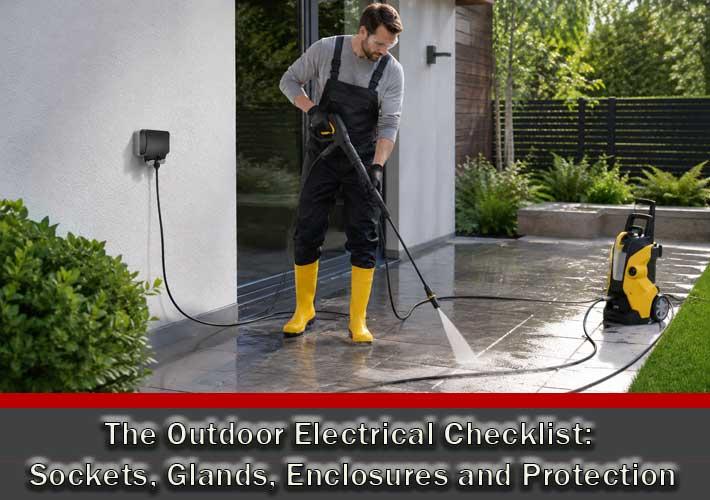
Outdoor electrical work becomes particularly common during the summer installation season. As gardens, patios, garages, sheds and other outdoor buildings receive more use, customers often need additional power, improved lighting control, safer connections and weatherproof equipment capable of withstanding British conditions.
Whether you’re installing a garden socket, supplying power to a shed, connecting outdoor lighting or upgrading a garage circuit, it’s essential to choose products designed for external use. Outdoor installations require more than standard electrical accessories. They need the correct IP rating, suitable cable entry, appropriate circuit protection and reliable fittings designed for damp, dusty or exposed environments.
This checklist covers some of the most useful products to consider before starting an outdoor electrical installation.
Outdoor sockets for gardens and patios
Outdoor sockets are one of the most common additions to domestic and light commercial properties. They can provide convenient power for garden tools, pressure washers, patio equipment, outdoor lighting, water features and other plug-in equipment.
For standard outdoor power, choose a socket with a suitable IP rating, such as IP65 or IP66, together with a robust weatherproof cover.
For customers looking for smarter control, the Lightwave Outdoor Smart 2 Gang Socket IP66 provides a weatherproof outdoor socket with app control, voice assistant compatibility, scheduling and energy monitoring.
The Lightwave system requires an L2 hub, which connects to the Wi-Fi network. It can then be expanded with other accessories, including relays for floodlights and wireless switches. Although the system can be more expensive than a conventional outdoor socket, it offers a wide range of smart control features for indoor and outdoor use.
Smart outdoor sockets can be particularly useful for garden lighting, water features, decorative lighting, seasonal equipment and outdoor appliances that customers want to control without manually switching the power.
For a straightforward non-smart option, products from ranges such as Click Aquip or Hamilton Elemento can also be considered.
Weatherproof junction boxes and enclosures
Outdoor electrical connections must be housed and protected correctly. A suitable weatherproof junction box or enclosure helps keep terminations safe, tidy and accessible while protecting them from dust, moisture and impact.
When selecting an enclosure for outdoor lighting, gates, garden buildings or external power supplies, consider exactly where it will be positioned. A box installed beneath a sheltered canopy will face different exposure levels from one mounted directly onto a garden wall or fence post.
The enclosure should suit the location, cable type and number of cable entries required. Options include IP-rated junction boxes for outdoor cable connections, adaptable weatherproof boxes for larger terminations, outdoor enclosures for relays and control equipment, and boxes with appropriate gland or conduit entry points.
For smaller outdoor connections, a compact IP-rated box may provide a cleaner solution than an oversized adaptable enclosure. The Unicrimp Q-Nect 3 Pole 3 Way IP68 Connection Box is designed for outdoor and underground connections and includes M16 and M20 cable entry options. It is suitable for applications such as garden lighting, water features and external cable joints, and is supplied with lever-style connectors.
For installations requiring more space, an ABS enclosure can accommodate larger terminations, controls or multiple cable entries. The Wiska IP65 ABS Enclosure provides a robust, weather-resistant housing for electrical equipment exposed to dust or moisture. Supplied with a mounting plate, it can also be used to create a tailored outdoor distribution enclosure.
Cable glands for a proper weatherproof seal
Cable glands may be a small part of an installation, but they are especially important outdoors. The correct gland secures the cable, helps maintain the enclosure’s IP rating and reduces the risk of water entering through the cable entry.
Standard cable glands can be used with flexible cables, outdoor lighting cables and general weatherproof accessories. Where steel wire armoured cable is used, suitable SWA glands are required to terminate the armour correctly and provide a secure finish.
SWA Storm cable glands are designed as universal glands for several cable types, including SWA, making them a useful option where cable protection and weatherproof sealing are important.
SWA cable accessories for outdoor supplies
Armoured cable is commonly used to provide power to garages, sheds, workshops, garden offices and other outdoor buildings. However, the accessories used with the cable are just as important as the cable itself.
A neat SWA installation usually requires the correct gland size, shrouds, earth tags, washers, fixings and suitable enclosure entry points. Selecting these components carefully helps create a safer, more robust installation and avoids untidy terminations that could cause problems later.
Common gland sizes include 20 mm small, 20 mm, 25 mm and 32 mm, depending on the cable and accessory being installed.
Before choosing cable and gland sizes, calculate the expected current demand, particularly for outdoor sockets, garages, sheds, garden offices, heaters and power tools. Once the load is known, the correct cable size, gland and enclosure entry can be selected.
RCD and RCBO protection for outdoor circuits
Outdoor circuits require suitable electrical protection. External sockets, garden lighting and outdoor power supplies can be exposed to moisture, physical damage and portable equipment, so circuit protection must be considered carefully.
RCDs and RCBOs are commonly used to provide additional protection. RCBOs are particularly useful where individual circuit protection is preferred, as a fault on one circuit is less likely to affect others.
A garage or outdoor sub-main may also require an IP-rated consumer unit, depending on the installation. Smaller boards can be purchased with or without incoming devices, allowing the installer to select suitable protection separately.
Before choosing protective devices, consider the load, cable route, installation method, earthing arrangement and current wiring regulations. Outdoor electrical work should always be designed and installed by a competent person.
PIR sensors, timers and photocells
Outdoor lighting becomes more useful and energy-efficient when it is controlled correctly. PIR sensors, timers and photocells can help reduce wasted energy, improve security and make the installation more convenient.
PIR sensors are ideal for entrances, driveways, side passages and security lighting where lights only need to operate when movement is detected.
Photocells are useful for dusk-to-dawn lighting, while timers provide greater control over when outdoor lighting or equipment is active.
Smart outdoor sockets may also be used to schedule and control suitable connected equipment, subject to the load and installation requirements.
Cable clips, fixings and installation accessories
Outdoor installations also require suitable fixings and accessories. Cable clips, screws, wall plugs, conduit fittings, mounting boxes and seals all contribute to a tidy and long-lasting installation.
Choose fixings that suit both the mounting surface and the environment. Brick, render, timber, fence posts, metalwork and outbuildings may all require different fixing methods.
Small details such as stainless-steel fixings, UV-resistant cable clips and properly sealed entries can make a noticeable difference to the quality and lifespan of the finished installation.
Final outdoor electrical checklist
Before starting an outdoor electrical installation, check that you have the correct products for the job. A typical installation may require:
- An outdoor socket or weatherproof switch
- A weatherproof junction box or adaptable enclosure
- Cable glands suited to the cable type
- SWA glands and accessories where armoured cable is used
- Suitable RCD or RCBO protection within a garage consumer unit
- A PIR sensor, timer or photocell for lighting control
- Suitable cable clips, fixings and sealing accessories
Outdoor electrical work requires products designed for the environment. Choosing the correct sockets, glands, enclosures and protective devices from the outset helps create a safer, tidier and more dependable installation.
Expert Electrical stocks a wide range of outdoor electrical accessories for domestic, commercial and trade installations, including outdoor sockets, cable glands, weatherproof enclosures, lighting controls and circuit protection.
Outdoor electrical installation FAQs
What IP rating is needed for outdoor electrical fittings?
The correct IP rating depends on the location and level of exposure. IP44 may be suitable for some sheltered areas, while IP65, IP66 or IP68 products offer greater protection against water and dust. Consider exposure to rain, spray, dirt and physical damage before making a selection.
Can a standard indoor socket be installed outside?
No. Standard indoor sockets are not designed for outdoor conditions. Outdoor sockets should be weatherproof, suitably IP-rated and fitted with a protective cover to prevent water and dirt entering when installed correctly.
Do outdoor sockets need RCD protection?
Outdoor sockets will normally require RCD protection because they are often used with portable equipment in environments where the risk of electric shock is higher. Protection may be provided by an RCD, RCBO or another suitable device within the main consumer unit.
What is the best cable for outdoor power?
The correct cable depends on the installation method and required load. SWA cable is commonly used for sheds, garages, garden buildings and other outdoor supplies because it provides mechanical protection.
Rubber H07 cable may also be suitable for certain applications, while conduit can be used to protect lighter cables. Always calculate the expected load and consider the route, installation method and protective device before selecting the cable.
Why are cable glands important outdoors?
Cable glands secure the cable where it enters an enclosure, junction box or socket. They also help maintain the weatherproof seal around the entry point. An incorrectly selected or poorly installed gland can allow moisture into the enclosure.
What size cable gland is required?
The correct size depends on the cable diameter and type. Common sizes include 16 mm, 20 mm, 25 mm and 32 mm, but the gland must be checked against the cable specification, enclosure entry and installation requirements.
Can electrics be installed in a shed or garden office?
Yes, but the installation must be designed correctly. A shed, garage or garden office may require its own consumer unit, suitable cable, appropriate earthing arrangements and RCD or RCBO protection.
The expected load should be calculated first, particularly where sockets, lighting, heaters or power tools will be used.
What is the difference between a junction box and an enclosure?
A junction box is generally used to make cable connections. An enclosure provides a larger housing for terminations, controls, relays or protection devices.
For outdoor use, both should have a suitable IP rating and be selected to match the location, cable entries and equipment being installed.
Can smart outdoor sockets be used for garden equipment?
Smart outdoor sockets can be useful for garden lighting, water features, seasonal lighting and some outdoor equipment. Always check the socket’s load rating and ensure the connected equipment is suitable.
Care should be taken with high-demand appliances such as patio heaters, as accidental remote activation could create a safety risk. Some smart systems provide a locking function to help prevent this.
Who should install outdoor electrical equipment?
Outdoor electrical work should be carried out by a competent person. External installations can involve moisture, buried cables, outbuildings, sockets and additional protection requirements, so the work must be safely designed and installed in accordance with current wiring regulations.
For more information on The Outdoor Electrical Checklist: Sockets, Glands, Enclosures and Protection talk to Expert Electrical Supplies Ltd