 Get Listed


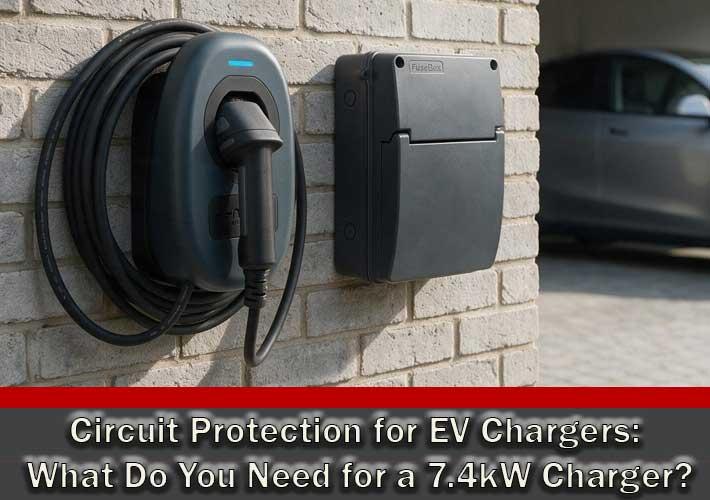
When installing a home EV charger, the charger itself is only part of the job.
The circuit protection supplying the charger is just as important.
A correctly specified external EV consumer unit or internal distribution unit can provide isolation, overload protection, residual current protection and surge protection for the charger circuit.
This is particularly useful when installing chargers such as the Tesla Wall Connector, where additional external protection may be required depending on the installation design.
Many modern EV chargers include built-in safety features such as open PEN fault protection and 6mA DC leakage detection, but the final circuit still needs to be correctly designed and protected by a qualified electrician.
What circuit protection does an EV charger need?
A domestic EV charger is usually installed on a dedicated final circuit.
The exact protection required depends on the charger, cable route, earthing arrangement, installation location and manufacturer’s instructions.
For most 7.4kW single-phase EV chargers, the main points to consider are:
Overcurrent protection, usually provided by an MCB or RCBO sized for the charger circuit.
RCD protection, with EV charging circuits normally requiring their own residual current protection, often at least Type A.
DC leakage protection, which may be built into the charger or provided separately.
Open PEN fault protection, which is required for many PME/TN-C-S installations unless another compliant method is used.
Surge protection, which is strongly recommended, particularly for expensive EV charging equipment.
Isolation, allowing the circuit to be safely disconnected for maintenance or testing.
One of the simplest ways to provide much of this protection is through a dedicated EV distribution unit or IP-rated consumer unit designed for EV charger installations.
How to specify the correct amp rating for a 7.4kW EV charger
A typical single-phase home EV charger is rated at 7.4kW.
In the UK, this is normally based on a 230V single-phase supply and a maximum current of around 32A.
The calculation is:
Power ÷ Voltage = Current
For a 7.4kW charger:
7,400W ÷ 230V = 32.17A
In practice, this is treated as a 32A EV charger circuit.
Many chargers are described as 7.4kW / 32A because 230V × 32A gives approximately 7.36kW, which is commonly rounded to 7.4kW.
That does not mean every installation will use exactly the same protective device.
Some manufacturers or installation designs may require a 40A protective device depending on the charger instructions, cable type, cable size, installation method and derating factors.
The final selection should always be made by the installing electrician.
32A or 40A EV consumer unit?
For a standard 7.4kW EV charger, a 32A RCBO is commonly used because the charger load is approximately 32A.
A 40A version may be suitable where the charger manufacturer’s instructions, cable calculations or installation design require a larger protective device.
The protective device must still protect the cable correctly, so the electrician needs to confirm factors such as cable size, installation method, grouping, insulation, ambient temperature and voltage drop.
As a simple guide, a 32A EV board is suitable for many 7.4kW EV charger installations where the charger is configured for 32A and the circuit has been designed accordingly.
A 40A EV board may be used where the installation design or manufacturer’s guidance calls for a larger protective device.
The charger output can also often be limited during commissioning, which can be useful where the property supply is restricted or load management is required.
Why surge protection is worth adding
An EV charger is a high-value electronic device connected to an outdoor load.
For this reason, surge protection can be a sensible addition to many EV charger installations.
A Type 2 surge protection device can help protect the charger and associated electronics from transient overvoltages caused by switching events, grid disturbances or nearby lightning activity.
It can represent a relatively small additional cost compared with replacing a damaged EV charger.
If the charger does not include integrated surge protection, an EV consumer unit or supply isolator with a Type 2 SPD provides a practical way to add it.
Recommended FuseBox options for EV charger circuit protection
FuseBox E2PMST2 Meter Supply Isolator with Type 2 SPD
The FuseBox E2PMST2 Meter Supply Isolator with Surge Protection Device and Main Switch can be useful where surge protection and isolation are required near the incoming supply.
It is supplied with a Type 2 SPD, 100A main switch and DIN rail connector.
It is normally installed near the incoming meter position and can provide a safer method of isolating the installation without removing the main incoming fuse.
This product does not replace the EV charger’s final circuit protection, but it can form part of the wider installation where surge protection and incoming isolation are required.
FuseBox AEV32AXBDGY IP65 EV Consumer Unit
For outdoor or garage installations, the FuseBox AEV32AXBDGY IP65 32A Bi-Directional Mini RCBO + Type 2 SPD Consumer Unit is one of the most useful options.
It is an IP65-rated aluminium consumer unit designed for internal or external use.
It includes a 100A main switch with SPD and a 32A bi-directional RCBO, making it suitable for many single-phase 7.4kW EV charger installations.
This is often a practical option where the EV charger is mounted outdoors, in a garage or away from the main consumer unit and an IP-rated enclosure is preferred.
FuseBox EV32ABDZ EV Distribution Unit
The FuseBox EV32ABDZ EV Distribution Unit is a non-IP-rated metal EV distribution unit designed for indoor installations.
It includes a 100A main switch, Type 2 SPD and 32A Type A RCBO.
This makes it a suitable choice where the EV distribution unit is installed indoors, such as near the main consumer unit or inside a garage where an IP65 enclosure is not required.
What are Henley blocks used for in EV charger installations?
In EV charger installations, Henley blocks, also known as service connector blocks or terminal blocks, are often used to split the meter tails after the electricity meter or main isolator.
This allows a separate supply to be taken to a dedicated EV consumer unit while the existing consumer unit continues to supply the rest of the property.
This can be useful where there is no spare capacity or suitable space inside the existing consumer unit, or where the EV charger is being supplied from its own dedicated distribution unit.
A typical arrangement may involve the main supply feeding terminal blocks, with separate outgoing tails supplying the main consumer unit and the EV charger consumer unit.
The FuseBox 5 Pole 100A Terminal Blocks are suitable for this type of installation where a secure 100A-rated terminal connection is required.
They feature dual screw terminations and a secure cover with wire locking screw, helping provide a neat and reliable connection point for larger conductors.
It is important to remember that Henley blocks do not replace the need for correct circuit protection.
They are used for splitting or terminating the supply, not as protective devices.
The EV charger circuit still needs suitable overcurrent protection, RCD or RCBO protection, surge protection where required and compliance with the charger manufacturer’s instructions.
Work around meter tails and incoming supply equipment should only be carried out by a qualified electrician.
The installer must check the main fuse rating, meter tails, earthing arrangement, maximum demand and DNO requirements before adding an EV charger supply.
What about Tesla Wall Connector installations?
The Tesla Wall Connector is a popular home EV charger, but it needs to be installed with the correct external circuit protection for the property.
Tesla lists the Wall Connector as suitable for up to 7.4kW / 32A on single-phase 230V installations and also lists integrated Type A RCD plus 6mA DC protection.
However, UK installations also need to take account of open PEN fault protection, the earthing arrangement and external isolation requirements.
This is why a dedicated EV distribution unit or other suitable external protection device is often specified as part of the installation.
For Tesla charger installations where additional protection is required, products such as the FuseBox AEV32AXBDGY IP65 EV Consumer Unit or FuseBox EV32ABDZ EV Distribution Unit can provide a more complete circuit protection solution.
What if the charger already has built-in PEN and RCD protection?
Many modern EV chargers now include features such as open PEN fault protection, Type A RCD protection and 6mA DC leakage detection.
For example, BG Sync EV chargers include integrated open PEN conductor protection, 30mA Type A RCD protection and 6mA DC protection.
Even where these features are built into the charger, the supply circuit still needs suitable overcurrent protection and may still benefit from surge protection.
The key is to avoid unnecessary duplication while still meeting the charger manufacturer’s instructions and BS 7671 requirements.
Which EV circuit protection product should you choose?
For an outdoor EV charger installation, the FuseBox AEV32AXBDGY can provide an IP65 enclosure, Type 2 SPD and 32A bi-directional RCBO.
For an indoor EV charger circuit, the FuseBox EV32ABDZ provides a metal EV distribution unit with a 100A main switch, SPD and 32A Type A RCBO.
For incoming supply isolation and surge protection, the FuseBox E2PMST2 can be used around the meter position.
For Sync EV charger installations, BG Sync EV chargers already include open PEN protection, Type A RCD protection and 6mA DC protection within the charger.
Final thoughts
For a 7.4kW EV charger, the load is normally around 32A, so a 32A EV circuit is common.
The final protective device must still be selected by the installer based on the charger instructions, cable calculations and installation conditions.
For many domestic installations, a dedicated EV consumer unit with a Type 2 SPD and Type A RCBO provides a straightforward approach.
For outdoor installations, an IP-rated enclosure may be appropriate.
For indoor installations, a metal EV distribution unit may be suitable.
If you are installing a Tesla Wall Connector, it is worth checking whether additional open PEN protection, surge protection or external circuit protection is required.
If you are installing a modern charger such as the BG Sync EV range, many of the EV-specific safety features may already be built into the charger, but the supply circuit still needs to be correctly protected.
Always use a qualified electrician for EV charger installations and follow the charger manufacturer’s installation instructions.
For more information on Circuit Protection for EV Chargers: What Do You Need for a 7.4kW Charger talk to Expert Electrical Supplies Ltd