 Get Listed

By Martin Constable, Operations Director, EPIT Group
As the global shift toward clean energy accelerates, hydrogen is becoming central to how we think about fuel, flexibility, and decarbonisation. But with growing adoption comes growing complexity – particularly in how we manage safety.
At EPIT, we engage with organisations across industry that are beginning to work with hydrogen. And while many of the safety concerns around hydrogen are well understood in theory, applying those principles consistently across operations remains a challenge.
Put simply, hydrogen’s safety profile doesn’t stand still. It changes depending on where the hydrogen is in the supply chain – whether it’s being produced, stored, or transported. Recognising this variability is fundamental to building systems and teams that can manage risk effectively.
Understanding safety as a dynamic concept
Unlike conventional fuels, hydrogen introduces hazards that are both familiar and uniquely nuanced. Low ignition energy, high diffusivity, and material compatibility challenges all combine to create a fuel that demands new thinking – not just updated procedures.
But what’s often overlooked is that the context of use matters just as much as the chemistry.
A production facility may be managing pressurised electrolysers and electrical zoning requirements. A transport depot might be focused on valve integrity and vehicle earthing. A storage site could be dealing with embrittlement or cryogenic handling risks. The safety principles may be consistent – but their application is not.
That’s where gaps can appear. And that’s where training, understanding, and operational preparedness become non-negotiable.
Three environments, three safety mindsets
- Production: Controlling the origin point
Whether hydrogen is generated through electrolysis or reforming, production sites bring together gas handling, electrical systems, and thermal processes — all within potentially hazardous zones.
The challenge: Designing and operating systems that prevent ignition while managing complex instrumentation and control environments. - Storage: Managing containment and compatibility
Hydrogen may be stored at extremely high pressures or as a cryogenic liquid. Both approaches require materials, seals, and monitoring systems that are specifically chosen and maintained to prevent leaks and structural failure.
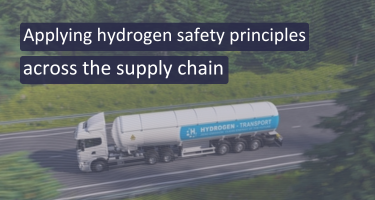
The challenge: Ensuring materials integrity and pressure relief capability over time, especially with potential embrittlement risks. - Transport: Moving hydrogen with precision and control. From cylinder trailers to road tankers, hydrogen transport introduces risks associated with vibration, accidental damage, and external environmental exposure — often beyond controlled site boundaries. The challenge: Maintaining consistent standards and awareness in mobile, distributed operations with varied personnel.
Building competence beyond compliance
The technical guidance is clear. Standards such as IEC 60079, IEC 80079, ISO/TR 15916, and ISO 19880 provide robust frameworks for hydrogen safety. But standards alone don’t build safe systems — people do.
Hydrogen safety depends not just on rules and equipment, but on the understanding of the people working with it — and how well those people apply safety principles in different contexts.
Training isn’t just about awareness — it’s about judgement, preparedness, and confidence. It ensures that hydrogen systems are not just designed correctly, but operated and maintained with the insight needed to keep them safe over time.
As hydrogen continues its path from innovation to mainstream application, the industry must move from theory to action — from general awareness to applied competence.
Applying hydrogen safety principles consistently across the supply chain isn’t just best practice. It’s what will enable long-term confidence in hydrogen as a viable, scalable energy solution.
Explore our hydrogen safety leadership series at epitgroup.com.
Or learn more about how we’re helping organisations prepare through our Hydrogen Safety Awareness course.
For more information on Applying Hydrogen Safety Principles across the Supply Chain talk to EPIT