 Get Listed

How Do Sectional Garage Doors Work?
Sectional garage doors operate by lifting a series of hinged horizontal sections. Basically, as the door moves each panel travels along a curved track before sliding back along the garage ceiling. Consequently, there is no outward swing, so driveway space is maximised. The panels are connected with articulated hinges, guided by smooth-running rollers, and supported by calibrated springs. When automated, a motor drives the movement, enabling the door to open and close effortlessly. Altogether, components work as a well-balanced system to ensure that weight, motion and safety are controlled effectively.
Video: How a Sectional Garage Door Works.
This video shows how a sectional garage door moves as its individual panels lift and travel along the overhead tracks.
Video Player
00:00
00:20
What controls a sectional garage door when it closes?
Spring system regulates the weight.
Torsion or extension springs counterbalance the door’s mass, allowing the panels to descend in a measured, stable motion instead of falling under gravity.
Tracks and rollers guide the panels.
Precision‑engineered rollers travel inside the track system, keeping each section aligned and preventing lateral movement as the door lowers.
Hinges and couplings control panel articulation.
Hinges between the panels pivot at the correct moment, allowing the door to fold and straighten smoothly throughout the downward travel.
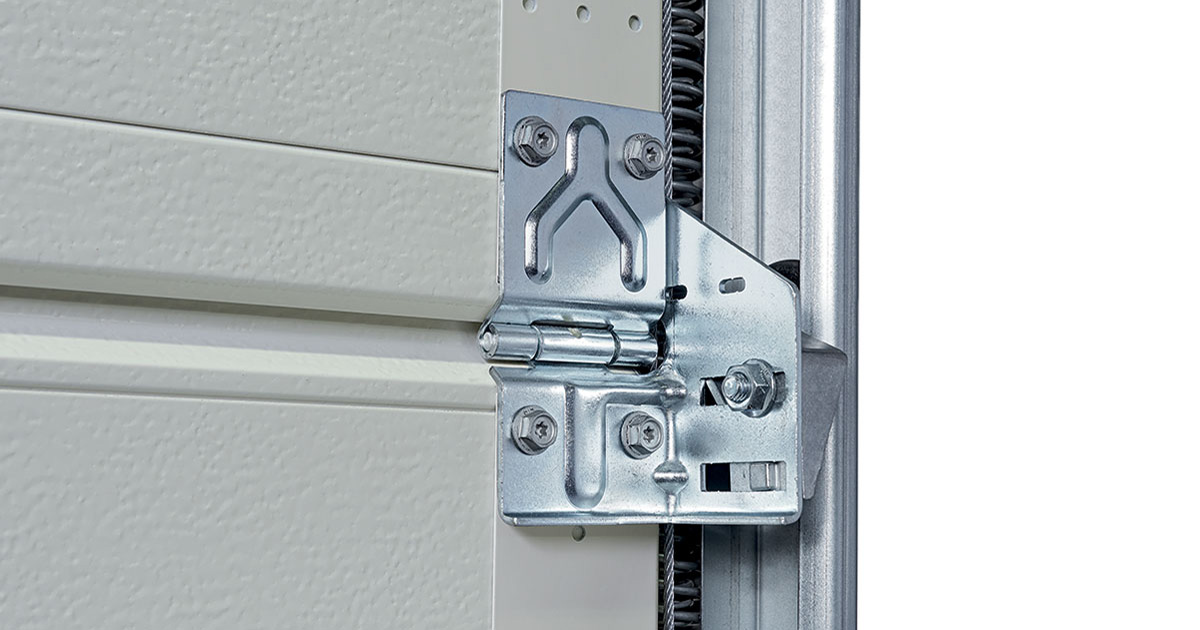
Sectional garage door hinge showing how door panels pivot during operation.
This hinge connects two sectional garage door panels and allows them to pivot as the door transitions, a key part of how a sectional garage door works.
Operator (motor) manages speed and force.
When automated, the operator uses a controlled drive system to regulate:
Closing speed
Stopping force
Soft‑start and soft‑stop behaviour
This prevents slamming and reduces mechanical strain.
Safety sensors prevent accidents.
Photo‑eye sensors and force‑monitoring systems ensure the door closes only when the path is clear, supporting a consistent, predictable motion – reversing the door if an object is in the way.
What controls a sectional garage door when it opens?
When the door rises, the system activates a coordinated lifting mechanism that elevates the panels and transitions them from vertical to horizontal. During the opening cycle, these components take charge:
Spring system balances the door.
Springs counterweight the door, enabling the panels to rise without abrupt movement or excessive load on the mechanism.
Tracks and rollers direct the upward travel.
Rollers within the track system maintain alignment and ensure each panel moves upward in a stable, controlled path. Likewise, tension-sprung tracks with built in safety features help to prevent derailment.
Tandem rollers made from durable steel and high‑grade nylon, often with sealed bearings, reduce wear and extend service life – especially on heavier doors.
Hinges and couplings manage panel flexing.
Hinges pivot at precise intervals, allowing the door to articulate cleanly as it transitions from the vertical plane into the overhead position.
Operator (motor) controls lifting dynamics.
When automated, the operator regulates:
Lifting speed
Acceleration and deceleration
This produces a smooth, predictable opening cycle.
Torsion or Tension Springs?
Sectional garage doors rely on a counterbalance system to make lifting safe and manageable.
Torsion springs sit above the opening and store torque as they wind and unwind.
Tension springs sit inside the tracks and stretch or contract under load.
Nevertheless, both systems reduce the effort required to lift the door, ease strain on the operator, and keep movement steady and predictable. The choice of spring is dependent on structural requirements of the garage, the weight of the door, and the headroom available – as defined by our professional surveyors.
Operator Systems.
Modern sectional doors pair with advanced operator units. Motors may use belt, chain, or direct‑drive systems housed inside a centrally mounted boom fixed to the ceiling. The operator connects to the top panel and works in harmony with the spring system, track design, and security features to deliver consistent operation, uniform pulling forces, and automatic locking. This ensures lifting and closing forces transfer smoothly throughout the door’s travel path.
Sectional garage door operator showing motor and drive system used to open and close the door.
The operator powers the sectional garage door by driving the trolley along the rail, pulling the door open and pushing it closed—an essential component in how a sectional garage door works.
In summary.
The result of each component working in harmony is a finely balanced door that ensures ribbing and section transitions are evenly distributed at every position. This makes sectional garage doors one of the most versatile and high‑performing options for residential properties. The coordinated mechanisms deliver smooth lifting, secure closing, strong insulation, and long‑term reliability. For homeowners comparing garage door types – or researching upgrades – understanding how these parts interact is essential for choosing high quality doors that have refined and well-developed details.
The features described do not always apply to the standard versions and can vary according to model and type of door.
For more information on How Do Sectional Garage Doors Work? talk to Eastern Garage Doors