 Get Listed

National Maritime Museum Greenwich
Atmospheric dome over the ocean
| Usage | Education & Culture |
| Solution | Natural Smoke Ventilation, 230 V Smoke Extraction |
| Construction year | 2025 |
| Location | United Kingdom |
| Architect | Vision Arch |
Natural ventilation and smoke vent for the atrium of the UNESCO World Heritage Site
Located in the heart of historic Greenwich, London, the National Maritime Museum has undergone extensive modernisation. The museum forms part of the Maritime Greenwich UNESCO World Heritage Site and is home to one of the world’s most significant maritime collections. The Ocean Court was at the heart of the renovation. This large, covered courtyard is the gateway through which millions of visitors enter the museum each year. The existing roof structure was completely replaced to address long-standing challenges such as overheating, water ingress and outdated building technology, without compromising the heritage status of the building, which is over 400 years old.

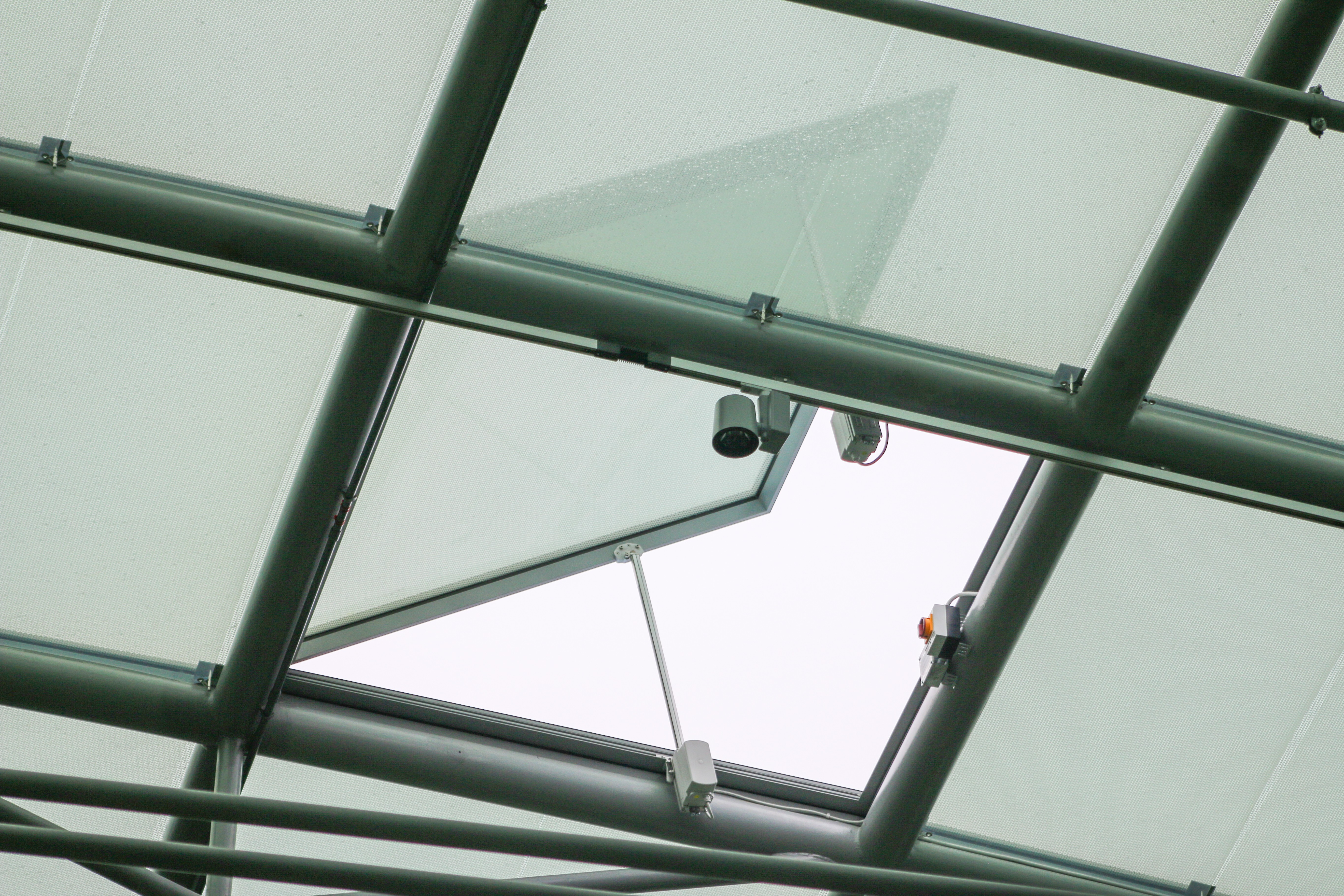
D+H UK developed an intelligent control system for natural ventilation and a smoke vent in the event of a fire event. The new glass dome above the Ocean Court acts as a central ventilation zone: fresh air flows in through the façade openings, whilst exhaust air is discharged in a controlled manner via roof openings. Over 50 chain drives from the robust, surface-mounted KA Classic Series are used in the façade. In the roof area, 16 heavy-duty rack and pinion drives from the DXD Series handle the heavy-duty work. Both drive types are mounted on the windows in pairs in a synchronised configuration and respond dynamically to temperature readings and building data – the opening widths are adjusted incrementally and as required.
For the smoke vent, the system operates according to the principle of cold smoke clearance: in the event of a fire event, the system initially closes completely, and only once the fire has subsided can the roof openings be opened selectively for smoke extraction.

Due to the exceptional cable lengths, a 230 V system was installed to reduce the required cable cross-sections. The entire system is controlled via a fully modular CPS-M series control panel with a touchscreen, which is fully integrated into the building management system via Modbus technology. This allows opening angles, fault messages, closure status and alarms to be monitored and controlled in real time.
The installation presented the team with major challenges. Parts of the glass dome are situated almost 30 metres above the museum floor and could only be accessed via a complex, specialised scaffolding structure. The heavy control cabinet, just under two metres high, had to be dismantled on site, transported to the plant room and reassembled. Furthermore, all tests had to be fully completed before the scaffolding could be dismantled.
The project marks a technological milestone for D+H UK: as one of the first projects in the UK to feature 230 V technology, a touchscreen panel and full Modbus integration, it laid the foundations for new standards.
The modernisation of the National Maritime Museum demonstrates how state-of-the-art building technology can be seamlessly integrated even into one of the UK’s most challenging existing buildings. For this showcase of technical innovation and system integration under extreme conditions, the UK branch received the D+H Atmosphere Award 2026 in the ‘Innovation’ category.
For more information on National Maritime Museum Greenwich talk to D+H UK