 Get Listed


Introduction
Industrial felt is available in a wide range of materials, grades, thicknesses and roll formats.
However, the width supplied by the material manufacturer is not always the width required on the production line.
This is where industrial felt slitting can help.
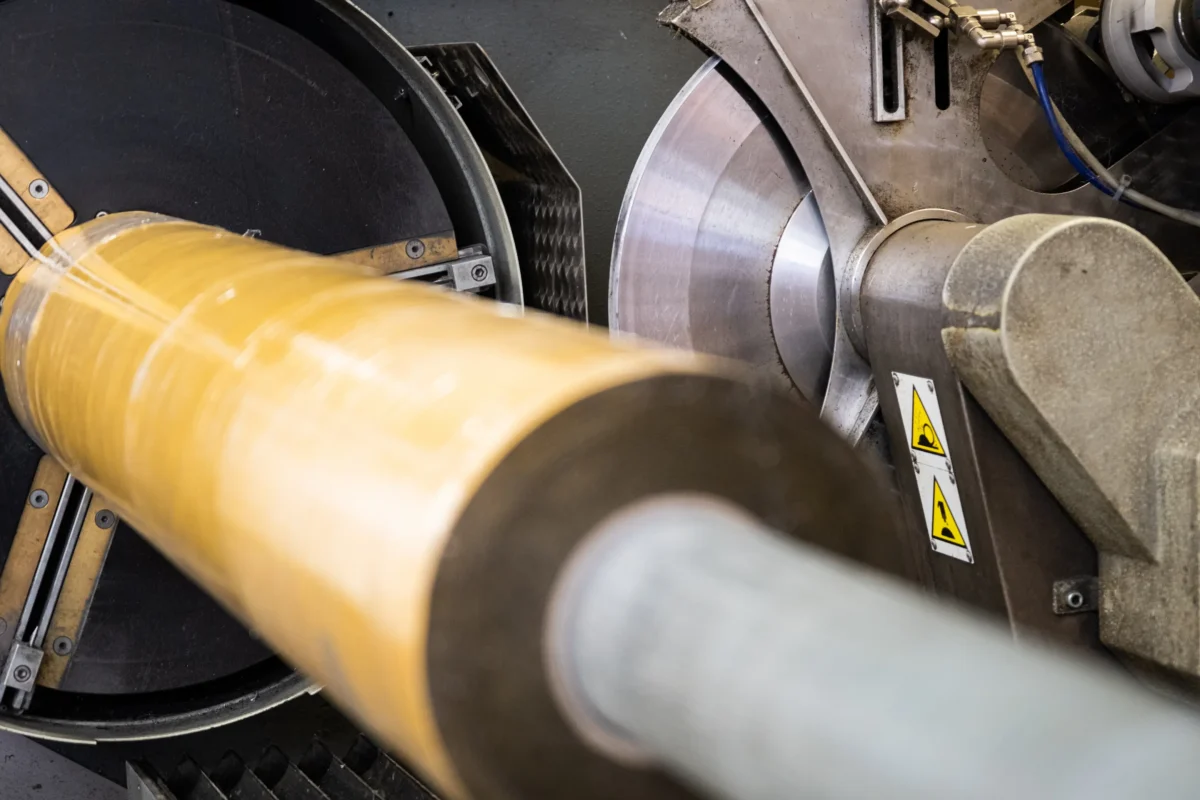
Slitting converts wider rolls of felt into narrower continuous rolls or coils, allowing manufacturers to receive material in a format better suited to their production process or end application.
At British Felt, slitting forms part of our wider industrial felt conversion capability.
Depending on the requirement, materials can also be adhesive laminated, die cut, kiss cut or CNC knife cut to produce anything from narrow continuous coils to individual finished components.
If you are still deciding which type of felt is suitable for your application, our Comprehensive Guide to Industrial Felt provides an introduction to industrial felt materials, properties, grades
What is Industrial Felt Slitting?
Industrial felt slitting is the process of converting a wider roll of felt into one or more narrower continuous rolls.
Rather than cutting across the material to produce individual sheets or components, the material is cut along the length of the roll.
The resulting narrow rolls are commonly referred to as coils, strips or tapes, depending on their width, construction and intended application.
For example, a wide roll of industrial felt could be converted into a series of narrow coils for use as:
- protective strips;
- cushioning material;
- anti-rattle strips;
- sealing strips;
- packing material;
- wiping strips;
- adhesive-backed felt tapes;
- production-line materials.
The important consideration is not simply the width of the felt, but how the converted material needs to be presented and used within the customer’s manufacturing process.
Why slit industrial felt into narrower rolls?
A manufacturer may be able to purchase industrial felt in a standard roll width, but that does not necessarily mean the material is ready to use.
If only a narrow strip is required, somebody still needs to convert the wider material into the required format.
For manufacturers without dedicated slitting equipment, this can mean additional handling and processing before the felt reaches the production line.
Having the material professionally slit can provide a more practical alternative.
Material supplied closer to the required width
One of the most obvious reasons for slitting felt is to obtain a specific finished width.
Instead of receiving a wide roll and cutting strips internally, the material can be converted into narrower coils before delivery.
This can be particularly useful where the same width of material is used repeatedly.
Easier handling on the production line
Narrow coils can be easier to store, unwind, feed and apply than full-width rolls.
This is especially relevant where felt is being applied progressively along a component or assembly rather than being cut into individual parts.
Reduced in-house conversion
Not every manufacturer wants to invest in specialist equipment for converting flexible materials.
Outsourcing the slitting operation allows the material to arrive closer to the format required for production.
Integration with other conversion processes
Slitting can also form one stage of a wider conversion process.
For example, felt can potentially be laminated with a pressure-sensitive adhesive before being slit, producing narrow rolls of adhesive-backed material.
This ability to combine processes can be particularly useful when the finished requirement is more specialised than a simple strip of plain felt.
What materials can British Felt slit?
Although industrial felt is an important part of our slitting capability, the process is not limited to felt alone.
Depending on the material and specification, British Felt Co.’s coil and tape slitting capability can be used with materials including:
- industrial felt;
- non-woven materials;
- foams;
- sponge rubbers;
- adhesive tapes;
- technical textiles.
This can be useful for manufacturers that use several flexible materials within the same product or assembly.
For industrial felt applications, however, selecting the correct material should come before deciding how it will be converted.
Factors such as the felt type, grade, thickness and physical properties can all influence whether a material is suitable for a particular application.
For more information, see our guide to industrial felt materials, grades and applications.
For more information on A Comprehensive Guide to Industrial Felt Slitting talk to British Felt Company