 Get Listed
Sign In

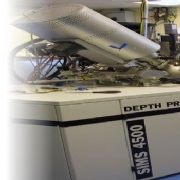
Ultra Low Energy SIMS (ule-SIMS)
One of the consequences of conventional SIMS depth profiling analysis, using beam energies in the 2-15 keV regime, is a “pre-equilibrium region” which is of the order ~ 10-12 nm. The implication is that, under these conditions, the “information” from the initial 10-12 nm of a profile is not reliable.
The use of ultra low energy primary ions (typically 200–700 eV) in ule-SIMS analysis overcomes this, reducing the pre-equilibrium region to ~1-2 nm. This is a major advantage for analysis of shallow junctions or low energy implants, where the information in the near surface region is crucially significant. The other virtue of ultra low energy SIMS is that it minimises the “ion beam mixing “effects thereby providing considerable benefits in terms of depth resolution.
In addition to "mixing", sputter induced roughening effects also have an adverse effect on depth resolution. It is therefore important to use special protocols which minimise such effects. Generally the evolution of sputter induced roughening effects is dependent upon the chemistry and crystalline structure of layers as well as the primary ion energy, species and their angle of incidence to the surface. To overcome these effects special protocols have been developed for ultra low energy SIMS deploying specific angles of incidence and taking measures to control chemistry of the surface (e.g. by oxygen flooding) during the sputtering process. For example, using O2 primary beams at normal (or near normal) incidence conditions minimise such roughening effects in silicon and silicon germanium.
Quadrupole SIMS instruments, equipped with ultra low energy beams, are well suited for high depth resolution applications. This is because they provide precise control of the angle of incidence, for both Cs and O2 beams at low (200-1000 eV) impact energies , thus resulting in SIMS depth resolutions (decay) of ~1.5 nm/decade.
The important application areas are analysis of ultra shallow junctions, low energy implants, SiGe analysis and ultra thin dielectrics.
For more information on Ultra Low Energy SIMS (ule-SIMS) analysis talk to Aystorm Scientific Ltd
More products
Welcome back to FindTheNeedle.
Not registered? Get listed — most visitors don't have an account yet.
List your company on FindTheNeedle.