 Add My Company
Why Your Compressed Air System Deserves Attention
Compressed air is often called the “fourth utility” in manufacturing – alongside electricity, gas, and water. Yet, unlike the others, it’s one of the least efficient forms of energy used in production. In many factories, compressed air accounts for up to 10% of total electricity costs, and in some industries, it’s significantly higher.
That’s why understanding how your system operates and where it might be wasting energy can deliver some of the fastest and most cost-effective savings available.
At Avelair, we often find that the key to reducing energy consumption isn’t about focusing on one component. Instead, it’s about taking a whole-system approach which means reviewing how every part of your compressed air network interacts – this can be completed via a compressed air audit.
Compressed air energy audit: More than just the Compressor
A compressed air system is exactly that – a system. It includes the compressor, dryers (refrigerant, desiccant or membrane), filters, receivers, pipework, and all the end uses. If one part isn’t optimised, it can affect the efficiency of everything else.
Imagine buying the most efficient compressor on the market, but connecting it to a pipe network full of leaks and pressure drops. In that case, you’re simply producing waste more efficiently. The compressor works harder than necessary, using more electricity and shortening its lifespan.
Our engineers at Avelair always begin with the big picture. We assess:
-
Air generation (the compressors)
-
Air treatment (dryers, filters, separators)
-
Air storage (receivers)
-
Distribution (pipework and controls)
-
End use (tools, machinery, blow guns, etc.)
By understanding how each part performs, we can uncover where energy is being lost and where it can be saved.
Measuring What Matters: Energy Use and Demand
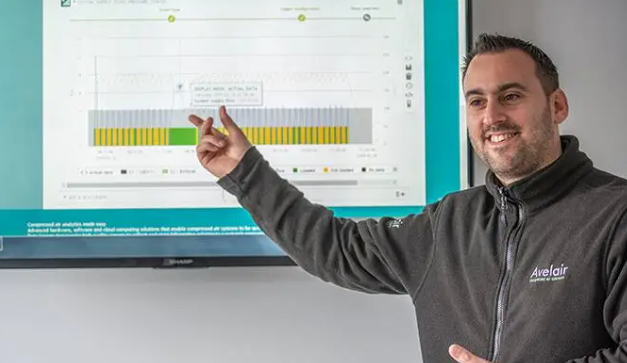
Before improvements can be made, it’s important to measure how much energy your compressors use. Installing data loggers onto the compressors for a week gives a clear picture of:
-
When compressors are running on-load (producing air) and off load (motor turning but not producing air)
-
Pressure changes
-
How demand fluctuates across shifts
- Air leaks
For example, one 75kW compressor operating 2,000 hours per year at 7 bar pressure can consume over 120,000 kWh annually costing roughly £14,000 to £18,000 in electricity. Multiply that by several compressors, and the savings potential becomes clear.
At Avelair, we use data logging and flow monitoring to create a real-time “demand profile” of your system. This allows us to identify inefficiencies such as excessive off-load running or oversized compressors and recommend smart control systems or load-sharing setups.
The Key to Efficiency: Matching Supply and Demand
In many factories, compressors are left running even when air demand is low or non-existent such as during breaks, weekends, or quiet production periods. That’s like leaving your car idling all night.
The goal is to ensure your compressors are producing only the air you need, when you need it. This involves:
-
Using intelligent compressor management controllers ensuring compressors are running only as and when required
-
Ensure the compressors are correctly sized and the correct type (eg fixed speed or Variable speed)
-
Adjusting operating pressure based on actual demand
-
Switching compressors off when not required
- Fixing leaks
By optimising the above, it’s possible to reduce total energy consumption by up to 20–30%, often without any major capital investment.
Don’t Forget the Basics: Leaks and Pressure Losses
Even the best control system can’t overcome air leaks or poor pipe design. A 3mm leak could cost over £600 per year in wasted energy, and most factories have dozens of them.
Similarly, every 1 bar of unnecessary pressure adds around 7% to energy costs. Fixing leaks and ensuring your system pressure is properly set can therefore provide immediate, measurable savings.
At Avelair, we include a leak detection and pressure drop analysis in every system audit. It’s a simple yet powerful way to reduce running costs and improve overall reliability.
Considering the Lifetime Cost, Not Just the Purchase Price
When planning upgrades, it’s tempting to choose lower-cost equipment to save on initial investment. But over time, energy makes up more than 70% of the total cost of owning and running a compressor.
Choosing higher-efficiency models, intelligent controls, and well-designed pipework pays back rapidly in reduced electricity bills and less downtime. The savings don’t just benefit the environment, they also improve your bottom line.
How Avelair Can Help
We’re passionate about helping manufacturers run cleaner, more efficient compressed air systems. Whether you’re looking to reduce energy use, improve reliability, or prepare for a compressed air energy audit, our team can help you identify and implement the best solutions.
We offer:
-
On-site system assessments
-
Energy data logging and analysis
-
Leak detection and repairs
-
Design and installation of efficient compressors and pipework
-
Ongoing maintenance and monitoring
If you’d like to discover where your compressed air energy is really going and how much you could save, contact our team at Avelair today on 01359 272828 or email david.wood@avelair.co.uk to arrange a compressed air energy audit.
For more information on Tip 1: How compressed air energy audits help reduce your energy consumption talk to Avelair Compressed Air Solutions