 Get Listed
Rethinking Nitrogen Supply for Laser Cutting
In laser cutting, nitrogen plays a vital role in achieving fast, clean, oxidation-free results. But traditional reliance on bottled or bulk nitrogen is now increasingly being questioned. With demand for fibre lasers growing and customer expectations rising, manufacturers are looking for greater control and lower operating costs, without compromising on cut quality.
New developments in nitrogen generation are enabling that shift, and a growing number of firms are bringing gas supply in-house for the first time to unlock performance gains, streamline operations and support future growth.
Nitrogen is widely used as an assist gas in laser cutting. It prevents oxidation during the cut, allowing for a clean, bright edge that supports downstream processing. This is especially important for stainless steel and aluminium, where oxidised edges can disrupt welding, painting, or powder coating.
While oxygen can be used for certain applications, it typically leaves a carbon-stained edge and can increase thermal damage around the cut. Nitrogen helps avoid this, enabling faster cutting speeds and a wider range of material compatibility, including non-ferrous metals such as brass and copper.
For these reasons, nitrogen remains the gas of choice in high-quality sheet metal processing. But how it is supplied can make a significant difference to both cost and carbon performance.
Historically, bottled or liquid nitrogen has been seen as the simplest option. It arrives ready to use and is delivered by a third party. But beneath the surface, the true cost of this approach can be much higher than it appears.
Ongoing delivery fees, rental costs, and volatile pricing can make external nitrogen supply unpredictable and expensive. On top of that, every delivery carries a carbon impact and introduces a supply chain risk that has become painfully clear to many businesses during recent times.
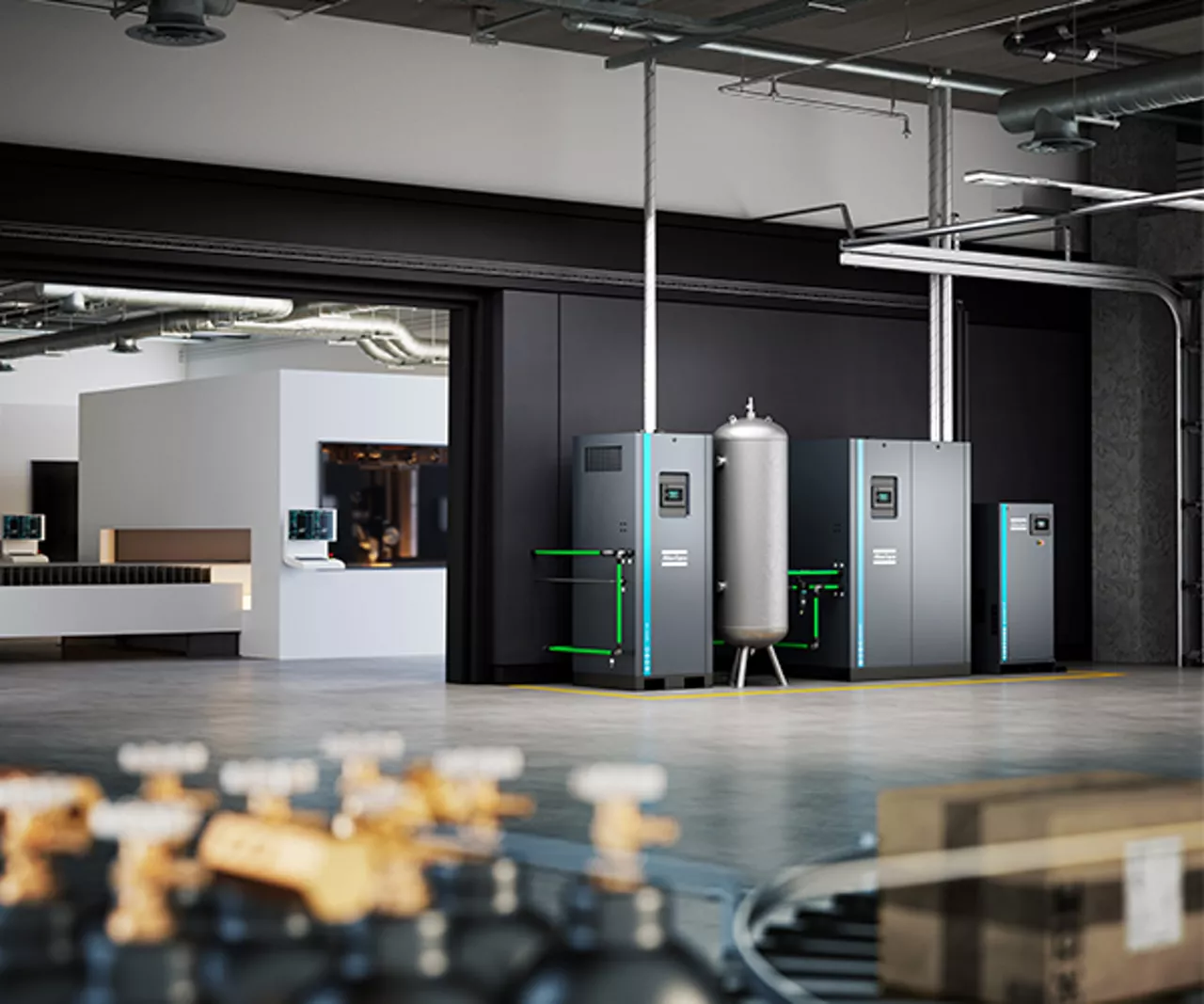
By contrast, generating nitrogen on-site allows manufacturers to take control. Systems are typically built around a compressed air source, which is dried, filtered, and fed into a nitrogen generator using Pressure Swing Adsorption (PSA) technology to separate oxygen from nitrogen.
The result is a constant, uninterrupted supply of nitrogen gas, available at the required purity and pressure, and produced at a far lower operating cost than a bottled supply.

One of the main benefits of on-site generation is the ability to specify the nitrogen purity that each application requires. Purity refers to the oxygen content remaining in the nitrogen stream, whereas quality relates to moisture, oil, and particulates. These are managed separately through filtration and drying systems.
In practice, many laser cutting tasks do not require five-nines (99.999%) purity. But this is what is often supplied by default when purchasing bottled nitrogen. Attempting to replicate this level of purity on-site, without needing it, results in oversized systems and unnecessary energy consumption.
Today’s nitrogen generators allow users to produce nitrogen gas at precisely the right purity for their process. For example, cutting mild steel at thicknesses up to 5 mm typically requires nitrogen at 99.99% purity, while some applications are well served by 98%. Specifying the right level can reduce air consumption, lower compressor load, and improve overall efficiency.
Where ultra-high purity is required, new technology is helping increase the already highly viable option of on-site generation. The Nitrogen Purifier through Hydrogen (NPH) from Atlas Copco, for instance, uses a two-stage approach to deliver 99.999% or higher purity without the traditional energy burden.
In a standard nitrogen generator, reaching the highest purities requires large volumes of feed air and significant compressor power. The NPH changes this by allowing the generator to produce nitrogen at a lower purity, such as 99.9%, then using a small amount of hydrogen to react with the residual oxygen. The result is nitrogen of up to >99.9999% purity, with up to 40% less feed air required.
The NPH can be added to an existing nitrogen system to boost performance and double output or built into a new setup to reduce equipment size and operating cost. Because it reduces strain on the site’s electrical infrastructure, it is particularly well suited to manufacturers facing power limitations or space constraints.

For businesses already using on-site nitrogen, there are good reasons to consider upgrading. Many older systems were built around less efficient designs, with higher air-to-nitrogen ratios and limited flow capacity.
Today’s systems incorporate refined CMS (Carbon Molecular Sieve) technology and improved PSA processes that enhance separation performance. Monitoring and control has also improved, with automatic purity checks, integrated safety systems, and remote management options as standard.
Replacing legacy equipment with a more modern generator can increase capacity, reduce energy costs, and improve reliability; particularly in fast-growing operations where nitrogen demand has outpaced system capability.
One final consideration is system integration. In some setups, the compressor, filtration, booster and generator are sourced from different manufacturers. While this can work, it complicates service and support. If performance issues arise, there can be delays in determining responsibility or sourcing parts.
A fully integrated solution designed, built, and supported by a single provider reduces that risk. It ensures all components are matched for flow and pressure, and it simplifies maintenance, which is especially important in 24/7 operations.
At HBH Laser in Kettering, investment in new fibre lasers prompted the company to reassess its nitrogen supply. By replacing two older nitrogen generators with a single high-performance unit, supported by a full-feature compressor and booster, HBH was able to improve cutting capacity and material flexibility.
The new system, based on an Atlas Copco NGP70+ generator, provides 99.99% nitrogen at 30.5 cubic metres per hour. It has enabled the company to cut thicker materials, including non-ferrous metals, with a cleaner edge and more consistent finish. As a result, reliance on waterjet cutting has been reduced, speeding up turnaround times and expanding design options.
Managing Director Lee Humphries notes that the biggest benefit has been independence. With on-site generation, HBH is no longer tied to gas deliveries or subject to external pricing changes. The move has improved both cost control and production resilience.
In Lisburn, Northern Ireland, KME Steelworks took a different approach. The company runs a 24-hour laser cutting operation and has been experiencing rising nitrogen costs and growing concerns over carbon emissions. By installing a containerised Atlas Copco AIRCUBE nitrogen generation system, KME eliminated the need for multiple weekly deliveries and significantly reduced its environmental impact.
The new setup, built around an NGP+ 160 generator and high-pressure booster, is fully integrated and was pre-tested before delivery. It delivers nitrogen at 99.999% purity, with built-in redundancy and remote monitoring. The investment is expected to pay for itself in under three years. The team is now exploring the addition of solar panels to power the system using renewable energy generated on-site.
For more information on Rethinking Nitrogen Supply for Laser Cutting talk to Atlas Copco Ltd