 Get Listed


Detecting extremely small amounts of light is essential in many scientific, medical, and industrial systems. Traditionally, photomultiplier tubes (PMTs) have been the dominant technology for measuring very low light levels because of their exceptional gain and sensitivity.
However, advances in semiconductor detector technology have introduced a powerful alternative: the silicon photomultiplier (SiPM). These compact solid-state sensors can achieve similar levels of sensitivity while offering several practical advantages in size, integration, and operating conditions.
Understanding how these two technologies work—and where each one excels—helps engineers select the best detector for their application.
A Brief Overview of Photomultiplier Tubes
Photomultiplier tubes have been used for decades to measure faint light signals. They rely on a vacuum tube design in which photons strike a photocathode, releasing electrons. These electrons are then accelerated through a sequence of dynodes held at increasing voltages, creating a cascade of secondary electrons that dramatically amplifies the signal.
This process can produce extremely high gain, often between 10⁶ and 10⁸, making PMTs capable of detecting single photons. Because of this sensitivity, PMTs have historically been used in applications such as:
-
Medical imaging systems including PET and SPECT
-
Radiation and particle detection
-
Scientific instruments used in physics experiments
Despite their impressive sensitivity, PMTs also have several drawbacks. Their vacuum tube construction requires high operating voltages and relatively large physical packages, which can complicate integration into compact systems.
How Silicon Photomultipliers Work
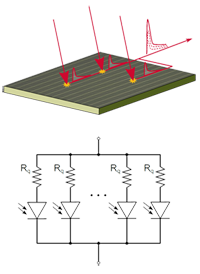
Silicon photomultipliers take a completely different approach. Instead of using a vacuum tube and dynodes, a SiPM is built from a large array of tiny avalanche photodiodes operating in Geiger mode, often called SPAD microcells.
Each microcell functions like a miniature photon detector. When a photon triggers an avalanche in one of these cells, it produces a standardized electrical pulse. A built-in quenching resistor then stops the avalanche so the microcell can reset and detect the next photon.
Because thousands of these microcells operate in parallel, the total output signal corresponds to the number of photons detected across the array. This architecture allows SiPMs to achieve gain comparable to photomultiplier tubes while remaining extremely compact.
Another advantage is operating voltage. While PMTs typically require kilovolt-level bias supplies, SiPMs generally operate at voltages below about 50 V, greatly simplifying system electronics.
Sensitivity and Photon Detection
PMT sensitivity is typically expressed using quantum efficiency (QE), which describes the probability that an incoming photon will generate a photoelectron at the photocathode. Many PMTs reach peak efficiencies around 35–40 % in the blue region of the spectrum.
SiPMs use a different metric called photon detection efficiency (PDE). This value reflects not only the semiconductor’s quantum efficiency but also the probability of avalanche initiation and the proportion of the device’s surface that is active detector area.
Modern SiPM devices can achieve PDE values above 60 % near 420 nm, meaning they can convert a high percentage of incoming photons into measurable signals.
This strong performance makes them particularly attractive for applications involving blue or ultraviolet scintillation light, such as radiation detectors and fluorescence measurement systems.
Noise Characteristics and Dynamic Range
Both detector technologies are capable of detecting individual photons, but their noise behaviour differs.
PMTs generally exhibit very low dark noise, thanks to their vacuum-tube structure. Even at room temperature, dark count rates can be extremely low, which helps maintain excellent signal-to-noise ratios.
SiPMs, being semiconductor devices, tend to generate higher dark counts due to thermally produced charge carriers. In some cases, cooling the detector can significantly reduce this noise.
Dynamic range is another consideration. PMTs can maintain linear response across a wide range of light intensities. SiPMs, however, contain a finite number of microcells, meaning they can approach saturation if too many photons arrive simultaneously. Careful device selection and operating conditions are therefore important when using SiPMs in high-flux environments.
Magnetic Field Behaviour
One of the most significant advantages of SiPM technology is its immunity to magnetic fields.
PMTs can suffer from reduced gain and increased noise when exposed to magnetic environments. This can require shielding or complex optical arrangements when they are used near magnetic equipment.
SiPMs, being semiconductor devices with no vacuum electron trajectories, are unaffected by magnetic fields. This makes them particularly useful in hybrid imaging systems such as PET scanners combined with MRI, where strong magnetic fields are unavoidable.
Size, Durability, and Integration
Physical size and robustness are additional areas where SiPMs often outperform traditional photomultiplier tubes.
PMTs typically use glass vacuum envelopes and internal dynode structures, making them relatively fragile and bulky. In contrast, SiPMs are compact solid-state devices that can be mounted directly onto circuit boards.
This construction provides several advantages:
-
Small footprint suitable for portable instruments
-
Surface-mount packaging for easy integration
-
Greater resistance to vibration and mechanical shock
Because of these characteristics, SiPMs are increasingly used in handheld detectors, portable radiation monitors, and compact analytical equipment.
Real-World Performance Improvements
In some applications, switching from PMTs to SiPMs can deliver measurable performance benefits. For example, in modern PET imaging systems, detectors based on SiPM technology have demonstrated significant improvements in time-of-flight resolution and system sensitivity compared with earlier PMT-based scanners.
These improvements can lead to faster scans, reduced radiation dose, and improved image quality—showing how detector technology directly impacts system performance.
Typical Applications for Silicon Photomultipliers
SiPMs are particularly well suited to applications requiring compact detectors, fast timing, or integration into complex electronic systems. Examples include:
-
Radiation detection and dosimetry
-
Medical imaging such as PET scanners
-
Fluorescence spectroscopy
-
LiDAR and time-of-flight measurement systems
-
Portable or handheld scientific instruments
Their combination of high photon detection efficiency, compact size, and low operating voltage makes them attractive for many modern sensing platforms.
Choosing the Right Detector
Both PMTs and SiPMs remain valuable technologies for detecting weak light signals. PMTs still offer advantages in applications requiring extremely low noise or very large sensitive areas.
However, SiPMs are often the preferred option when system designers need compact size, lower operating voltage, magnetic field compatibility, and robust solid-state construction.
By evaluating factors such as signal levels, operating environment, system size, and power requirements, engineers can determine which technology best matches the needs of their optical detection system.
For more information on Silicon Photomultipliers (SiPMs) vs Photomultiplier Tubes (PMTs): Why Choose SiPMs? talk to AP Technologies Ltd