 Get Listed

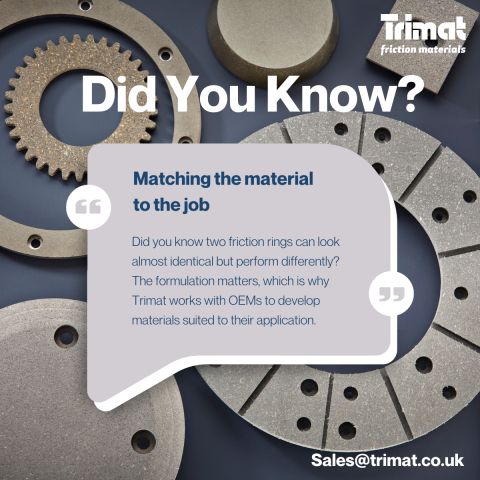
Two friction rings may look identical in terms of shape and dimensions, but differences in their material composition can have a significant impact on braking performance, reliability and service life.
Operating temperatures, environmental conditions, braking frequency and torque requirements all influence the choice of friction material. Selecting the right formulation is therefore an important consideration when developing new electromagnetic brakes or reviewing the performance of existing designs.
Trimat works closely with original equipment manufacturers (OEMs) to understand these requirements and develop bespoke friction material formulations suited to individual applications.
Different Friction Materials for Different Operating Conditions
The performance requirements of an electromagnetic brake can vary considerably depending on its intended use. A holding brake may require high static friction, while an emergency stopping application may depend on stable dynamic torque and good thermal performance.
Trimat manufactures both rubber-based wet-mix and resin-based dry-mix friction materials, offering a range of characteristics to suit different operating requirements.
Depending on the formulation selected, benefits can include:
- High thermal stability for emergency stopping applications
- High static friction for holding brakes
- Excellent wear resistance for extended operating life
- Low-noise performance
- Non-stick properties for humid environments
- High-speed capability, with selected materials proven at speeds of up to 90m/s
By tailoring the material composition to the application, manufacturers can achieve a more suitable balance between frictional performance, mechanical strength and durability.
Bespoke Friction Components for OEMs
Trimat's manufacturing capabilities include press moulding, roll forming, weaving and precision machining, allowing friction materials to be supplied as finished components manufactured to customer drawings and specifications.
Products can be supplied as individual friction rings, discs, segments and other specialist shapes, or as complete assemblies incorporating metal carriers. Depending on the requirements, friction materials can be attached to metal components through bonding, riveting or integral moulding.
All Trimat friction materials are manufactured at its UK production facility under an ISO 9001 accredited quality management system, with in-house research and development supporting both existing product improvements and new material formulations.
Free Friction Material Samples for Evaluation
Whether reviewing an existing friction material or developing a completely new brake design, OEMs can work with Trimat to explore alternative formulations and identify materials suited to their operating requirements.
Free samples are available for evaluation, allowing manufacturers to assess material suitability and performance within their own equipment before progressing to production.
For more information on Why Friction Material Selection Matters for Electromagnetic Brake Performance talk to TRIMAT LTD