 Get Listed


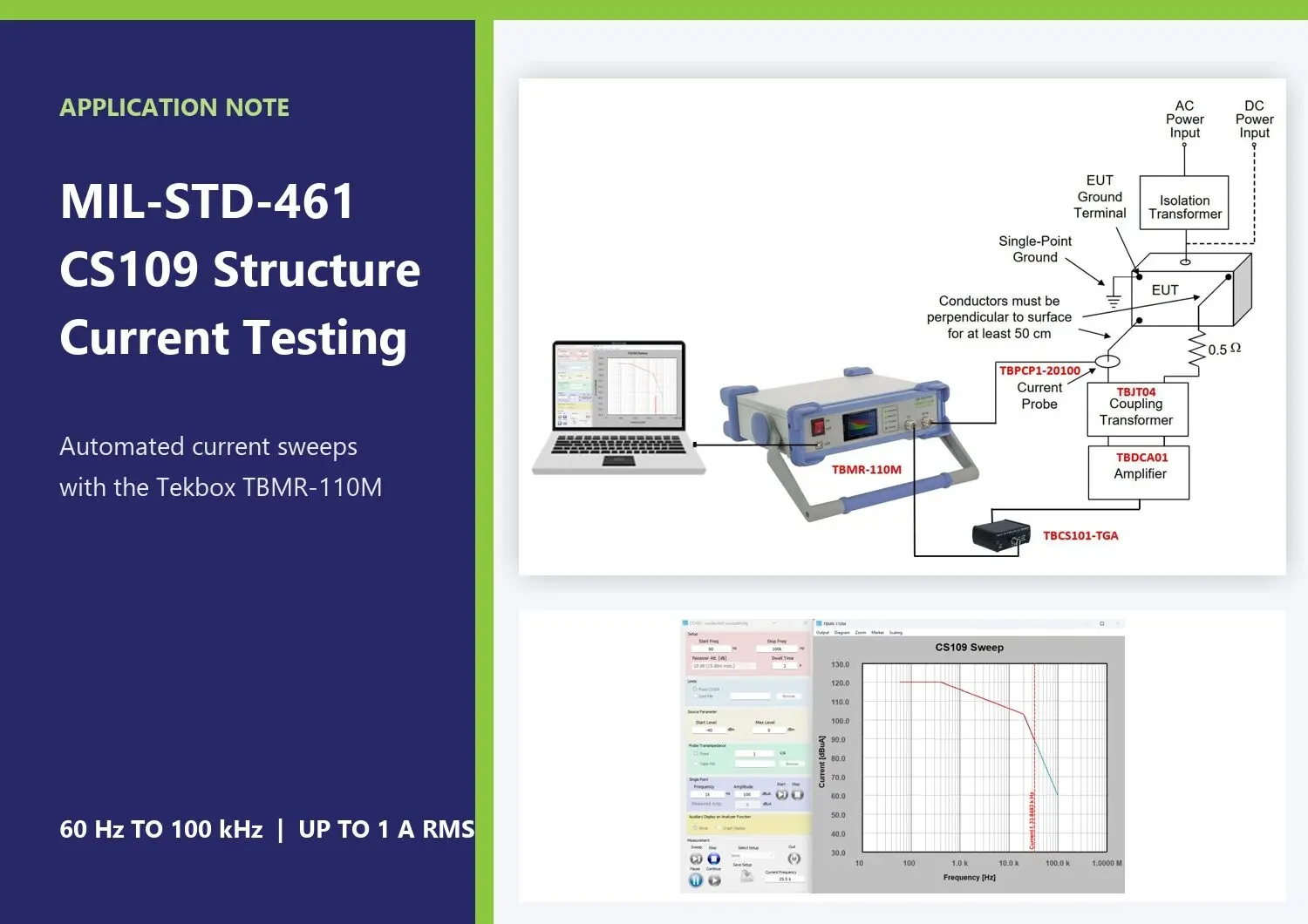
MIL-STD-461 CS109 evaluates whether equipment remains functional when low-frequency current flows through its conductive enclosure or structure. The Tekbox TBMR-110M turns the measurement into a controlled sweep, using either a conventional amplifier-and-transformer path or direct current injection with the TBRFCI1.
The source application note covers 60 Hz to 100 kHz and a maximum test current of 120 dBµA, equivalent to 1 A RMS. The required limit and applicability must always come from the contractual standard edition and the approved test plan.
Engineering note: this article explains the workflow shown in the Tekbox application note. It does not replace MIL-STD-461, the equipment test plan, laboratory safety controls or the grounding and isolation requirements for the EUT and test equipment.
What CS109 is designed to reveal
Current flowing through a chassis can create small voltage differences across joints, shields and reference points. Sensitive low-frequency circuits may then respond to the resulting magnetic fields or common-impedance coupling. CS109 reproduces that condition in a controlled way so susceptibility can be identified before it becomes a system-level problem.
The source note summarises the method as applying to equipment and subsystems operating at 100 kHz or less with sensitivity of 1 µV or better, while identifying handheld equipment as exempt. Treat that as a guide to the note: applicability must be checked against the edition invoked by the programme.
The standard arrangement drives the EUT structure through a power amplifier, coupling transformer and 0.5 Ω load resistor. A current probe measures the actual injected current and returns it to the receiver. The EUT and test hardware share a carefully controlled single-point ground connection.
The current Tekbox TBJT04 uses a 2:1 turns ratio, producing the 4:1 impedance transformation required by this application. The distinction matters: the “4:1” figure describes impedance ratio rather than turns ratio.
Automating CS109 with the TBMR-110M
The TBMR-110M combines a low-frequency EMI receiver with a tracking generator. Its PC software includes a dedicated CS109 application, allowing the same instrument to create the swept drive signal, measure the current feedback and regulate the output at each frequency point.
Alternative direct injection with the TBRFCI1
The TBRFCI1 is a four-quadrant current injector that can drive the structure directly, up to the 1 A RMS maximum described in the note. Its current-monitor output provides the feedback signal, removing the separate coupling transformer, load resistor and current probe from this version of the setup.
Because the injection path is tied to the EUT structure, the application note calls for an additional isolation transformer for the PC, TBMR-110M and TBRFCI1 supply arrangement. Grounding and isolation should be reviewed before energising either configuration.
For more information on MIL-STD-461 CS109 Structure Current Testing with the Tekbox TBMR-110M talk to Telonic Instruments Ltd